Stará Dubá Castle: A Medieval Noble Fortress in Czechia


Site at a Glance
- Rating
- 4.7
- Popularity
- Very Low
- Country
- Czechia
- Primary era
- Medieval
- External website
- Open
- Eras represented
- Medieval
- Civilizations
- Holy Roman Empire, Kingdom of Bohemia
- Site type
- Military
- Remains
- Castle
On this page13 sections
History
Stará Dubá Castle is a medieval fortress in Czechia, near Čerčany, founded by the Bohemian nobleman Ondřej z Dubé in the second half of the thirteenth century. Its construction probably took place at the end of the reign of King Přemysl Otakar II or shortly after his death. The first written reference dates from 1283, when Ondřej first used the castle’s name in his title. For much of its existence, Stará Dubá was closely associated with the powerful lords of Dubá.
Foundation and the lords of Dubá
The castle became a centre of the Dubá family’s holdings. In 1350, another Ondřej z Dubé founded a chapel dedicated to Saint Clement. It was intended as a filial chapel, meaning a subordinate chapel served by the clergy of a parish church, and its services were to be performed by the priest of the Church of Saint Clement near Lštění.
After Ondřej died before 1361, his sons Ondřej, Vaněk, and Beneš inherited the family possessions, with Ondřej initially administering them. Around 1367, the brothers divided their holdings. Vaněk z Dubé received Stará Dubá, half of Lštění, the town of Ondřejov, and other villages. He was married to Frejdla, and their sons were Václav, also known as Vaněk, and Jindřich. Stará Dubá later passed to Václav z Dubé.
Václav z Dubé and the castle’s military role
Václav z Dubé supported King Václav IV, the late fourteenth- and early fifteenth-century king of Bohemia whose political conflicts shaped the castle’s military history. Václav captured his neighbour Jan Zoul z Ostředka after Jan had declared himself hostile to the king. He took Jan to Karlštejn, where Jan was imprisoned for a time. Following his release, Jan promised not to oppose either Václav IV or Václav z Dubé.
Their relationship later changed. During Václav IV’s conflict with a noble league in 1399, Václav z Dubé and Jan Zoul allied and attacked merchants. Goods taken in the raids were brought to Stará Dubá and then transported to markets in Prague. The castle garrison took part under its burgrave Vaněk Šedivý, the official responsible for administering and defending the castle, as well as the chamberlain Jindřich and the stable officer Hrubec. On one occasion, Václav demanded from Jan a share of the loot worth 100 kop of groschen, a medieval accounting sum equal to 6,000 groschen.
The attacks stopped temporarily, but resumed after Václav IV was captured in 1402. Václav z Dubé and Jan Zoul then declared war on the Prague towns. Their plundering ended after the king returned to the kingdom in 1403. Jan Zoul continued his raids, however, and probably seized Stará Dubá through deception.
Siege, succession, and declining condition
In 1404, a land levy, a military force called up by the ruler or the estates, besieged the castle. Jan Zoul was captured at Čejchanov, and Stará Dubá was conquered as well, possibly by forces connected with Václav z Dubé. Václav again held the castle in the following years and was last recorded in 1416.
Václav’s only known child was his daughter Anežka, born from his marriage to Markéta z Rychemburka. The castle appears to have been intended for Václav’s brother Jindřich z Dubé, but Jindřich also died in 1416, leaving the inheritance to his sons. Markéta received income from part of the estate and held a dower, property or revenue assigned to a widow from her husband’s possessions, valued at 2,000 kop of groschen. The holder of the castle at that time is unknown. Markéta’s residence in the settlement beneath the castle suggests that Stará Dubá was already in poor condition.
Disputed inheritance and destruction
In 1428, Markéta sold her dower to Perchta ze Šternberka, who may also have acquired hereditary rights to the castle. After Markéta’s death in 1437, an escheat claim was proclaimed for 2,000 kop of groschen. An escheat was a legal claim through which property could revert to the ruling authority when direct hereditary succession failed. Perchta and Rozkoš z Dubé opposed the claim, with Rozkoš acting for Anežka, Václav’s daughter.
Perchta sold her share of the Dubá estate in 1440 to the brothers Buzek, Mrakša, Přech, and Zdebor of Bezejovice. The agreement required them to make annual payments to Beneš z Dubé and Hanuš z Maršovic. In 1443, the rights to these payments passed to Bohuš Kostka z Postupic, who lived at Hrádek.
The last holder of Stará Dubá was Kuneš Rozkoš z Dubé. In 1447, when Bohuš Kostka purchased the estate’s escheat rights from the sons of Jan of Jenštejn, Kuneš reserved the right to use the castle, the settlement below it, and all their roads. According to August Sedláček, he used Stará Dubá for military ventures, but this right ended after Kuneš’s death.
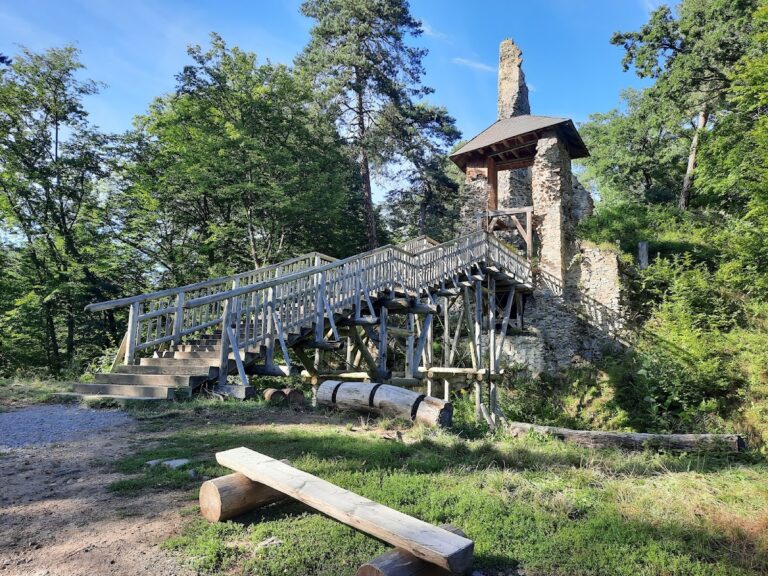
The castle was conquered and demolished during the conflict with the Strakonice League at the turn of 1449 and 1450. The Strakonice League was a late-medieval alliance of nobles involved in the conflict that brought about the fortress’s destruction. Stará Dubá, together with Příběnice in southern Bohemia, was one of the few castles whose size and architectural grandeur could rival those of smaller royal castles with buildings arranged around their perimeter. Its scale reflects the exceptional resources available to the most powerful nobles of its period. The ruins are protected as a cultural monument of the Czech Republic.
Remains
Setting and overall arrangement
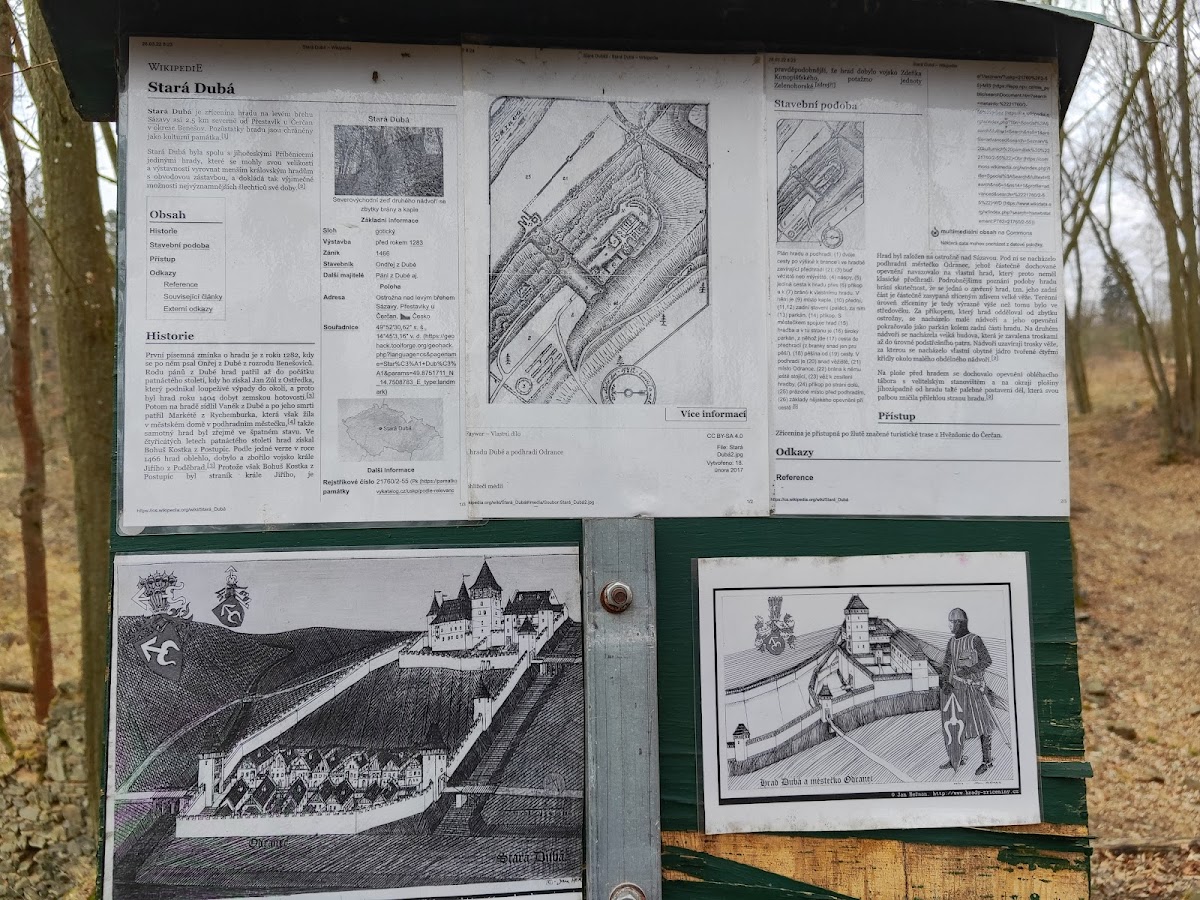
The ruin occupies a spur above the left bank of the Sázava River, about 2.5 kilometres north of Přestavlky near Čerčany. The settlement of Odranec lay directly below it. Odranec’s fortifications connected with the castle complex, creating a wider defensive arrangement in which the settlement’s walls formed part of the castle’s protection. As a result, Stará Dubá did not have a conventional outer bailey.
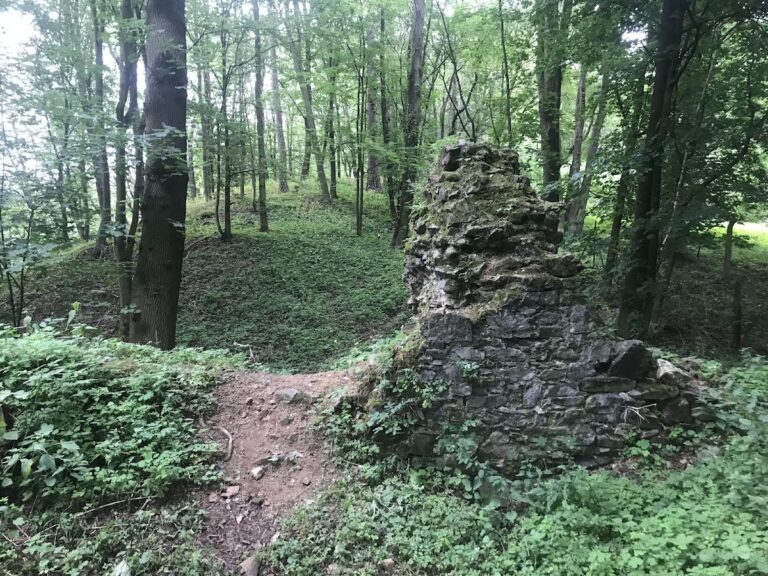
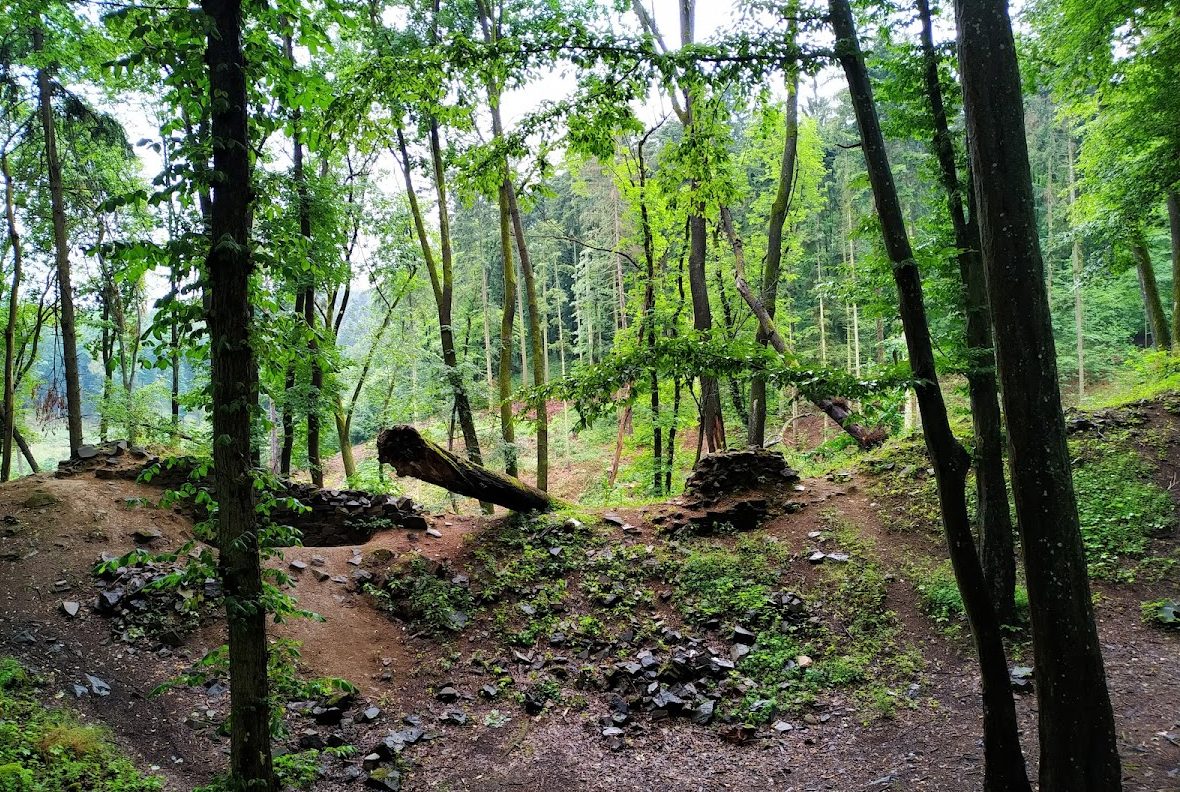
Stará Dubá is a closed castle, a fortress whose rear or enclosed core has become heavily obstructed by collapsed masonry. A large tower fell over part of the rear section, burying it beneath stone and raising the present ground level well above the medieval surface. This altered level makes the original form of the castle difficult to reconstruct. A ditch separated the castle from the remainder of the spur. Beyond the ditch stood a small courtyard, whose defenses continued around the rear of the castle as an outer defensive space between successive fortifications.
Courtyards and residential core
Outer courtyard and defensive works
The small courtyard beyond the ditch formed an intermediate defensive area between the castle and the rest of the spur. Its fortifications continued around the rear of the castle, linking the courtyard with the outer defenses. The surviving works must be understood together with the fortifications of Odranec, which extended the castle’s defensive system into the settlement below.
Palace and inner residence
A second courtyard contained a large palace building. Fallen masonry now covers the palace to the level of its former attic storey, leaving the structure deeply buried within the ruin. The courtyard was closed by the remains of a tower. Behind that tower lay the residential core, composed of four wings arranged around a small rectangular courtyard. The arrangement placed the principal living buildings within an enclosed central group, although the collapse of the tower and palace has obscured much of their original form.
Evidence of the final siege
Besieging army’s camp
In the area in front of the castle, remains of the besieging army’s camp survive, including a command post. These earthworks belong to the military activity that accompanied the castle’s final destruction and provide physical evidence of the siege environment outside the fortified complex.
Artillery position
At the edge of the plateau southwest of the castle is an artillery position. Guns placed there destroyed the adjacent side of the castle. The position therefore preserves a direct relationship between the attacking force’s deployment and the damage visible in the surviving ruin.