Killochan Castle: A Historic Scottish Tower House in Ayrshire

Visitor Information
Google Rating: 4.9
Popularity: Very Low
Official Website: www.killochancastle.com
Country: United Kingdom
Civilization: Unclassified
Site type: Military
Remains: Castle

History
Killochan Castle lies near Girvan in Ayrshire, Scotland, and was constructed by the Scottish people during the late 16th century. The estate has deep roots reaching back to the 14th century when it came under the ownership of the Cathcart family. One of the early notable figures was Robert Cathcart of Killochan, who died in 1513 at the Battle of Flodden, a significant conflict between Scotland and England.
The present stone castle was built in 1581, probably replacing an earlier structure on or near the same site. John Cathcart, who supported one faction in a local Kennedy family feud, is credited with its construction. He played a military role, commanding the rearguard at the Battle of Pennyglen, which highlights the turbulent clan conflicts of the period. In 1586, John’s successor, Jhone Cathcart, expanded the tower by adding a new wing and raising it by two extra storeys, indicating the growing importance and status of the family line.
Throughout the 18th century, the castle underwent further modifications, including the demolition of some older outbuildings. These were replaced with a new wing, courtyard, and gatehouse, reflecting changes in domestic and defensive needs. Despite these alterations, the Cathcart family maintained intermittent residence until 1954, when the property was sold outside the family for the first time in centuries.
Following the mid-20th century transition, Killochan Castle changed hands several times. In the late 19th century, Col. Alexander Brown Grant held ownership. Later, in the late 20th century, Michael Knighton acquired the castle from 1989 to 1997. Subsequently, Princess Viola von Hohenzollern owned it until 2012. By 2020, the estate belonged to a Saudi businessman. During the 1990s, the castle underwent modernization, and a comprehensive restoration took place around 2015. Since 1971, Killochan Castle has been recognized as a Grade A Listed building, marking its significance in Scotland’s architectural heritage.
One distinctive aspect of the castle’s history is the oak wall paneling removed during restoration. These panels, now exhibited at the National Museum of Scotland, feature carved portraits of Cathcart family members and display the coat of arms of John Cathcart and Helen Wallace, who were married in 1563. This artistic detail offers valuable insight into the family’s identity and status at the time.
Remains
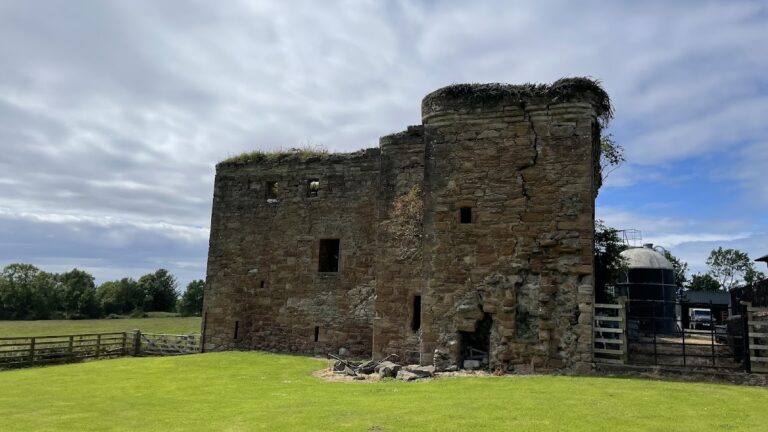
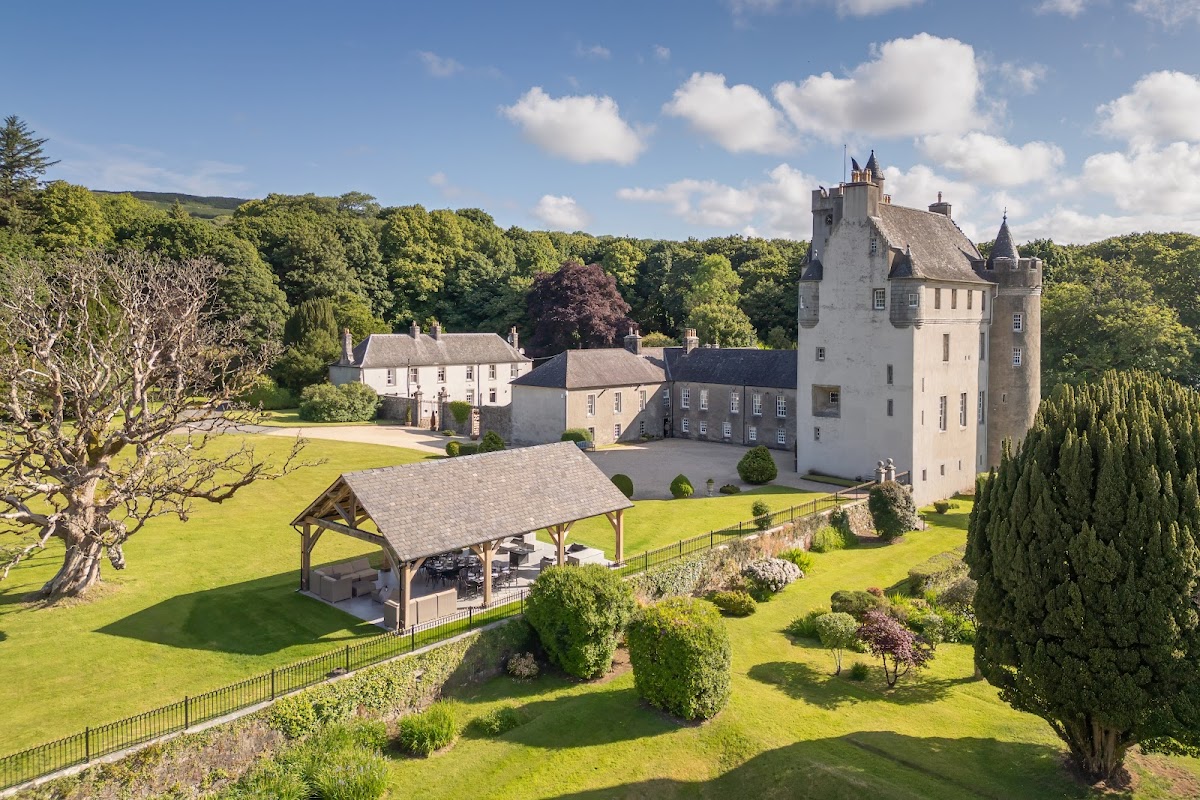
Killochan Castle stands as a well-preserved five-storey tower house, displaying the classic L-shaped design common to Scottish fortified homes of the period. The building’s main block runs roughly east to west, while a taller wing stretches northward at its east end, forming the characteristic L plan. At the corner where the two sections meet, a square stair tower rises within the re-entrant angle, providing internal access between floors.
One corner of the castle is marked by a round tower topped with a corbelled parapet and two small bartizans, which are overhanging turrets historically used for observation or defense. The south side is notable for its unusually high parapet wall, lending the structure a striking silhouette. The roofline is defined by continuous eaves without dormer windows, preserving the castle’s clean external profile.
Defensive features incorporated into the castle’s walls include small openings called shot-holes, designed to allow defenders to fire weapons while remaining protected. Above the entrance, a machicolation—a projecting parapet with floor openings—was built to defend against attackers by enabling objects or substances to be dropped on those below.
Visitors ascending the castle first enter a wide scale-and-platt staircase, which is a straight flight with flat landings, leading to the main hall on the first floor. This hall, a central gathering space, includes an adjacent chamber. From here, a spiral turnpike staircase within the re-entrant angle allows access to the upper floors. The vaulted basement, constructed with arched stone ceilings, housed the kitchen and two cellars, indicating the functional organization of the household.
In the 18th century, a two-storey wing was appended to the castle, reflecting adaptations to contemporary living standards. Nearby, the 18th-century stables comprise two long buildings positioned parallel and linked by a distinctive gate wall featuring bossing, a raised decorative pattern. A connecting low wing extends from the southern stable directly to the main house. These stables, built with pink harled (roughcast) walls and topped with hipped roofs slanting on all sides, demonstrate the integration of estate service buildings into the wider castle complex.
The castle commands a sizeable estate of 131 acres, including gardens and woodlands, situated overlooking the Girvan Water. This natural setting complements the historic structure, underscoring its role as an aristocratic residence deeply connected to the surrounding landscape.
Nearby sites