Cloncaird Castle: A Sixteenth-Century Castle and Country House in Scotland


Site at a Glance
- Rating
- 4.8
- Popularity
- Very Low
- Country
- United Kingdom
- Primary era
- Modern
- External website
- Open
- Eras represented
- Early Modern, Modern
- Civilizations
- British, Kingdom of Scotland
- Site type
- Domestic
- Remains
- Castle
On this page7 sections
History
Cloncaird Castle is a sixteenth-century castle and later country house near Kirkmichael in Scotland, United Kingdom. Built beside the Kelsie Burn, a Scottish stream, it originated as a feudal mansion and retains an armorial panel dated 1585.
The Sixteenth-Century Castle
Toward the end of the sixteenth century, Cloncaird was held by Walter Mure, a descendant of the Auchendrane family. Mure was responsible for the murder of Sir Thomas Kennedy of Culzean, a Scottish landed proprietor, with assistance from Kennedy of Drumurchy.
Transformation into a Country House
In the early nineteenth century, Henry Ritchie of Craigton and Busbie purchased Cloncaird and made it his principal residence. In 1814, he had the front completely rebuilt and modernized, transforming the earlier castle into the country house that gives the property its present appearance.
Ritchie died in 1843, after which the estates passed to his sister’s son, William Wallace of Cairnhill. Colonel Hugh Robert Wallace sold Cloncaird to Mrs Dubs in 1905, and he married her in 1908. The castle underwent extensive renovation during this period.
Institutional Use and Later Ownership
After Mrs Dubs died in 1947, the mansion became the Dubs Memorial Convalescent Home in 1949. Operated by the local authority, the convalescent home provided accommodation and care for people recovering from illness or surgery. It later closed, and the property returned to private ownership. Before 2003, Ephraim Belcher, chairman of Belcher Food Products, purchased the house.
Cloncaird Castle is a Category B listed building, a designation used in Scotland for structures of regional or more than local importance. It received this status in 1971, while associated buildings in the grounds have Category C status, applied to buildings of local importance or lesser regional value.
Remains
Castle and Country House
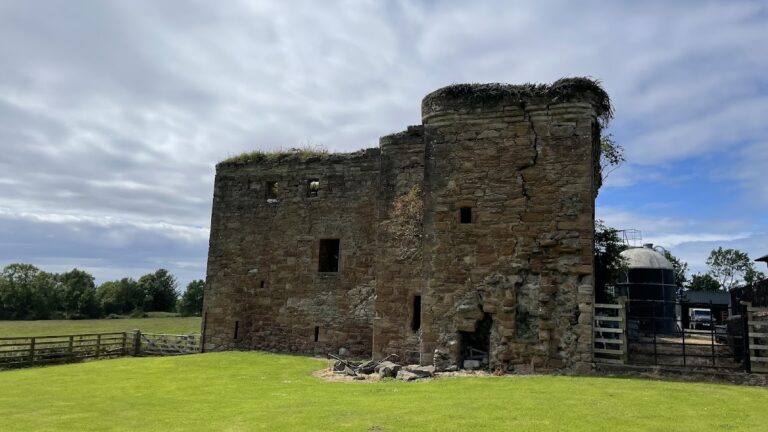
The estate extends across approximately 140 acres, or 57 hectares, with the castle positioned beside the Kelsie Burn. The original building included a large square tower, a narrow spiral staircase, and other features characteristic of a sixteenth-century castle. Its surviving 1585 armorial panel is a carved heraldic feature on a castle wall. The front was entirely rebuilt and modernized in 1814, reflecting the building’s change from an earlier feudal mansion into a country house.
Estate Buildings and Landscape
The grounds include an Arts and Crafts-style garage, associated with a late-nineteenth- and early-twentieth-century movement that emphasized traditional craftsmanship, natural materials, and informal design. A U-shaped stable block and a bridge over the Kelsie Burn form part of the estate’s supporting buildings and infrastructure. The landscape also contains a pond, a weir with a fountain, and a walled garden.