Culzean Castle: A Scottish Country House and Kennedy Family Seat


Site at a Glance
- Rating
- 4.7
- Popularity
- Medium
- Country
- United Kingdom
- Primary era
- Early Modern
- External website
- Open
- Eras represented
- Medieval, Early Modern
- Civilizations
- British, Kingdom of Scotland
- Site type
- Domestic
- Remains
- Castle
On this page13 sections
History
Culzean Castle is a historic castle in Scotland, United Kingdom, overlooking the Firth of Clyde near Maybole. Its origins may extend to the late fourteenth century, when a tower was built on the rocky coastal site, while the present country house took shape through Robert Adam’s neoclassical rebuilding between 1777 and 1792. The castle was the residence of the Marquesses of Ailsa, chiefs of Clan Kennedy, and remains part of a historic estate conserved by the National Trust for Scotland.
Medieval Origins and the Kennedy Family
The site appears in fifteenth-century records as the House of Cove or Coif Castle. In 1569, the fourth Earl of Cassillis granted the castle site to his brother, Sir Thomas Kennedy. From about 1590, Sir Thomas enlarged the building, establishing an important phase in the castle’s development. Gardens were added during the seventeenth century, and the name Cullean Castle gradually developed into Culzean Castle during the eighteenth century.
The Kennedy family was a prominent Scottish aristocratic family. Its head held the hereditary title of Earl of Cassillis and later that of Marquess of Ailsa, while Clan Kennedy described the wider kinship and heraldic tradition associated with the family. Another Sir Thomas Kennedy inherited Culzean in 1742. He began modernizing the castle in 1750 and, following a three-year legal battle with a rival, inherited the title of Earl of Cassillis in 1762.
Robert Adam’s Rebuilding
David Kennedy, Sir Thomas Kennedy’s son, commissioned the Scottish architect Robert Adam in 1776 to remodel Culzean. Adam was associated with the neoclassical style, which drew on the architecture and ornament of ancient Greece and Rome. The work proceeded in stages from 1777 to 1792, converting the earlier castle into a country house intended to serve as the seat of the earldom.
Culzean later passed to Archibald Kennedy, the eleventh Earl of Cassillis, and then to his son, Archibald Kennedy, the twelfth Earl of Cassillis and third Marquess of Ailsa. The Ayrshire (Earl of Carrick’s Own) Yeomanry, a British Yeomanry cavalry regiment, was formed at Culzean by the Earl of Cassillis around 1794. On 24 June 1961, the regiment returned to the castle, where General Sir Horatius Murray presented it with its first guidon, a cavalry regiment’s ceremonial flag.
From Aristocratic Residence to National Trust Property
After the death of the third Marquess of Ailsa in 1938, the Marquesses visited Culzean increasingly rarely. In 1945, the Kennedy family transferred the castle and its grounds to the National Trust for Scotland, a charitable heritage organization responsible for conserving and presenting historic buildings, landscapes, and cultural sites in Scotland.
The transfer included a special provision for the apartment at the top of the castle. It was to be given to General of the Army Dwight D. Eisenhower in recognition of his service as Supreme Commander of the Allied Forces in Europe during the Second World War. Eisenhower, the American army general who later became President of the United States, first visited Culzean in 1946 and stayed there four times, including once during his presidency.
Culzean reopened in April 2011 after refurbishment supported by a bequest from the American millionaire William Lindsay. Lindsay directed a substantial part of his bequest to the National Trust for Scotland toward Culzean, reportedly because of his interest in Eisenhower’s stays at the castle. From 1972 to 2015, an illustration of Culzean appeared on the reverse of five-pound notes issued by the Royal Bank of Scotland. The castle and its designed grounds have been included in Scotland’s Inventory of Gardens and Designed Landscapes since their designation on 1 July 1987.
Remains
Castle Form and Principal Rooms
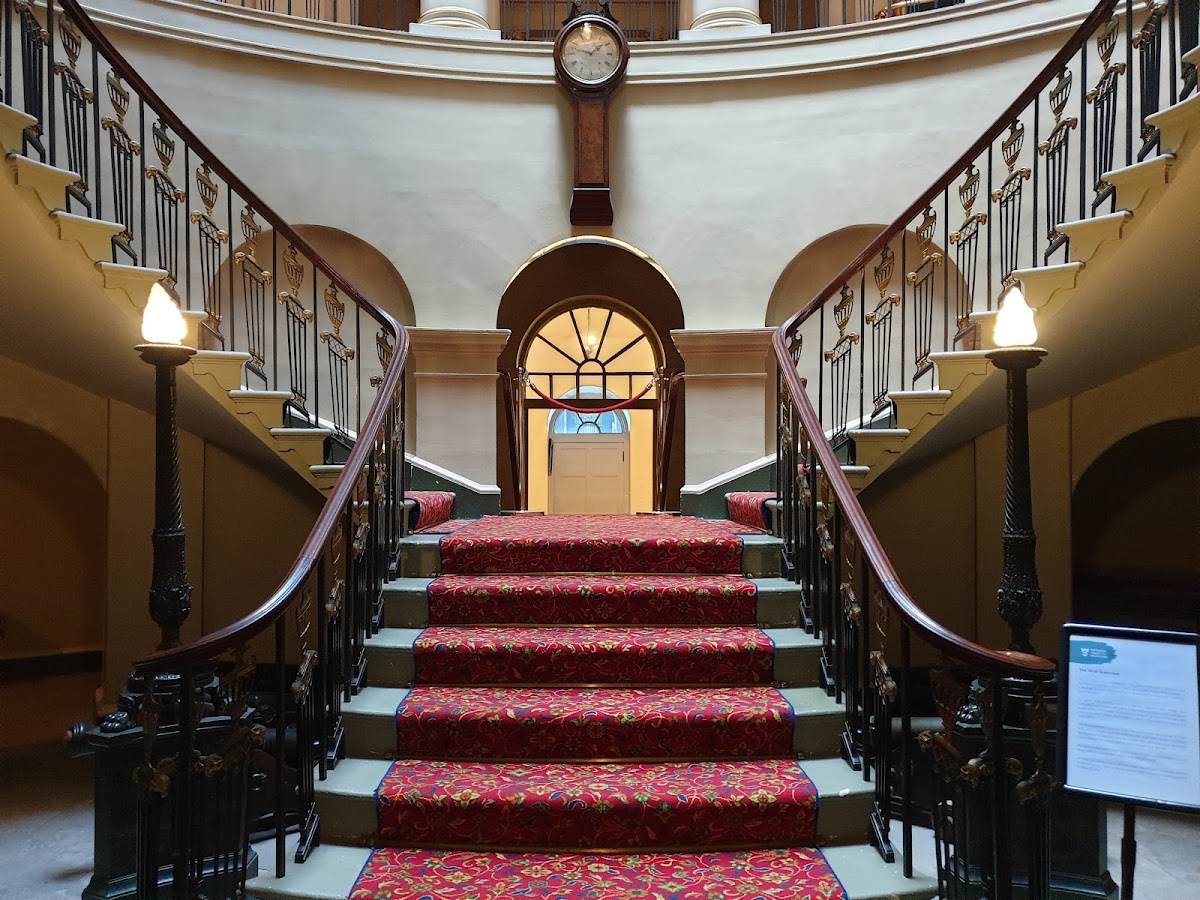
Built of sandstone on a rocky clifftop promontory, Culzean has an L-shaped plan, with two principal wings arranged at right angles. Its main composition includes a large drum tower, a rounded tower projecting from the building, which contains the circular saloon, together with a grand oval staircase and a suite of well-appointed apartments. The arrangement reflects the transformation of the earlier castle into Adam’s eighteenth-century country house.
Circular Saloon
The circular saloon occupies the drum tower and overlooks the Firth of Clyde. As the castle’s principal reception room, it forms one of the defining spaces within the coastal composition.
Oval Hall and Apartments
The oval hall is decorated with Ionic and Corinthian columns and is regarded as one of Robert Adam’s masterpieces. The interior also contains an exhibition hall displaying Adam’s latest works. On the upper floor is the apartment associated with Dwight D. Eisenhower, whose connection with Culzean began with his first visit in 1946.
Military and Service Buildings
Armoury
The armoury contains a propeller from an aircraft flown by Leefe Robinson when he shot down a German airship north of London in 1916. It also displays weapons that belonged to the West Lowland Fencible Regiment, a Scottish locally raised force intended primarily for home defence.
Clock Tower
The Clock Tower originally served as a carriage house. Its clock was added during the nineteenth century, giving the building the name by which it is now known.
Gas-Plant Buildings
North of the castle is a group of former gas-plant buildings that supplied the estate with town gas until 1940. The complex includes the gas manager’s house, which contains an exhibition on William Murdoch, the Scottish engineer and inventor associated with the development of coal-gas lighting, as well as the Retort House and the remains of the gasometer. A Retort House was used to heat coal to produce gas, while a gasometer stored the resulting gas.
Gardens, Coast, and Country Park
The grounds form the 240-acre, or 97-hectare, Culzean Castle Country Park. Their principal designed features include Fountain Court, a walled garden, a Victorian vine greenhouse, and a swan pond. The walled garden occupies the site of a house formerly inhabited by Scipio Kennedy, an enslaved man held by the Kennedy family.
Sea caves lie beneath the castle, extending the physical remains of the estate into the coastal rock below the promontory. The country park also contains other estate buildings, including publicly accessible buildings, together with shops, cafés, and a playground.