Kadaň Castle: A Medieval Royal Fortress in the Czech Republic




Visitor Information
Google Rating: 4.6
Popularity: Low
Google Maps: View on Google Maps
Country: Czechia
Civilization: Medieval European
Remains: Military

History
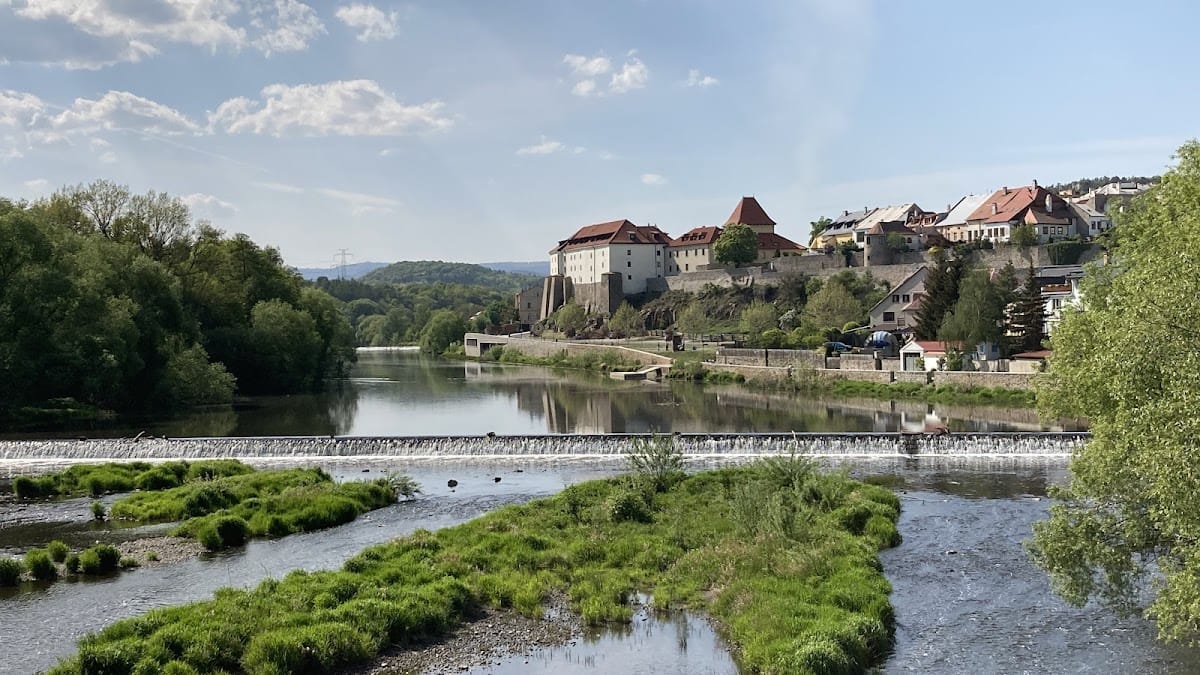
Kadaň Castle is situated in the town of Kadaň in the modern Czech Republic. It was constructed in the mid-13th century by the medieval Bohemian kingdom as a royal fortress.
The castle’s foundation dates to around 1250 when it was established on a prominent rhyolite rock overlooking the Ohře River. Built in the Gothic style, it served as the residence of the royal burgrave, an official who governed the surrounding area known as the Kadaňská župa, functioning as an important administrative and defensive center. Between 1306 and 1312, the castle was closely connected with the administration of this region.
During the late 13th century, prominent rulers were linked with the castle. King Wenceslaus II visited on multiple occasions in 1295 and 1297, using the site for notable political meetings, including talks with Elector Otto IV of Brandenburg. The castle also hosted the marriage of Wenceslaus II to Guta of Habsburg, integrating royal alliances and domestic affairs within its walls. In the mid-15th century, King George of Poděbrady ordered significant renovations in 1467 to maintain the castle’s condition.
A turning point in the castle’s history came in 1422, when it became the headquarters for a crusader expedition led by Frederick of Brandenburg. During military action, the early Gothic fortress suffered irreparable damage and ceased to function as a royal residence. This event marked the decline of the castle’s role as a seat of royal power.
In 1504, Jan Hasištejnský of Lobkowicz initiated a large rebuilding project that altered the medieval Gothic character of the castle, transforming its appearance and adapting it to new needs. By 1595, the castle had passed into municipal ownership through a decree by King Rudolf II, reflecting a shift from royal to local control.
The Thirty Years’ War in the 17th century brought further destruction. The castle was seriously damaged, especially during a siege by Swedish forces, leaving it in ruins for about a century. After a major fire in 1746, Empress Maria Theresa repurposed the ruined fortress into military barracks. Structural expansions followed after 1816 to serve the needs of the Austrian army, and later the Czech military, until the end of the 20th century.
Since the 1990s, the town of Kadaň owns the castle and has converted it for cultural and social uses. It now houses a museum with exhibitions focused on its history and architecture, together with a municipal library, a ceremonial hall, and a multi-purpose cultural space introduced in 2014.
Remains
Kadaň Castle was originally laid out on a roughly square plan, incorporating four corner towers typical of Central European fortifications from the Gothic period. This structure stood on a rhyolite rock terrace, which provided natural defense and a commanding view over the Ohře River below. Between these towers, residential palace wings were constructed. Some of the upper floors were accessible by an arcaded gallery, a covered passageway with arches that connected different parts of the living quarters.
Defensive features included a surrounding outer bailey, known as a parkán, and a moat that helped separate the castle precinct from the adjoining town fortifications. The castle’s eastern and western facades were built as part of the town’s defensive walls, integrating it into the larger urban defense system.
Late Gothic alterations significantly changed parts of this layout. The two western towers were dismantled, and the outer bailey was filled in to create a gatehouse structure, improving access and defense. Palaces inside the castle were vaulted with stone ceilings and enhanced by new window openings that provided more light. Some original early Gothic windows still survive, displaying sandstone moldings with distinctive trefoil arches, a three-lobed design common in Gothic architecture.
Excavations have uncovered the foundations of two towers located in the southern wing of the complex. The northeastern tower remains partly intact and has been restored, including the replacement of its roof in a hipped style where all sides slope downwards. The northern wing of the castle is two stories tall and features a late Gothic entrance gate, which presents evidence of the castle’s evolving defensive architecture.
From the period of Empress Maria Theresa onward, a three-winged, three-story vaulted barracks was built within the complex, positioned above the river and partially set below ground level. This large military building reflects the castle’s later use as barracks and its adaptation from medieval fortress to a functional military installation.
Restoration work has revealed portions of the early Gothic window openings and late Gothic stone details, especially around the northern gate’s portals and the windows of the northeastern tower. These preserved fragments highlight the castle’s long architectural history, making it one of the most important remaining examples of an early Gothic royal castle in Central Europe, with origins traceable to the reign of Přemysl Otakar II in the 13th century.
Nearby sites