Perštejn Castle: A Gothic Fortress in Czechia


Site at a Glance
- Rating
- 4.4
- Popularity
- Low
- Country
- Czechia
- Primary era
- Medieval
- Eras represented
- Medieval
- Civilizations
- Holy Roman Empire, Kingdom of Bohemia
- Site type
- Military
- Remains
- Castle
On this page12 sections
History
Perštejn Castle is a Gothic fortress in Czechia, built on a steep spur above the village of Perštejn during the second half of the thirteenth century, probably near the century’s end. Formerly known as Borschenstein, it became a possession of the Šumburk family and later played a role in the Hussite Wars and the political conflicts between Bohemia and Saxony.
Foundation and Šumburk rule
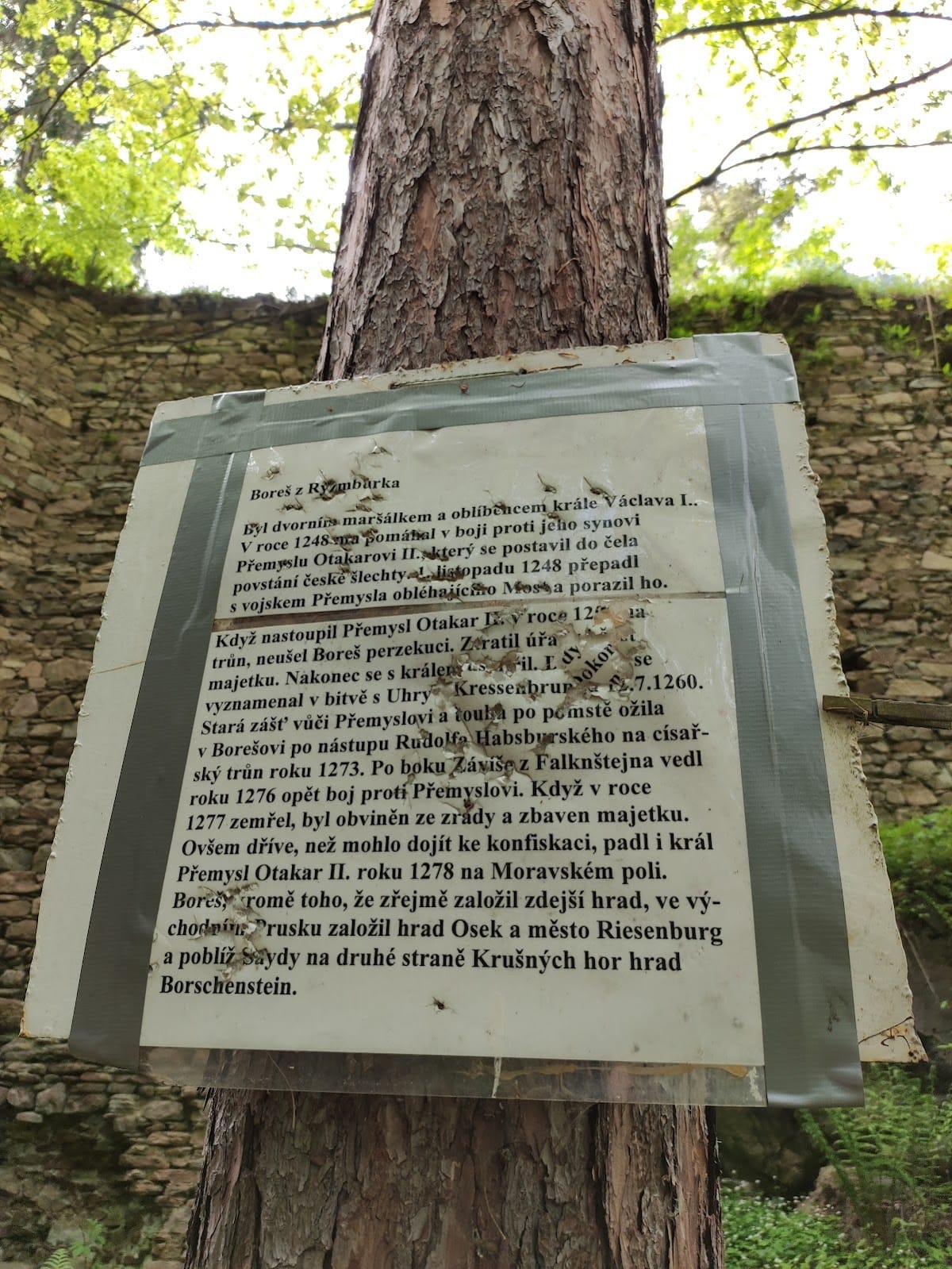
The castle’s founder is uncertain. The historian Tomáš Durdík regarded the Lords of Šumburk as the most likely founders, while Boreš of Rýzmburk has also been proposed. Boreš is mentioned in records dating from 1248 to 1276. Perštejn is first directly associated with Bedřich of Šumburk, described as its lord in 1338.
In 1352, the Šumburk family received Perštejn and several connected lordships as a fief from Charles IV, the medieval king of Bohemia and Holy Roman Emperor. A fief was territory held from a superior ruler in return for service or allegiance. The castle and its estate remained connected with the Šumburk family through much of the following century.
Conflict during the Hussite period
During the Hussite Wars, fifteenth-century religious and political conflicts in Bohemia, a dispute between the cousins Aleš of Šumburk and Vilém of Šumburk led to the division of their estates in 1431. Aleš received Perštejn and half of Přísečnice. Vilém acquired, among other possessions, Klášterec nad Ohří and Kadaň, and founded Šumburk Castle.
In 1446, Aleš joined the Strakonice League and entered a financially motivated feudal alliance with the Saxon Margrave Frederick. A German garrison at Perštejn then ravaged the estates of nobles loyal to George of Poděbrady, the fifteenth-century king of Bohemia, including those of Aleš’s cousin Vilém.
After Aleš died in 1451, the guardian of his sons, Bedřich of Šumburk and Glouchov, continued to violate the Cheb truce between George of Poděbrady and Saxony. A military expedition led by Jakoubek of Vřesovice was sent against him. Jan Calta of Kamenná Hora, Aleš and Petr of Šternberk, and the towns of Žatec and Louny also took part.
Perštejn was captured in 1451, and Bedřich was taken prisoner. The campaign was dated from 22 May until January of the following year, although the castle was probably seized much earlier, between 4 and 10 July. The attackers used mercenaries, a siege engine of uncertain type, a protective cover, and a cannon. Žatec supplied provisions.
To avoid imprisonment, Bedřich ceded Perštejn to representatives of the Žatec region. He was allowed to remove his belongings, except food, while the garrison could leave freely. The estate was to remain with Aleš’s sons, but the castle itself was intended for demolition and permanent abandonment. Its destruction is uncertain, since the castle was still standing in 1508.
Later ownership and decline
In 1466, Aleš’s son Bedřich of Šumburk enlarged the Perštejn estate with villages that had belonged to the abandoned Funkštejn Castle. He acquired Trutnov in 1470 and, in 1487, sold his revenues from Prunéřov, Mikulovice, and Ciboušov to Felix of Fictum.
Jan, Albrecht, Heřman, and Karel of Šumburk sold Perštejn Castle to Albrecht of Kolowrat in 1508. Kolowrat soon sold the estate and castle to Opl of Fictum. In 1530, Perštejn belonged to Opl’s brother Jiří, whose property was confiscated for counterfeiting.
Ferdinand I, a sixteenth-century Habsburg king of Bohemia, subsequently pledged the castle to several members of the royal council. Under royal officials, Perštejn steadily deteriorated, and by 1537 it was described as a ruin. In 1539, Opl’s third brother, Hanuš, recovered the ruin and estate through the courts, but permanently attached Perštejn to Šumburk. The administrative center then moved to the chateau at Klášterec nad Ohří.
Perštejn has been protected as a cultural monument of the Czech Republic since 1963.
Remains
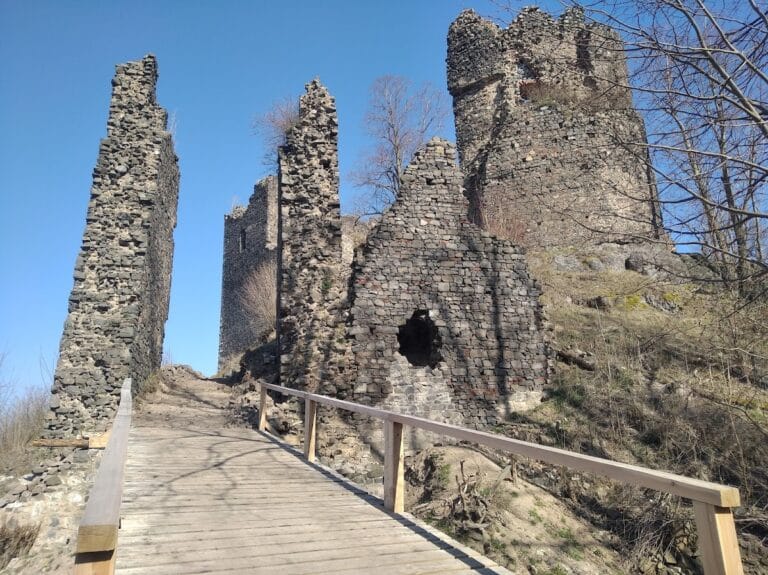
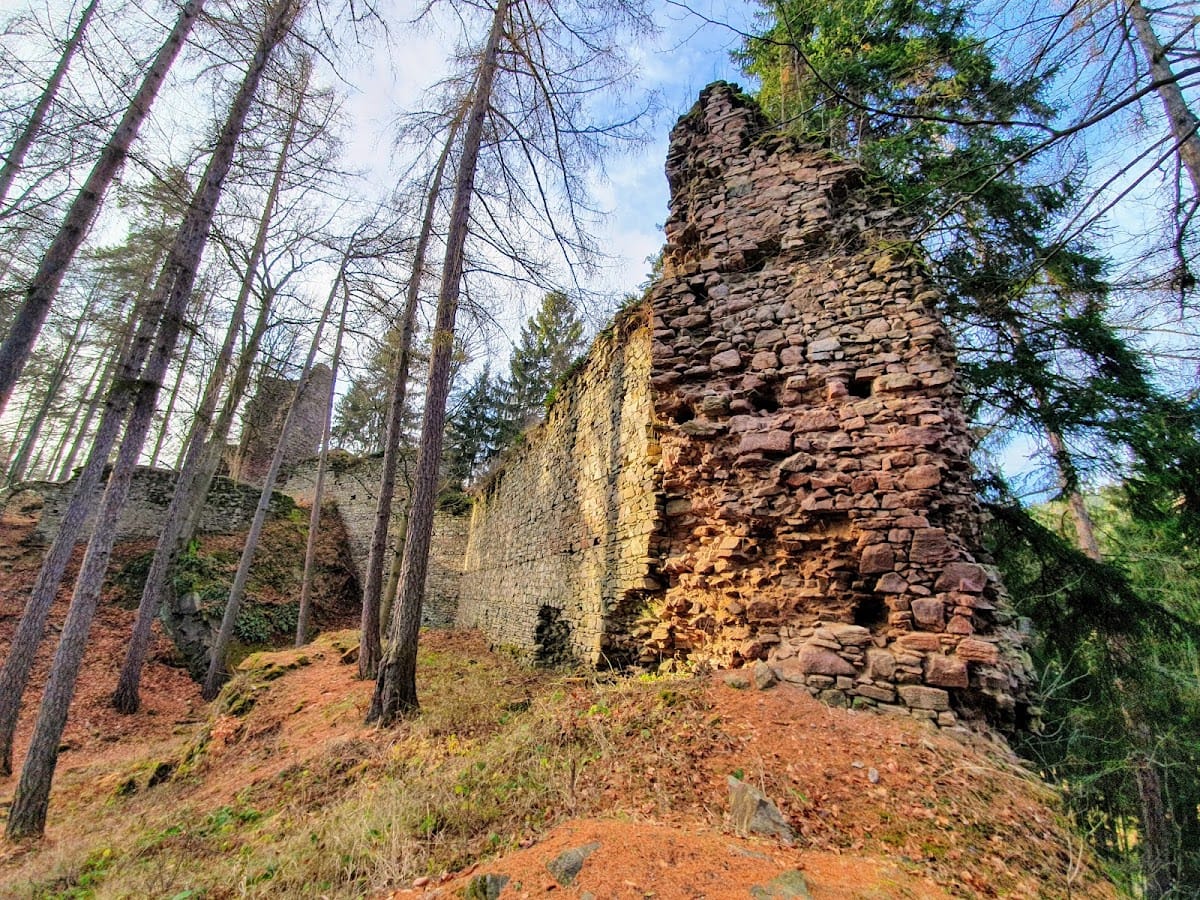
Perštejn occupies a rocky spur about 466 meters above Perštejn and approximately three kilometers west of Klášterec nad Ohří. The Gothic spur castle consists of a high core surrounded by outer defenses. Extensive wall remains survive, including parts of the palace, the outer walls, and a round bergfried, the principal defensive tower of a medieval German-style castle.
Outer defenses and entrance
First courtyard
The approach road came from the north and crossed a double ditch before reaching the lower first courtyard. A substantial stretch of the courtyard wall survives, particularly on the western side. A small gate in this wall opens into a narrow outer defensive passage. At the passage corner, a square bastion, a projecting defensive platform, strengthened the position and was open toward the interior.
Southern defenses and bergfried
A building stood along the eastern side of the first courtyard, and fragmentary masonry survives there. The outer wall continued southward, where another square bastion reinforced the area below the castle core. On the southern side, the wall formed a bastion-like projection before continuing along the western side of the core toward the bergfried.
The bergfried remains are incorporated into the first-courtyard wall immediately north of and close to the core. It was probably reached by a drawbridge from the wall-walk of the core’s enclosing wall. A mostly buried gate survives in the short wall section between the core and the tower.
Castle core
The oldest building phase is represented by the castle core on the highest part of the spur. Its ground plan was oval. The uneven terrain and small wall fragments leave its precise form uncertain without further archaeological research. The core was probably towerless and is classed among castles whose main defense was a mantle wall, a high enclosing wall forming the principal defensive element.
Parts of the palace and the outer walls remain alongside the bergfried. Together they form a ruin with extensive masonry, preserving the relationship between the high core, the first courtyard, and the surrounding defensive circuit.
Siege landscape
Ridge camp
Remains of a siege camp cover about 0.69 hectares on a ridge extending from Vysoká Hill, approximately 450 meters north of the castle. An oval fortification occupied the front of the camp, while steep slopes bounded its sides. A 95-meter-long linear defense with two bastions protected the rear.
The camp rampart reaches 0.7 meters in height. Its ditch is about three meters wide and up to one meter deep. The oval fortification measures approximately 11 by 11 meters and is enclosed by a rampart about 1.5 meters high with a ditch up to three meters wide.
Perštejnský Špičák position
A surface feature on Perštejnský Špičák, 407 meters from the castle, may also relate to the siege. Its position would have prevented direct bombardment of Perštejn, but it may have helped control the approach road.