Křivoklát Castle: A Medieval Royal Fortress in the Czech Republic



Visitor Information
Google Rating: 4.7
Popularity: High
Google Maps: View on Google Maps
Official Website: www.hrad-krivoklat.cz
Country: Czechia
Civilization: Medieval European
Remains: Military

History
Křivoklát Castle stands near the village of Křivoklát in the Czech Republic. It was established by the medieval Czech state, rooted in the era of the Přemyslid dynasty, which ruled Bohemia during the early 13th century.
The origins of the castle date back to around 1230, built as part of the Přemyslids’ network of fortifications and hunting estates. During the reign of Přemysl Otakar I and his son Václav I, Křivoklát emerged as a royal residence and an administrative hub. It was favored by kings such as Václav I and Přemysl Otakar II, who frequently visited the castle. Over time, the site also found use as a state prison, particularly under the rule of the Habsburg dynasty. Several notable captives were held here, including Ota II Olomoucký in the early 12th century and Jan Augusta from 1547 to 1563. Among the prisoners was also the English alchemist Edward Kelley, who was detained in the late 16th century.
Throughout its history, Křivoklát endured recurrent fires roughly every two centuries, with major destructive events recorded in 1422, 1597, 1643, and 1826. Each disaster led to periods of repair or reconstruction. The late 15th century saw a significant transformation under King Vladislav II Jagellonský. Guided by master builders Benedikt Rejt and Hans Spiess, the castle was redeveloped into a late Gothic royal residence, modernizing its defenses while enriching its architectural style.
In subsequent centuries, ownership of Křivoklát passed through several noble families, including the Valdštejns and the Fürstenbergs, who held the castle from 1733. In the 20th century, specifically in 1929, the castle was nationalized by the Czechoslovak state, marking a new phase in its preservation.
Archaeological studies at Křivoklát have uncovered traces of human occupation extending back to prehistoric times, with Bronze Age pottery and fortifications dating from the 9th to 12th centuries revealing its long history of settlement and defense. From 1965 onward, the castle has received protection as a cultural monument, gaining national cultural monument status after 1989. Today, it is maintained by the National Heritage Institute.
Remains
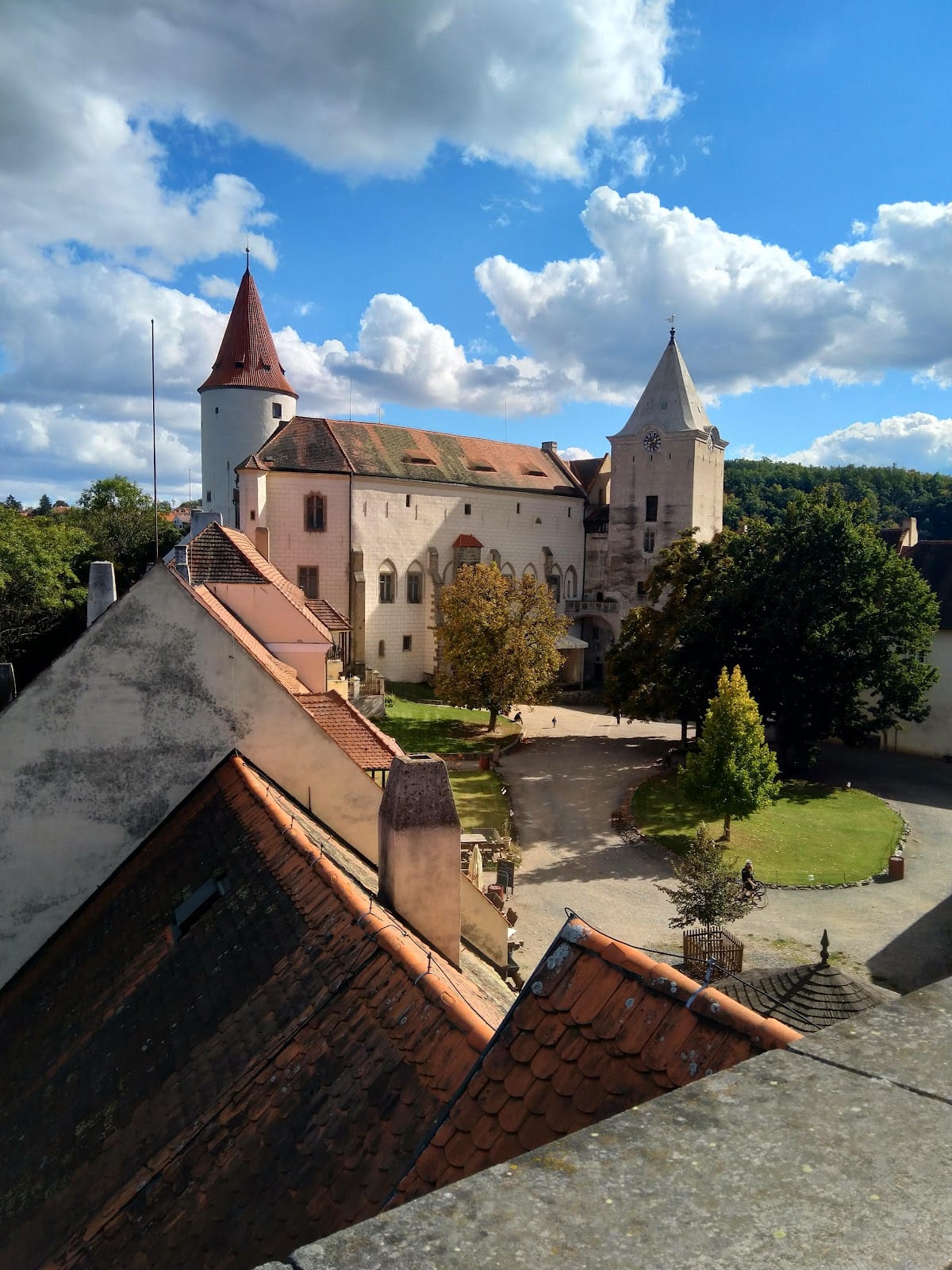
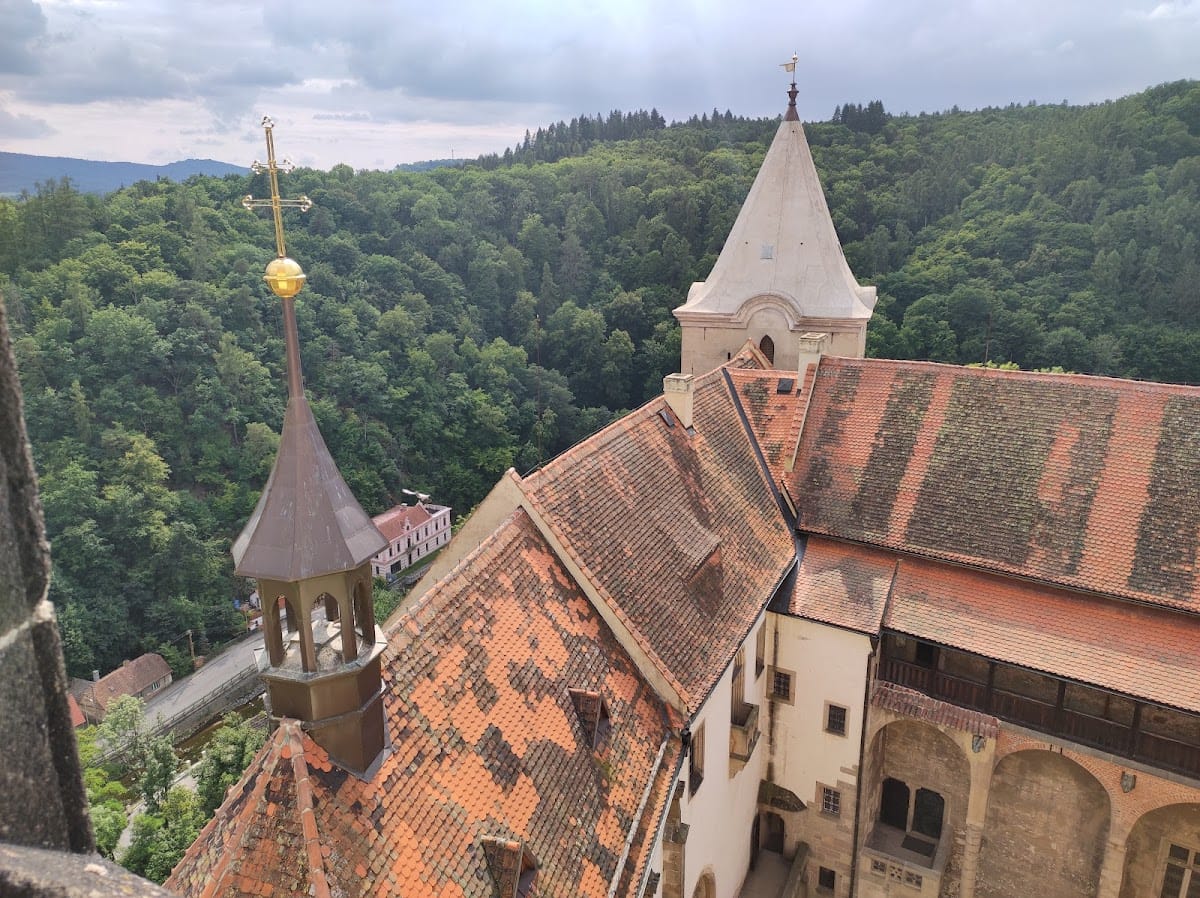
Křivoklát Castle occupies an irregular triangular rocky promontory formed of Paleozoic rock and clay shale. It is naturally defended on three sides by the Rakovnický potok stream, with entry limited to the eastern approach. The complex is divided into an upper castle and a lower courtyard, separated originally by a transverse wall.
At the heart is the upper castle, whose triangular courtyard is bordered by three main wings. The southern wing contains the Chapel of the Coronation of the Virgin Mary, built in the late Gothic style. Noteworthy elements include its polygonal apse and a net vault, a form of ribbed ceiling creating a net-like pattern. The chapel features intricately carved sedilia, seating for clergy, and an altar crafted around 1490, rich in Gothic woodcarving.
The western wing houses a spacious hall characterized by a four-field six-part vault—a design that divides the ceiling into six sections using intersecting ribs—and eight tall pointed windows with elaborate stone tracery. This hall underwent significant late Gothic vaulting and decorative work during renovations commissioned by Vladislav II Jagellonský in the late 15th century, when old arcades and dividing walls were removed and broad staircases linking floors were added.
On the northern side, known as the Queen’s wing, smaller private chambers once served royal family members. Behind these relocations, the large round donjon tower rises 42 meters high. Its outer walls reach up to 10 meters thick for defensive strength, while the interior walls facing the courtyard are 2.5 to 3 meters thick. In the late 15th century, the main tower was remodeled to include a new entrance on its first floor, connected internally by staircases.
Fortifications extend beyond the core castle with an outer curtain wall called a parkán. This line was strengthened in the Gothic period through the addition of covered galleries for defenders to shoot from, as well as bastions—platformed defensive protrusions—and a battery tower suited for artillery. Notably, the Golden Bastion, a large circular fortification on the southwestern corner, anchors the outer defenses alongside a moat-protected gate with the Prochoditá Tower reinforced by casemates (vaulted rooms used by gunners or defenders). The main lower courtyard is fully enclosed by buildings and features two late Gothic bastions. Its principal gate carries a carved figure of the Czech lion, symbolizing Bohemia.
Several functional buildings occupy the lower court. Among them is the old brewery, now repurposed for administrative use, and the Hejtman’s House. The Purkrabství served as the burgrave’s residence, or the castle’s governor. The Huderka Tower, within these precincts, is famed as the place where Edward Kelley was imprisoned. Nearby is a well more than 40 meters deep, matching the height of the castle’s main tower, a vital source of water deep below ground.
Inside the castle, the Stříbrnice treasury room preserves its original 15th-century oak doors, inscribed with a dated number, a rare surviving detail from this period. The prison area contains several cells showcasing instruments of torture used in the past. The Knight’s Hall holds a collection of Gothic art, and the King’s Hall is imposing, measuring 28 meters in length and standing 8.5 meters tall, with an intricate star vault adorning its ceiling. The castle library houses an extensive collection of roughly 53,000 volumes.
In addition to later architectural phases, archaeological work has uncovered earlier layers beneath the castle. Researchers found remnants of an earlier structure known as the Manský dům (Mansky House), which was destroyed in the 1422 fire. Prehistoric artifacts, including Bronze Age ceramics, have been documented, alongside remains of 9th to 12th-century fortifications, evidencing the site’s long-standing strategic importance.
Surrounding the main fortress, cellars associated with the former brewery offer over 600 square meters of storage area. Adjacent stands a chapel dedicated to the Holy Trinity, dating from the late 17th or early 18th century. A series of Baroque-style statues of saints lines the road leading up to the castle, adding a spiritual dimension to its approach.
The castle’s construction uses local Paleozoic stone and clay shale, blending Romanesque, Gothic, and Renaissance architectural elements preserved or restored during its long history. Together, these features paint a detailed picture of Křivoklát’s development from a medieval stronghold into a complex palace-fortress through centuries of use and renewal.
Nearby sites