Castle Nižbor: A Royal and Aristocratic Stronghold in Czechia


Site at a Glance
- Rating
- 4.5
- Popularity
- Medium
- Country
- Czechia
- Primary era
- Medieval
- External website
- Open
- Eras represented
- Medieval, Early Modern
- Civilizations
- Habsburg, Holy Roman Empire, Kingdom of Bohemia
- Site type
- Domestic
- Remains
- Castle
On this page13 sections
History
Castle Nižbor is a medieval castle in Czechia, founded in the thirteenth century by King Přemysl Otakar II as a royal stronghold. Older literature also proposes King Václav I as its founder, but that attribution remains uncertain. The castle was originally known as Miesenburg or Nižburk, names derived from the Mže, the former name of the Berounka River.
Royal foundation and administration
Nižbor was already an important royal site in the thirteenth century. In 1265, Přemysl Otakar II issued a charter there authorizing the foundation of the town of Polička and established the office of the Podbrdy region at the castle. The site was administered by burgraves, governors responsible for a castle and its surrounding territory. Dětřich Špaček of Kostelec held that office from 1278 to 1283.
King Václav II favored Nižbor as a residence and issued numerous charters there between 1284 and 1301. During his reign, the castle was expanded and strengthened. In 1307, Vilém Zajíc of Valdek seized it, but the castle returned to royal ownership in 1319 after his death. King Jan of Luxembourg later pledged Nižbor to the brothers Vavřinec and Pešek of Janovice and to Duke Rudolf I of Saxony. A pledged castle was transferred temporarily as security for an obligation while ultimate ownership remained with the ruler.
The Moravian margrave Jan Jindřich lived at Nižbor after 1341. Emperor Charles IV included the castle in his planned law code, Majestas Carolina, among the castles that the ruler could pledge for no more than ten years. King Václav IV pledged Nižbor in 1384 to Konrád of Zlosina and later to his cupbearer Jan Kunat. Despite these repeated transfers, Nižbor remained a royal castle until 1601.
Hussite capture and repairs
Poor maintenance made the castle vulnerable during the Hussite Wars, the conflicts associated with the religious reform movement of Jan Hus. In 1425, 120 Hussites commanded by Otík Laut of Hlažovice captured Nižbor. Their force was soon defeated by the armies of Aleš of Šternberk and Hanuš of Kolovrat. The castle then came under the control of Mikuláš Kapoun of Smiřice, burgrave of Křivoklát, and later passed to his son Petr. The Kapoun family repaired the damaged castle.
In 1510, King Vladislav II Jagiellon granted Nižbor to Jan Otto of Losu. His identically named son repaired the dilapidated castle in 1538 and reinforced its fortifications. These works formed part of the castle’s continued use before its transformation into an aristocratic residence.
Renaissance transformation and aristocratic ownership
In 1601, Emperor Rudolf II granted Nižbor as a free estate to his chamberlain and captain of Prague Castle, Konrád Šanovec of Šanov. Šanovec began converting the medieval complex in the Renaissance style, but the project left him heavily indebted. A court order led to the sale of Nižbor in 1613 to Fridrich Mičan of Klinštejn for 33,000 kops of groschen.
Albrecht Mičan of Klinštejn inherited the estate in 1616 and supported the rebels in the Bohemian Estates’ Revolt, the uprising that began the Thirty Years’ War. Fearing confiscation, he transferred Nižbor to his wife, Magdaléna of Hodkov at Miletín. Damage caused during the war was later repaired. Magdaléna’s granddaughter, Mandaléna Polyxena of Ladron, née Valdštejn, subsequently owned Nižbor but sold the indebted estate in 1664 to Pavel Morzin of Vrchlabí for 36,000 florins.
Prince Jan Adolf I of Schwarzenberg acquired Nižbor in 1679 and incorporated it into the Křivoklát estate. Ferdinand Wilhelm Schwarzenberg sold it in 1685 to Arnošt Josef of Valdštejn. His son, Jan Josef of Valdštejn, commissioned the conversion of the Renaissance château into a Baroque residence. Anna of Valdštejn inherited the property in 1731 and married Josef Wilhelm of Fürstenberg. The estate remained with their descendants until 1929.
Later use and restoration
During the Fürstenberg period, Princess Leontýna’s library was established on the first floor and held 5,000 volumes. From the late 1940s, the château contained apartments, and its roof was completely repaired in 1971. The municipality of Nižbor acquired the deteriorated property in 1997. Reconstruction followed at the beginning of the twenty-first century, and a multimedia exhibition and Celtic Culture Information Centre opened in 2004. A permanent exhibition presents Celtic life, crafts, deities, and warfare. Castle Nižbor is protected as a cultural monument of the Czech Republic.
Remains
Castle layout and medieval defenses
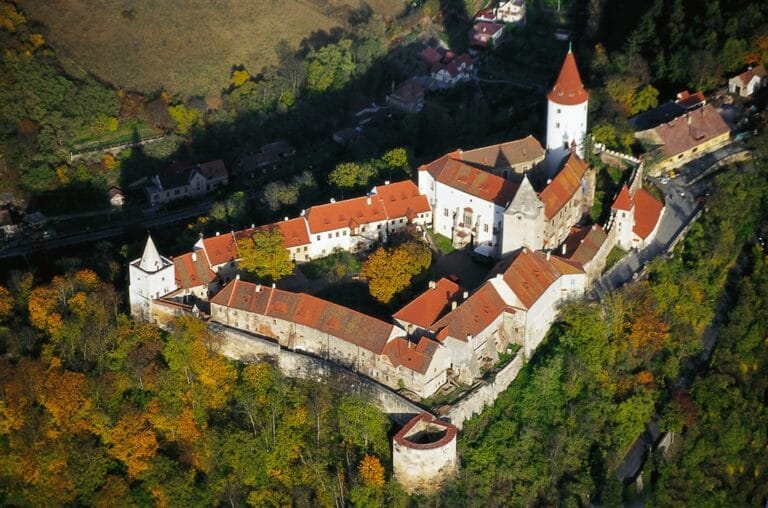
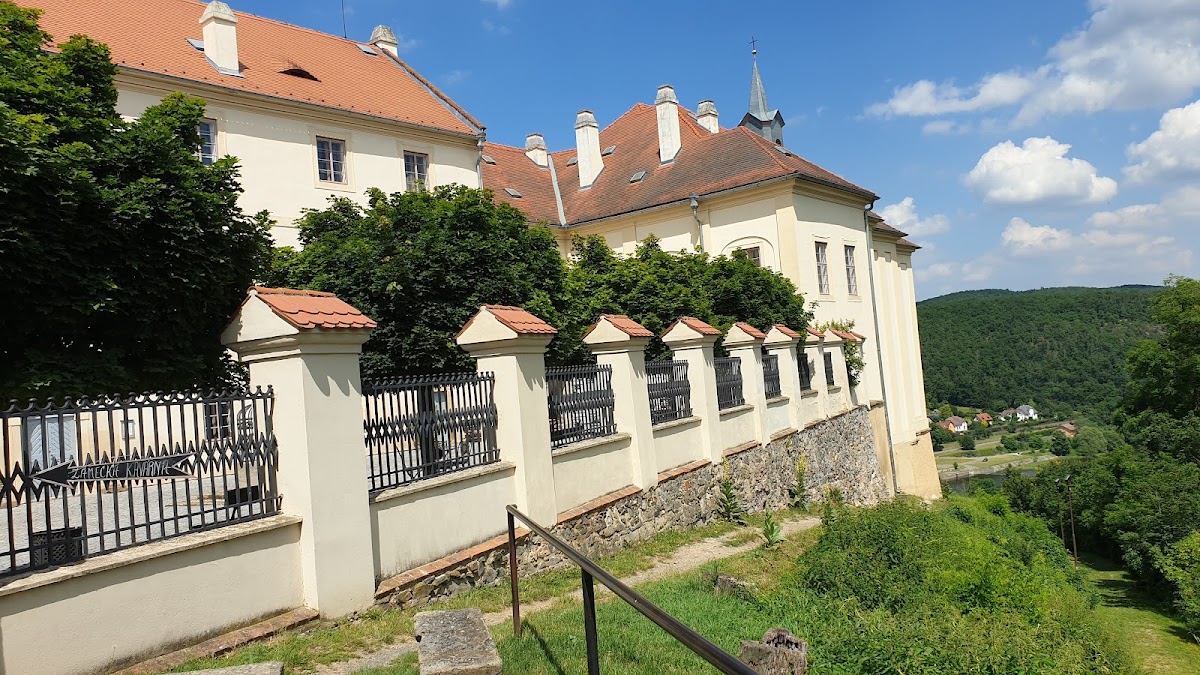
Castle Nižbor occupies a descending promontory above the confluence of the Berounka and Habrový potok. The two-part complex was organized around a forward section and a central castle core. Its many towers are known mainly through historical images, while their limited capacity to provide flanking fire has led to the castle being regarded as a probable, though poorly understood, example of the castell-type arrangement. This form organizes a fortress around an enclosed core, with towers intended to defend the adjoining walls from the sides.
Forward castle
A tower stood at the river-facing corner of the forward part of the castle. Part of the perimeter wall survives on the northern side, where a privy tower has also been identified. A privy tower housed latrines. Archaeological investigation established that this section stood above a neck ditch and identified the position of its gate and of a tower at the northwestern corner. During the Baroque alterations, part of the ditch was incorporated into cellars beneath newly built structures.
Northern palace
The original castle core contained two palaces. Only parts of the northern palace survive. Its large hall was lit by broad Gothic windows with tracery, the ornamental stone framework that divides a window opening. Historic drawings show a round tower at the palace’s northwestern corner.
A round flanking tower survives in the lower part of the palace’s eastern side, beside a prominent polygonal chapel. The chapel has a multi-sided plan. A presumed outer defensive strip around it has not been archaeologically confirmed. Investigation on the palace’s northern side also showed that a massive buttress, a projecting support for a wall, was originally another privy tower.
Southern palace
The southern side of the courtyard was enclosed by a second palace that narrowed slightly toward the chapel. At least three rooms occupied its eastern half. The palace probably disappeared as early as the fourteenth century because of unstable ground, while its outer perimeter wall was repaired and reused as a fortification wall.
Courtyard and later features
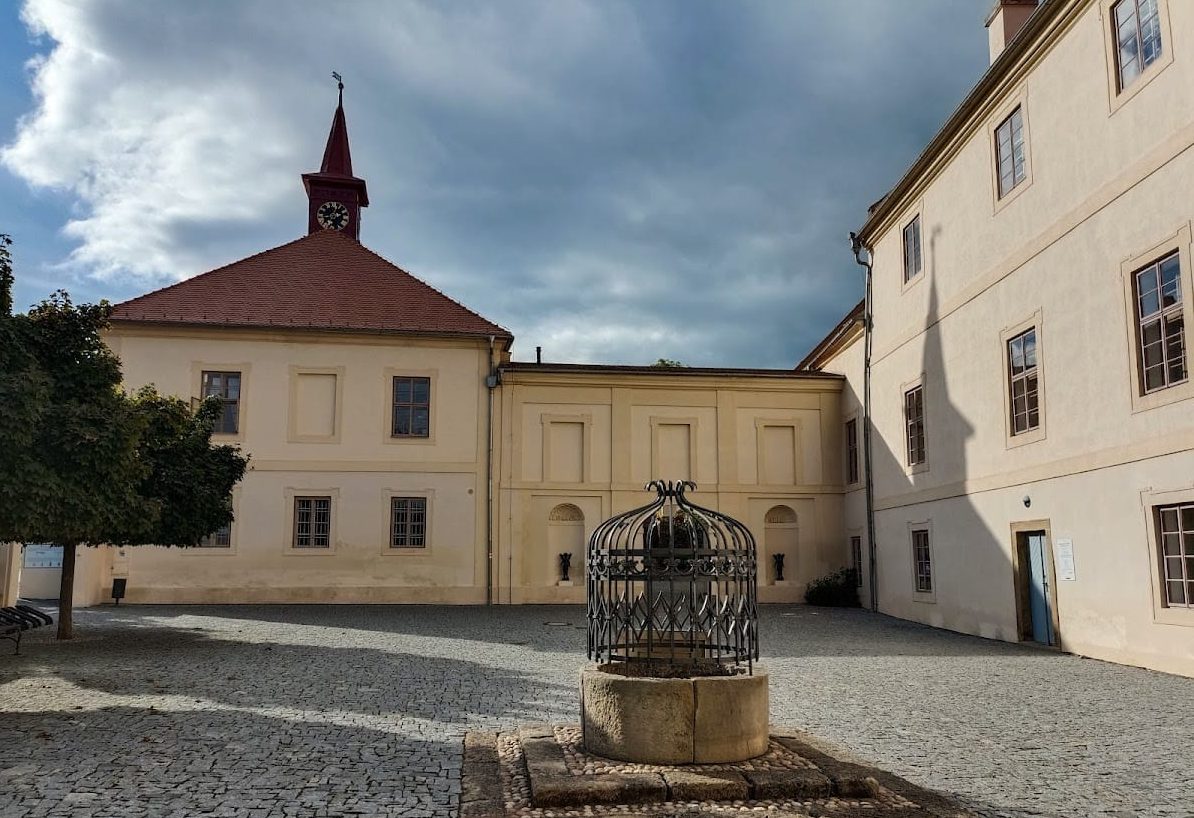
Archaeological research showed that the second courtyard sloped downward. Its western part lay two to three metres below the medieval ground level. The same investigations clarified the position of the former neck ditch, the gate, and the tower at the forward castle’s northwestern corner. These findings help relate the surviving later structures to the medieval arrangement.
Sundials and meridian marker
Two sundials stand in the courtyard. The left-hand dial indicates true local time and carries the Latin inscription Sine sole nequid sum, meaning “Without the sun I am nothing.” The right-hand dial shows Old Czech time, which measures the period elapsed since sunset on the preceding day. Its inscription, Sol cognovit occasum suum, means “The sun knows its setting.” A simple tablet set into the paving marks the line of the fourteenth meridian east of Greenwich.
Church of the Exaltation of the Holy Cross
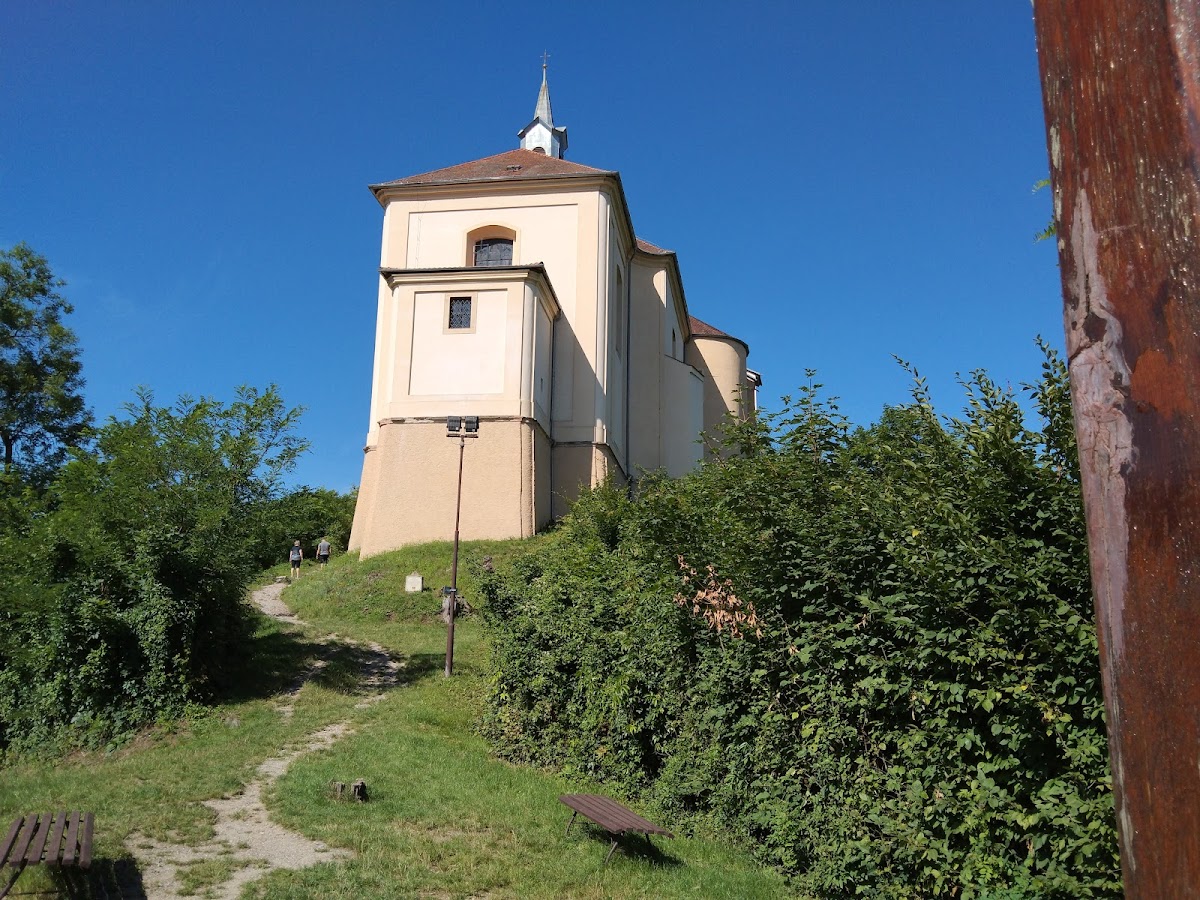
On the eastern side of the château stands the Church of the Exaltation of the Holy Cross. František Maxmilián Kaňka rebuilt it in the Baroque style in 1724. The church occupies the edge of the rock above a thirteenth-century Early Gothic chapel, originally dedicated to Saint Catherine.