Industria: A Roman Municipium and Archaeological Site in Piedmont, Italy
Table of Contents

Visitor Information
Google Rating: 4.2
Popularity: Low
Google Maps: View on Google Maps
Official Website: cultura.gov.it
Country: Italy
Civilization: Celtic, Roman
Remains: Burial, City, Domestic, Economic, Infrastructure, Military, Religious

Context
The Archaeological Area Roman Town of Industria is situated in Monteu da Po, within Italy’s Piedmont region in the northwestern part of the country. Positioned near the confluence of the Po River—the longest river in Italy—and the Dora Baltea, the site occupies a strategic location in the fertile plains of the lower Po Valley. This landscape of gently rolling hills and alluvial soils provided favorable conditions for agriculture and settlement throughout antiquity. Industria’s placement along the Po River basin connected it to important regional communication and trade routes linking the Italian interior with transalpine territories.
Archaeological evidence indicates that Industria was primarily occupied during the Roman Republican and Imperial periods, from approximately the 2nd century BCE through the 4th century CE. The site developed as a municipium exhibiting characteristic Roman urban planning and infrastructure. Its decline in the late Roman era is documented stratigraphically and through material culture, suggesting a gradual abandonment by the 4th or early 5th century CE, although the precise causes remain undetermined. Excavations initiated in the 20th century have revealed well-preserved urban features, including residential quarters and religious complexes, partially protected by alluvial deposits that have limited erosion. Ongoing research and conservation efforts continue to enhance understanding of Roman urbanism in this segment of the Po Valley.
History
Pre-Roman and Celtic-Ligurian Period
Prior to Roman domination, the site of Industria was occupied by a Celtic-Ligurian settlement known as Bodincomagus, a toponym meaning “marketplace on the Po River” in the Ligurian language. This community was strategically located near the junction of the Dora Baltea and Po rivers, facilitating trade and communication between the Alpine regions, including the Aosta Valley, and the Po Valley lowlands. Bodincomagus is attested in early imperial inscriptions and referenced by Pliny the Elder in his *Naturalis Historia*, confirming its regional significance as a commercial node. The settlement’s position within fertile plains made it a natural intermediary for exchanges between indigenous populations and transalpine trade networks, serving as a focal point for local artisanal and mercantile activities.
Roman Foundation and Republican Period (2nd century BCE)
Following military campaigns led by the consul Marcus Fulvius Flaccus in the Monferrato region, the Romans established a colonia at the site between 124 and 123 BCE, effectively superseding the earlier Celtic-Ligurian settlement. This foundation integrated the local population into the Roman administrative system, enrolling inhabitants in the tribus Pollia and incorporating the town within the Augustan Regio IX Liguria. Industria’s location at the confluence of two rivers made it a pivotal commercial and artisanal center, particularly for metallurgy. Ore extracted from Alpine mines was transported via the Po River, with Industria functioning as a river port facilitating the distribution of metal products and Alpine stone slabs throughout the Republic.
Archaeological data reveal a carefully planned urban layout characterized by a nearly square grid of rectangular insulae measuring approximately 40 by 70 meters. Construction techniques employed local roughly hewn stone with limited use of bricks, indicative of skilled masonry consistent with early Roman building practices. The town’s infrastructure supported mixed residential and economic functions, reflecting its role as a municipium with administrative autonomy and commercial specialization within the Roman Republic.
Imperial Roman Period (1st–4th century CE)
Industria experienced significant growth and economic prosperity during the 1st and 2nd centuries CE under the Roman Empire. The town’s economy was largely driven by metalworking and trade, managed by prominent Italic merchant families such as the Avilii and Lollii, whose commercial networks extended to the eastern Mediterranean and northern Italy. The urban fabric comprised residential domus with peristyles, artisan workshops, and commercial shops arranged along orthogonal streets. A principal feature was the sanctuary complex dedicated to the Egyptian deities Isis and Serapis, initially constructed during the Augustan-Tiberian period and expanded under Emperor Hadrian in the early 2nd century CE.
The sanctuary included a rectangular temple of Isis with a pronaos and single cella, set within a peristyle courtyard, and a later monumental semicircular temple of Serapis featuring a large central courtyard surrounded by a semicircular portico and a polygonal cella flanked by two smaller shrines. Facilities for ritual purification and priestly residences attest to an organized religious community. Numerous inscriptions and ritual objects, including bronze statuettes and votive lamps, document the presence of a collegium of pastophoroi (priests of Isis), underscoring the cult’s institutional structure. Industria’s continuous occupation into the late 4th century CE is evidenced by imported goods and refined craftsmanship, reflecting sustained urban vitality and social stratification.
Late Antiquity and Early Christian Period (4th–6th century CE)
From the 4th century CE onward, Industria underwent a gradual decline amid the broader transformations of the late Roman world. The region experienced repeated barbarian incursions, including raids by the Huns, which contributed to the abandonment and partial destruction of the pagan sanctuary complex. Concurrently, Christianity gained ascendancy, with a Christian community documented in a letter by Saint Eusebius dated between 356 and 361 CE. The urban settlement contracted spatially, with inhabitants dispersing into smaller rural clusters centered around a pieve (rural church), preserving the place name in modified forms such as Dustria or Lustria.
Archaeological evidence includes sporadic burials in former public spaces and a Lombard grave from the early 7th century CE containing grave goods, indicating continued but diminished occupation. By the 10th century, the pieve was under the jurisdiction of the Diocese of Vercelli, and the medieval village relocated to a nearby hill, eventually developing into the modern town of Monteu da Po. Romanesque religious buildings dating to the 12th century reflect the continuity of sacred architecture in the area, marking the transition from late antique urbanism to medieval ecclesiastical organization.
Archaeological Rediscovery and Research (18th century to present)
The identification of Industria with the archaeological site near Monteu da Po dates to the mid-18th century, following the discovery of a bronze inscription naming its ancient inhabitants. Early 19th-century excavations led by Count Bernardino Morra di Lauriano uncovered a large semicircular structure initially misinterpreted as a theater but later recognized as part of the sanctuary complex. The site suffered from looting during the 19th century due to insufficient protective legislation.
Renewed scholarly interest in the late 19th and 20th centuries, spearheaded by figures such as Ariodante Fabretti and institutions including the University of Turin, clarified the urban layout and religious functions of Industria. Systematic excavations from the 1960s onward expanded knowledge of the sanctuary and residential areas. Recent archaeological campaigns have focused on artifact cataloging, refining the chronology of urban transformations, and conservation efforts addressing threats from environmental factors and modern urban expansion. Many artifacts are housed in the Museo di Antichità in Turin. The site currently serves as a venue for cultural events and educational programs involving international archaeological institutions.
Daily Life and Importance by Period
Pre-Roman and Celtic-Ligurian Period
During the pre-Roman era, the settlement of Bodincomagus was inhabited by a Celtic-Ligurian community whose social organization likely centered on clan-based structures typical of the region. The population engaged in local commerce and artisanal activities facilitated by the settlement’s strategic position near the confluence of the Dora Baltea and Po rivers. Economic life revolved around small-scale trade, subsistence agriculture, fishing, and hunting. Housing consisted of simple stone or wooden structures adapted to the fertile plains. While direct evidence of religious practices is limited, indigenous animistic and nature-based cults were probably observed. Bodincomagus functioned as a regional marketplace, enabling exchanges between mountain and lowland communities.
Roman Foundation and Republican Period (2nd century BCE)
Following its establishment as a Roman colonia, Industria’s population comprised Roman settlers alongside indigenous Ligurian-Celtic inhabitants, enrolled in the tribus Pollia and governed under the Augustan Regio IX Liguria. The social hierarchy included Roman magistrates and local elites overseeing municipal administration, with a population of landowners, artisans, and servile laborers. Economic activities focused on metallurgy and riverine trade, exploiting ore from Alpine mines transported via the Po River. Metalworking workshops operated at both household and larger artisanal scales, while agriculture supported cultivation of cereals, vines, and olives.
Residential architecture followed a planned urban layout with rectangular insulae, featuring stone-built houses with courtyards and storage rooms. Clothing likely reflected Roman styles, including tunics and cloaks, with access to imported textiles through trade networks. Markets and river ports facilitated the exchange of raw materials and finished goods, with transport relying on river navigation and local roads. Religious life began to incorporate Roman cults alongside indigenous practices, with civic temples and public spaces emerging. Industria functioned as a municipium with administrative autonomy, serving as a commercial and artisanal hub linking the Po Valley to broader Roman economic circuits.
Imperial Roman Period (1st–4th century CE)
During the Imperial period, Industria’s population included Italic merchant families such as the Avilii and Lollii, skilled artisans including servile workers of Greek origin, and a structured priesthood managing the sanctuary of Isis and Serapis. Elite households resided in domus featuring peristyles and elaborately decorated interiors with mosaic floors and frescoed walls. Social stratification was evident, distinguishing wealthy merchants, artisans, and laborers.
The economy thrived on metallurgy, particularly copper and iron processing sourced from Aosta Valley mines, alongside diversified artisanal production and trade extending to the eastern Mediterranean. Workshops and commercial shops lined the orthogonal streets, while river transport remained vital for distributing goods. Diet included cereals, olives, wine, fish from the Po River, and imported delicacies, reflecting a mixed agricultural and mercantile lifestyle. Clothing adhered to Roman fashions, with evidence suggesting access to fine textiles and jewelry.
Religious life centered on the sanctuary complex dedicated to Isis and Serapis, featuring temples, ritual purification facilities, and priestly residences. The collegium of pastophoroi administered cultic rites involving musical ceremonies with instruments like the sistro, votive offerings, and processions. Inscriptions attest to organized religious leadership and community cohesion. Civic structures included magistracies and public buildings supporting urban governance. Industria’s role as a municipium was reinforced by its economic specialization and religious significance, integrating local traditions with imperial cult practices.
Late Antiquity and Early Christian Period (4th–6th century CE)
From the 4th century onward, Industria experienced demographic contraction and urban decline due to barbarian incursions and the shifting religious landscape. The pagan sanctuary was abandoned and dismantled, while Christianity gained prominence, evidenced by a Christian community mentioned in a letter by Saint Eusebius. Population dispersed into smaller rural clusters centered around a pieve, reflecting a transition from urban to rural settlement patterns.
Economic activities diminished but persisted at a reduced scale, focusing on subsistence agriculture and localized crafts. Burial practices shifted to Christian cemeteries, with sporadic pagan burials and Lombard graves indicating cultural continuity amid transformation. Household structures became simpler, with less emphasis on monumental architecture. Clothing and diet adapted to changing social conditions, likely emphasizing practical garments and locally sourced food.
Religious life was dominated by Christian worship, with ecclesiastical authority overseeing the pieve and community organization. Educational activities probably included Christian catechesis and liturgical instruction, consistent with regional practices. By the 10th century, the area fell under the Diocese of Vercelli, and the medieval village relocated to a nearby hill, evolving into modern Monteu da Po. Industria’s civic role shifted from a municipium to a rural ecclesiastical center, reflecting broader late antique transformations in northern Italy.
Remains
Architectural Features
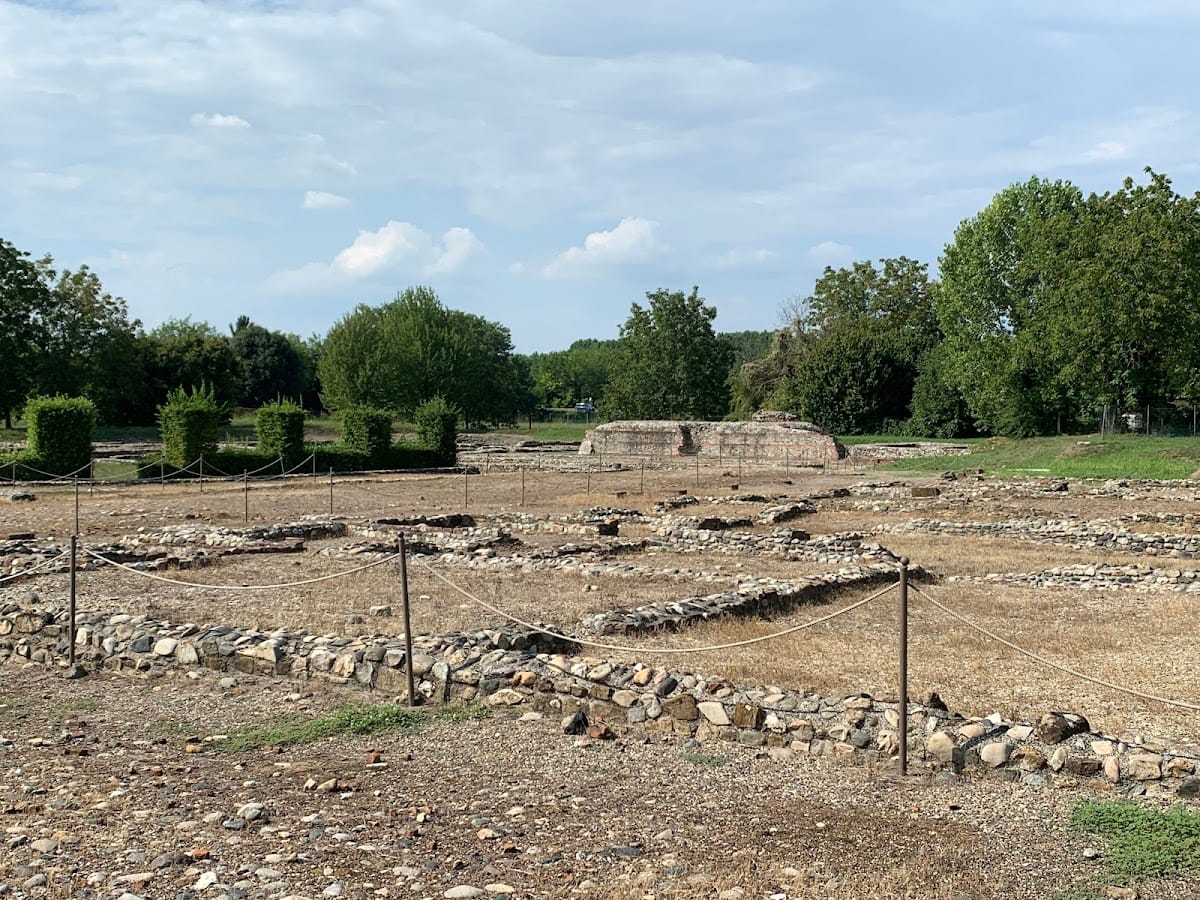
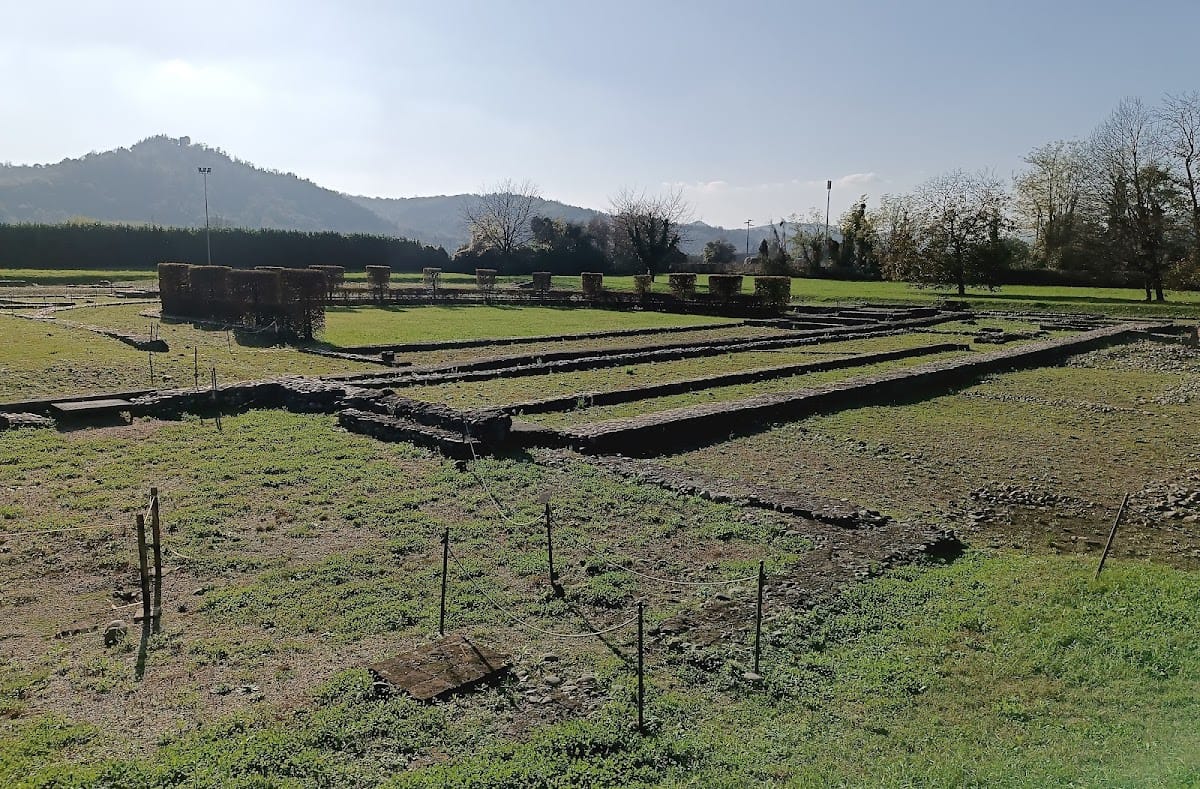
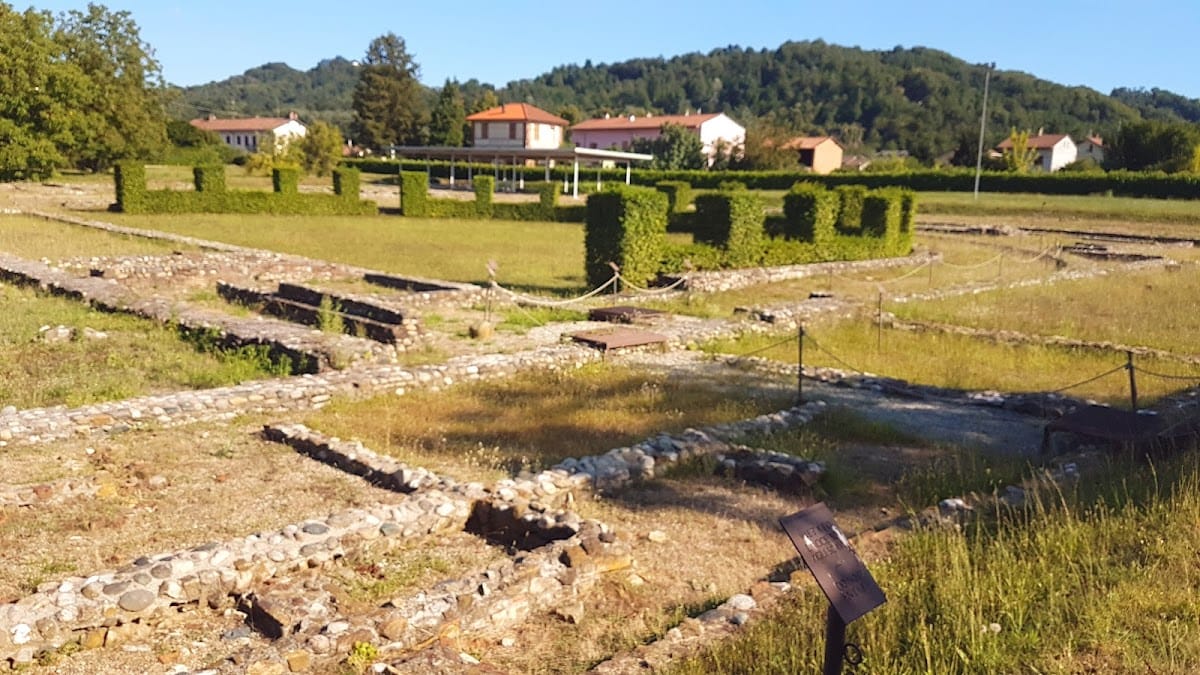
The archaeological remains of Industria reveal a small Roman town with a nearly square plan measuring approximately 400 meters per side. The urban layout follows a rectangular grid pattern with regular insulae (city blocks) roughly 40 by 70 meters in size. Excavations have uncovered about 15,000 square meters, representing approximately one-tenth of the original urban area. Streets run predominantly east-west and north-south, with a principal east-west street providing access to the site. Construction techniques include local roughly hewn stone masonry with limited early use of bricks, while later phases incorporate more complex architectural elements and imported decorative stones such as marble. The town’s fabric comprises residential, artisanal, commercial, and religious structures, reflecting a mixed urban character rather than a purely civic or military function.
Over time, the city expanded during the 1st and 2nd centuries CE, with evidence of architectural renovations and additions, particularly within the sanctuary precinct. By the late 4th century CE, the urban area contracted, and many structures fell into disuse or were partially dismantled. The site’s preservation owes much to partial burial under alluvial deposits, which protected foundations and lower walls from erosion. Visible remains today are mainly at foundation level, with some standing walls and architectural fragments.
Key Buildings and Structures
Sanctuary of Isis and Serapis
The sanctuary complex dedicated to the Egyptian deities Isis and Serapis was constructed during the Augustan-Tiberian period, approximately from the late 1st century BCE to the early 1st century CE. It underwent significant modifications in the mid-1st century CE and again under Emperor Hadrian in the early 2nd century CE. The sanctuary ceased functioning in the 4th century CE, coinciding with the decline of pagan cults in the region.
The sanctuary’s layout includes a courtyard with a semicircular portico at one end and two rectangular rooms on the opposite side. A ritual purification structure and residences for priests are integral to the sacred precinct. The temple of Isis is rectangular, set within a peristyle courtyard, and preceded by a pronaos (atrium) with two chambers. It features a single cella (inner chamber) and an eastern entrance accessed by a staircase. Behind the Isis temple, a procession route leads to the Serapis temple.
The Serapis temple, dating to the mid-to-late 2nd century CE, is monumental in scale. It comprises a large central courtyard surrounded by a semicircular corridor. The temple’s polygonal cella is centrally located at the back of the semicircular portico and is flanked by two smaller temples. The sanctuary was separated from the residential blocks by a wide porticoed street running north-south, integrating it into the urban fabric. Numerous bronze statuettes and ritual objects recovered here are now housed in the Museo di Antichità in Turin.
Residential Buildings and Urban Blocks
Residential structures dating to the 1st century CE line the main east-west street. On the street’s right side, excavations revealed a domus featuring a courtyard surrounded by a portico (peristyle), with living rooms opening onto this central space. On the left side, houses contained artisan workshops and shops, indicating mixed residential and economic use. The insulae are rectangular and well-defined, constructed primarily with local stone.
At the intersection of the main streets, a wide porticoed street runs north-south, separating residential blocks from the sanctuary area. This street leads to a large square room interpreted as a gathering space for worshippers or community meetings. The urban fabric demonstrates a planned layout with orthogonal streets and regular blocks, consistent with Roman town planning principles established during the 2nd century BCE foundation.
River Port and Economic Infrastructure
Near the confluence of the Po and Dora Baltea rivers, remains of a river port facilitated trade and transport. The port area supported the movement of Alpine stone slabs and metal ores, particularly copper and iron, linked to nearby mining activities. Although structural remains of the port are fragmentary, surface traces and associated artifacts confirm its function as a commercial hub. The port’s proximity to the urban center underscores its integration into Industria’s economic life.
Other Remains
Excavations uncovered a large semicircular building initially misidentified as a theater but now recognized as part of the sanctuary complex. This structure includes a semicircular portico and adjacent rooms, contributing to the religious precinct’s architectural ensemble.
Surface traces and foundation remains of additional houses, workshops, and public buildings are visible across the site, though many survive only at the foundation level. Tombs and funerary remains from late antiquity and early medieval periods have been found, including a Lombard grave with grave goods dated to the early 7th century CE. Some architectural fragments and inscriptions have been incorporated into the parish church of Monteu da Po, reflecting reuse of Roman materials in later periods.
Archaeological Discoveries
Excavations at Industria have yielded numerous bronze artifacts, including statuettes of Isis-Fortuna, Tyche, and Arpocrates (Horus as a child), votive lamps, a sistro (a musical instrument used in Isis worship), and small bulls offered to Serapis. A bronze plaque records a dedication by the collegium of pastophoroi (priests of Isis), signed by the craftsman Trophimus Graecanus. These finds demonstrate a high level of local craftsmanship and the presence of an active cultic community during the 1st to 4th centuries CE.
Stone materials used in construction are mainly local rough-hewn stone, with limited early use of bricks. Later architectural phases include marble and other imported stones for decorative elements, indicating connections to wider Roman trade networks. Pottery, coins, and domestic objects recovered from residential and workshop areas provide insight into daily life and economic activities. Inscriptions found on-site offer information on religious dedications and local administrative organization.
Preservation and Current Status
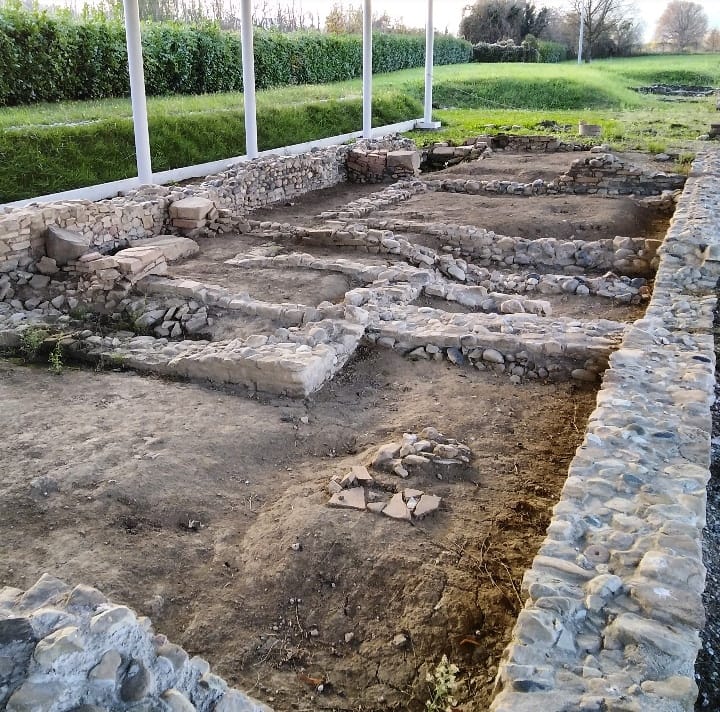
The ruins of Industria are preserved primarily at foundation level, with some standing walls and architectural fragments, especially within the sanctuary complex. The sanctuary of Isis and Serapis retains visible structural elements such as porticoes, cellae, and courtyards. Residential buildings and urban blocks survive mainly as foundation outlines. The large semicircular sanctuary building is partially preserved.
Restoration efforts have focused on stabilizing exposed structures, with no extensive modern reconstruction. The site benefits from protection by the Italian state, and ongoing conservation addresses threats from erosion, vegetation growth, and past looting. Archaeological investigations continue, supported by local heritage authorities and international collaborations. Many artifacts are conserved and displayed in the Museo di Antichità in Turin.
Unexcavated Areas
Significant portions of Industria remain unexcavated, including large sections of the urban grid beyond the currently explored 15,000 square meters. Surface surveys and geophysical studies suggest buried remains of additional residential blocks, workshops, and possibly civic structures. Some areas are inaccessible due to modern land use or conservation policies limiting excavation.
Future archaeological work aims to expand understanding of the town’s full extent and urban development phases. However, excavation is constrained by preservation concerns and the need to balance research with site protection. Planned investigations include further geophysical surveys and targeted excavations to clarify the spatial organization and chronology of lesser-known sectors.
Nearby sites