Mazzè Castle: A Fortified Residence and Historic Headquarters in Italy


Site at a Glance
- Rating
- 4.1
- Popularity
- Low
- Country
- Italy
- Primary era
- Medieval
- External website
- Open
- Eras represented
- Classical, Medieval, Early Modern, Modern
- Civilizations
- Holy Roman Empire, Roman
- Site type
- Domestic
- Remains
- Castle
On this page13 sections
History
Mazzè Castle is a historic fortified complex in Mazzè, Italy, with origins in a Roman-period stronghold and a present appearance shaped largely by medieval construction and nineteenth-century Neo-Gothic renovation. It stands in the Canavese area of Piedmont, near the Dora Baltea, and its strategic position brought it into several important military episodes.
Roman origins and the Salassi
The site incorporates the remains of an ancient fortification associated with the Roman period. In 141 BC, the Roman consul Appius Claudius Pulcher defeated the Salassi, an ancient Alpine people who occupied parts of the western Italian Alps and the Canavese region before and during Roman expansion. The Salassi had fortified themselves at Mazzè, where the Romans established a defensive position to protect the principal bridge over the Dora Baltea.
A local tradition associates the site with Ipa, described as the “queen without lands” of the Salassi. According to the legend, she drained Lacus Maior, a lake that had covered the Ivrea morainic amphitheatre, a broad curved accumulation of glacial debris left by a former glacier. The exposed land was believed to have become the fertile eastern Canavese. The story also says that hundreds of enslaved workers died during the undertaking and that Ipa was subsequently burned alive.
The Valperga period
In 1100, Emperor Henry IV granted the fief of Mazzè to a member of the Valperga family. The Valperga held the castle for about 740 years, until the family became extinct in 1840. During their tenure, two principal buildings were established. The Small Castle was built in 1313 as the residence of the Valperga counts, while the Great Castle was constructed in 1430 as a fortified medieval residence.
The castle’s position made it useful during later conflicts. In 1641, during the Thirty Years’ War, a major European conflict fought from 1618 to 1648 amid dynastic, political, and religious struggles, the complex served as a French territorial headquarters. In 1859, during the Second Italian War of Independence, the conflict in which Piedmont-Sardinia and France fought Austria during the process of Italian unification, it became an operational headquarters for the advancing French-Piedmontese forces.
During the sixteenth and seventeenth centuries, the Great Castle was transformed from a fortified residence into a luxurious house for receiving relatives, friends, and distinguished guests. Louis XII of France stayed there in 1499. Later guests included Francesco De Sanctis, Victor Emmanuel II of Italy, Marshal Canrobert, Camillo Benso, Count of Cavour, Nicholas II of Russia, Benedetto Croce, Benito Mussolini, and Umberto II of Savoy.
Military headquarters and twentieth-century changes
Benito Mussolini directed the large military manoeuvres of the Northwestern Quadrilateral from the castle in 1925. On 2 May 1945, German forces signed their final surrender to the Allies at Mazzè Castle.
After the Valperga line ended, ownership passed to the Counts Gandolfi Alliata from 1841 to 1849 and then to the Counts Brunetta d’Usse from 1850 to 1919. Count Eugenio Brunetta d’Usse, a co-founder and secretary-general of the International Olympic Committee, began a major renovation in the Neo-Gothic style, a nineteenth-century revival of medieval Gothic forms. The architect Giuseppe Velati Bellini directed the work, which established much of the complex’s current character.
After Brunetta d’Usse’s death, the castle passed to the Gelfi-Scaglia families from 1920 to 1959 and then to the Salino family of Cavaglia, who owned it from 1959 to 2012. The Salino family undertook a twenty-year restoration after severe damage from looting and neglect in the 1960s. The work recovered interiors and landscaped areas. In 1981, the Italian Ministry of Cultural and Environmental Heritage declared the complex a national monument.
The Underground Museum of Torture was established in 1999 in cooperation with Amnesty International. Its purpose was to present historical evidence of human cruelty as a warning against tyrannical rule. In 2012, Mikhail Lyubchenko, a businessman from Saint Petersburg, purchased the castle for approximately EUR 3 million for his wife Irina. The Small Castle remained a private residence, while the Great Castle formed the publicly visitable part of the complex.
Remains
The two castle wings
Great Castle
The complex is formed principally by two separate building masses, the Great Castle, or West Wing, and the Small Castle, or East Wing. The Great Castle began in 1430 as a fortified casaforte, a residence that combined domestic accommodation with defensive features. Its original functions included housing servants and storing agricultural supplies and weapons. When it became a more luxurious residence, it acquired a rectangular plan, an aristocratic courtyard, and two floors of ceremonial rooms.
The nineteenth-century Neo-Gothic renovation raised the Great Castle’s crenellated curtain wall and tower. It also added an eastern wing above the portico to provide bathrooms and created a guesthouse on the western terrace. The interiors were altered, decorated, and refurnished. Later restoration recovered the crenellated towers, decorated rooms, panoramic terraces, internal gardens, and the Piazza d’Armi.
Small Castle
The Small Castle was built in 1313 as the residence of the Valperga counts. During the nineteenth-century renovation, its crenellated walls were enclosed by a covered terrace, its windows were enlarged, and its square tower was restored. A panoramic garden separates this East Wing from the Great Castle. The Small Castle remains a private residential area.
Rooms and medieval circulation
Ceremonial rooms
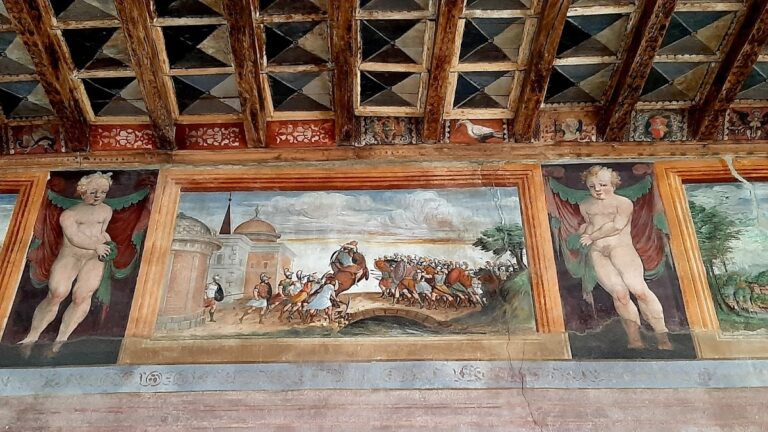
The Great Castle contains twelve rooms dating from the fifteenth to the nineteenth centuries. The Throne Room includes frescoes by Romolo Bernardi, inlays by Carlo Arboletti, and a fireplace by the Catella brothers, although parts of the room’s fabric underwent substantial restoration. The Music Room has ceilings by Giovanni Battista Beroggio, while the Baroque Pink Room is decorated with medallions showing knightly subjects.
The Golden Room has a mosaic floor and an eighteenth-century frescoed ceiling by the Galliari brothers. The Gothic-style dining room has a cross-vaulted ceiling covered with frescoes. The Armoury Room retains an original fifteenth-century wooden ceiling and contains a collection of weapons and armour.
Tower staircase
A fifteenth-century tower staircase connects the lower and upper floors. It is described as the part of the castle preserved without substantial alteration. The restored terraces overlook the park, the Dora Baltea, the Vercelli plain, Monferrato, and the Ligurian Alps.
Park and river landscape
The Oasi del Bosco Parco occupies the core of the former Valperga di Mazzè estate. Eugenio Brunetta d’Usse restored and partly transformed the grounds in the nineteenth century. The landscape includes a mule track, the site known as the Spring of Love, a panoramic viewpoint, the Park of the Princes, long avenues through ancient woodland, a bamboo grove, and the Mound Plain, which tradition regards as a setting for magical rites.
A suspension bridge leads to a lakeside landing suitable for observing birdlife. Near it, a monumental entrance faces the river valley. At the bottom of the valley stand the ruins of the Church of Saint Mary Magdalene, dated to 1230. A return route through the park begins at the monumental entrance, follows a panoramic road, passes the Cave and the Observation Tower, and ends at the starting point. The park is recognized as a landscape and ecological monument.
Underground museum
The Underground Museum of Torture occupies 500 square metres divided into thematic spaces. Its displays include instruments and methods associated with the Inquisition, the ecclesiastical tribunals established in different periods to investigate and prosecute suspected religious heresy. The underground complex also contains a Celtic crypt dated to the tenth century BC, cells and a refrigerated room dated to the fourteenth century, a fifteenth-century mortuary chapel, and Roman underground rooms with a cistern dated to the second century BC.
The museum displays torture instruments and iconographic images. Together, these underground spaces bring together remains and settings associated with prehistoric, Roman, medieval, and later uses of the castle site.