Castello di Brusasco: A Historic Fortified Complex in Italy


Site at a Glance
- Rating
- 4.5
- Popularity
- Low
- Country
- Italy
- Primary era
- Early Modern
- Eras represented
- Medieval, Early Modern, Modern
- Civilizations
- Holy Roman Empire, Kingdom of Sardinia
- Site type
- Domestic
- Remains
- Castle
On this page8 sections
History
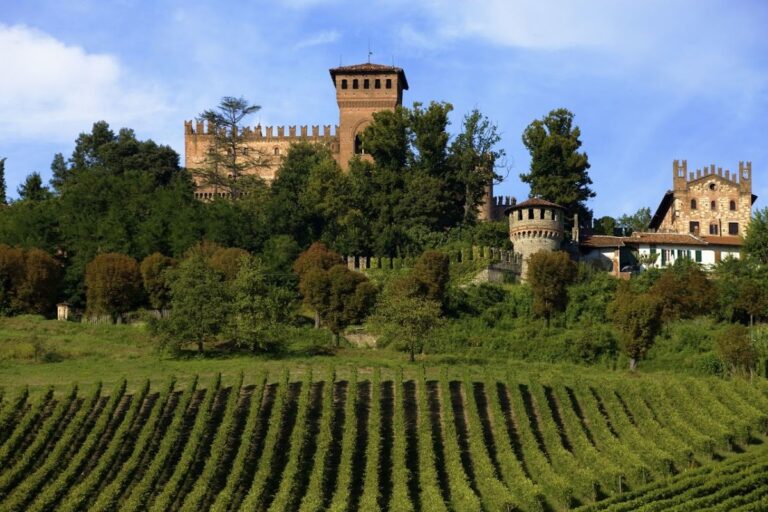
Castello di Brusasco is a medieval fortified complex in Brusasco, Italy, whose first nucleus is traditionally dated to 891, although its construction is also placed broadly around the year 1000. Built on the hill of Luogo, it offered refuge from military raids and the flooding that affected the settlement near the confluence of the Dora Baltea and the Po.
Early feudal history
The castle’s earliest feudal history remains uncertain. The first lords of Brusasco were the marquises of Ivrea, who may have given the property to the Bishop of Vercelli. Another tradition places its transfer to Novalesa Abbey in 998. Before 1000, the site came into the possession of the Aleramici, the marquises of Monferrato, a territory governed by a marquess, and Brusasco thereafter followed the history of Monferrato.
During Frederick I Barbarossa’s war against the communes, the self-governing urban communities of medieval northern Italy, William IV, Marquess of Monferrato, supported the emperor. In 1164, Barbarossa confirmed the fief to William, who began constructing a larger castle on the site of the earlier one. Brusasco was later constituted as a commune and granted as a fief in 1186 to Count Ottobono Radicati of Cocconito.
Monferrato and the movement to Luogo
When control of the marquisate passed from the Aleramici to the Paleologi, Brusasco entered a more prosperous period. The new marquises ordered the construction of walls around the settlement and encouraged its agricultural economy. After the Paleologi line became extinct, the marquisate, including Brusasco, passed to the Gonzaga in 1536.
At the end of the sixteenth century, the Gonzaga ordered the population to move to Luogo. In 1704, during the siege of Verrua Savoia, French troops serving Louis XIV severely damaged Luogo. In 1713, the inhabitants descended from the hill and settled in the valley.
The Cotti renovation and later ownership
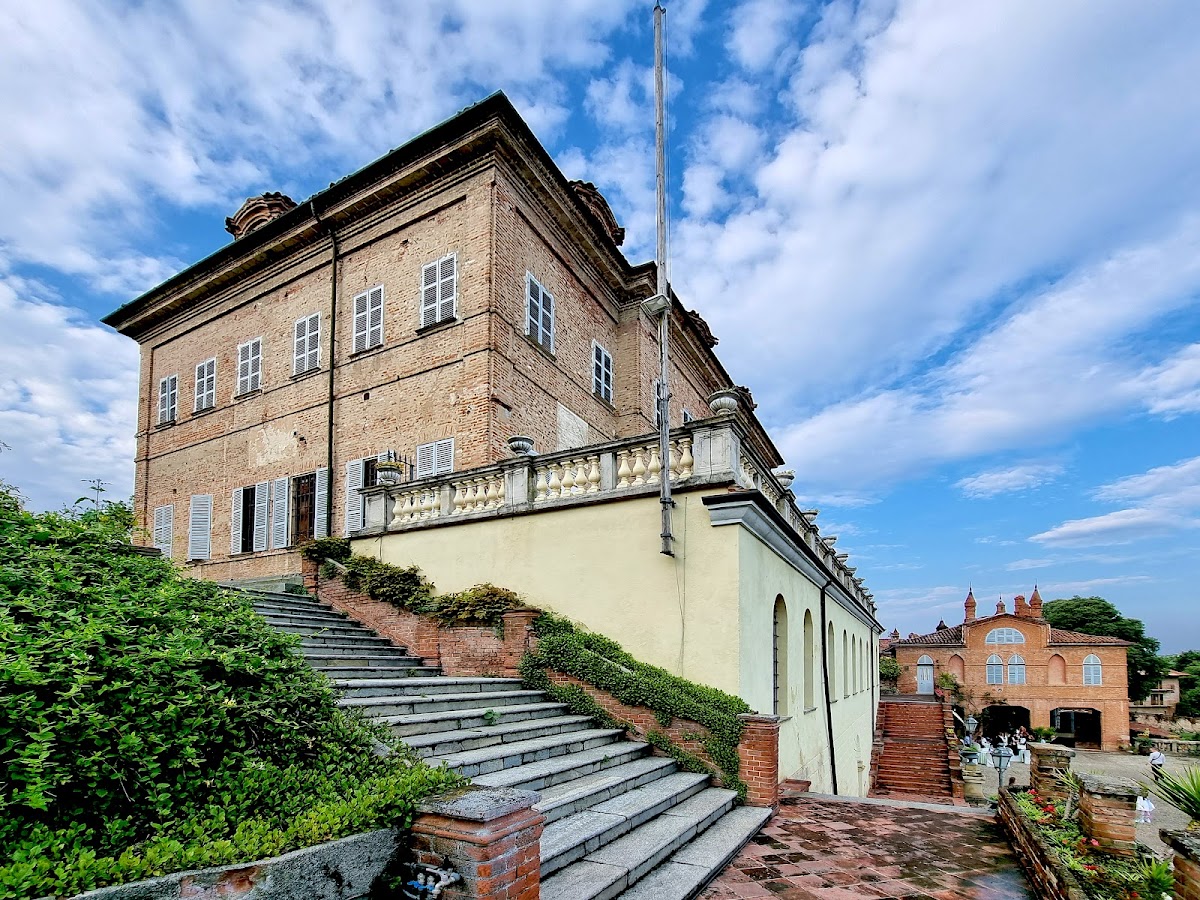
The castle passed to the Cotti family in 1722, and they began its renovation. The present building dates from the mid-eighteenth century and is attributed to Giovanni Maria Molino, who worked for Count Giovanni Ottavio Cotti. Cotti was a musician, attorney general of Piedmont, and first president of the Savoy Senate.
Claudio Cesare Dodolo of Chieri was among the later owners. The castle’s poor condition was such that he reportedly chose to live in the parish church. During the Risorgimento, the nineteenth-century movement that led to Italy’s political unification, Giuseppe Garibaldi and the newly formed Corps of the Hunters of the Alps stayed at the castle in 1859. The settlement around it has since been called Borgo Garibaldi.
Count Gazzelli Brucco of Ceresole acquired the castle in 1874. After a long period under the Marianist Fathers and subsequent neglect, the Violi family purchased it in 1970 and converted it into an agriturismo, a rural hospitality establishment connected with agricultural land or activity.
Remains
The surviving complex occupies the hilltop village of Luogo within the comune, or municipality, of Brusasco. Its physical development reflects successive building phases: an early fortified nucleus was enlarged into a larger castle, later enclosed by defensive walls, and eventually reshaped as an eighteenth-century residence with landscaped grounds and nineteenth-century additions.
Hilltop fortifications
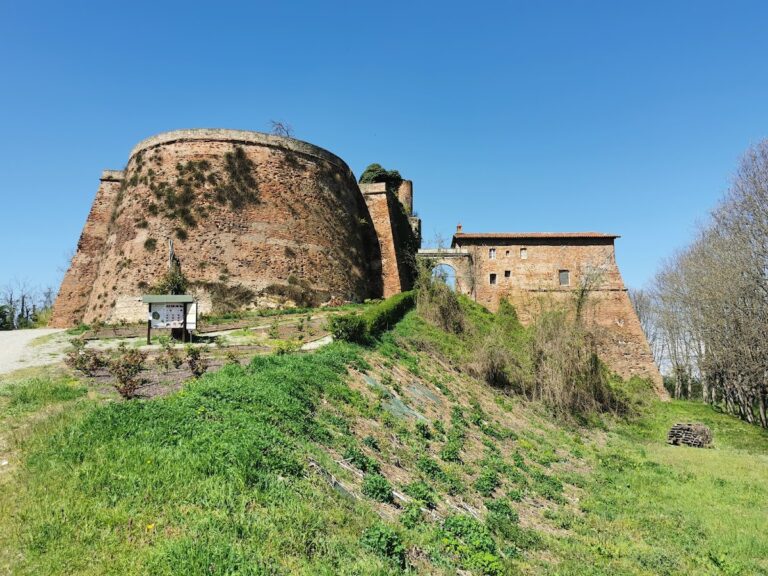
The larger medieval castle was built on the site of the earlier structure. A surrounding defensive wall was added during the period of Paleologi rule, forming part of the fortified settlement on the hill. The remains therefore combine the site of the early refuge with later fortification work associated with the changing administration of Monferrato.
Eighteenth-century castle and park
The present castle building belongs to the mid-eighteenth century and is attributed to Giovanni Maria Molino. Its renovation began after the Cotti family acquired the property in 1722. In 1780, Count Luigi Cotti redesigned the park in the English style, incorporating medieval ruins and adding a faux Roman nymphaeum, an ornamental structure associated with water and modeled on Roman garden architecture.
Nineteenth-century additions
In 1874, Count Gazzelli Brucco added a neo-medieval tower with an adjoining chapel. This later work forms part of the complex’s architectural layering, alongside the medieval fortifications, the eighteenth-century residence, and the landscaped park. The castle’s later poor condition and period of neglect preceded its twentieth-century conversion into an agriturismo.