Hartenštejn Castle: A Late Gothic Fortress near Bochov, Czech Republic


Visitor Information
Google Rating: 4.7
Popularity: Low
Official Website: www.mesto-bochov.cz
Country: Czechia
Civilization: Medieval European
Site type: Military
Remains: Castle

History
Hartenštejn Castle, located near Bochov in the present-day Czech Republic, was constructed by European builders in the late Gothic period during the 15th century. It emerged as a response to military and administrative needs following the destruction of the nearby Hungerberg Castle in 1469. This new fortress was initiated around 1471 to serve as a stronghold and center of governance for Heinrich II of Plauen, a noble who had received the County of Hartenstein from King Sigismund in 1426. The castle’s original name, Neuhartenstein, reflected this connection, later evolving into Hartenstein and finally Hartenštejn.
By 1473, the castle was occupied and governed primarily by members of the Plauen family. Heinrich III of Plauen was one of its notable residents, and his son Heinrich IV, who is believed to have been born there in 1510, represents the continuation of the family’s presence into the early 16th century. Following Heinrich III’s death in 1519, the castle and estates became part of a complex inheritance arrangement that involved guardianship and claim disputes within the noble lineage.
The subsequent decades saw several changes in ownership tied to marriage and political alliances. Johann the Younger of Kolovrat acquired the castle through marriage to Barbara, the widow of Heinrich III. After 1567, possession shifted to Heinrich Niklas of Lobkowicz, indicating transitions between noble families during a period of regional restructuring. However, by 1573, the castle was described as deserted, signaling its decline in military and residential importance.
Efforts to restore the castle were undertaken in the late 1500s and into the early 1600s, though by 1609 it was fully abandoned. Following its desertion, Hartenštejn Castle became part of the wider estate of Andělská Hora. Until the mid-16th century, the nearby fortress at Herstošice was also administered as part of this estate system. Recognizing its historical value, the site was designated a cultural monument in 1964, with conservation work in the 20th century focusing on stabilizing and partially restoring key defensive structures.
Remains
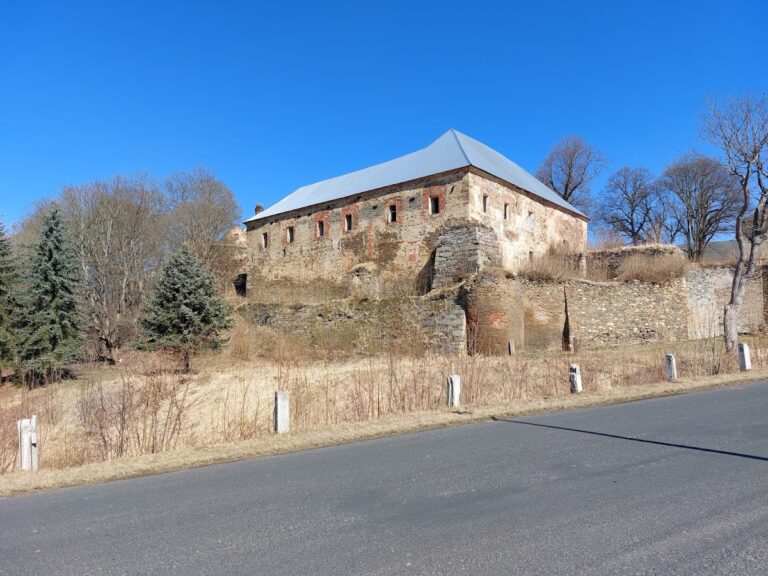
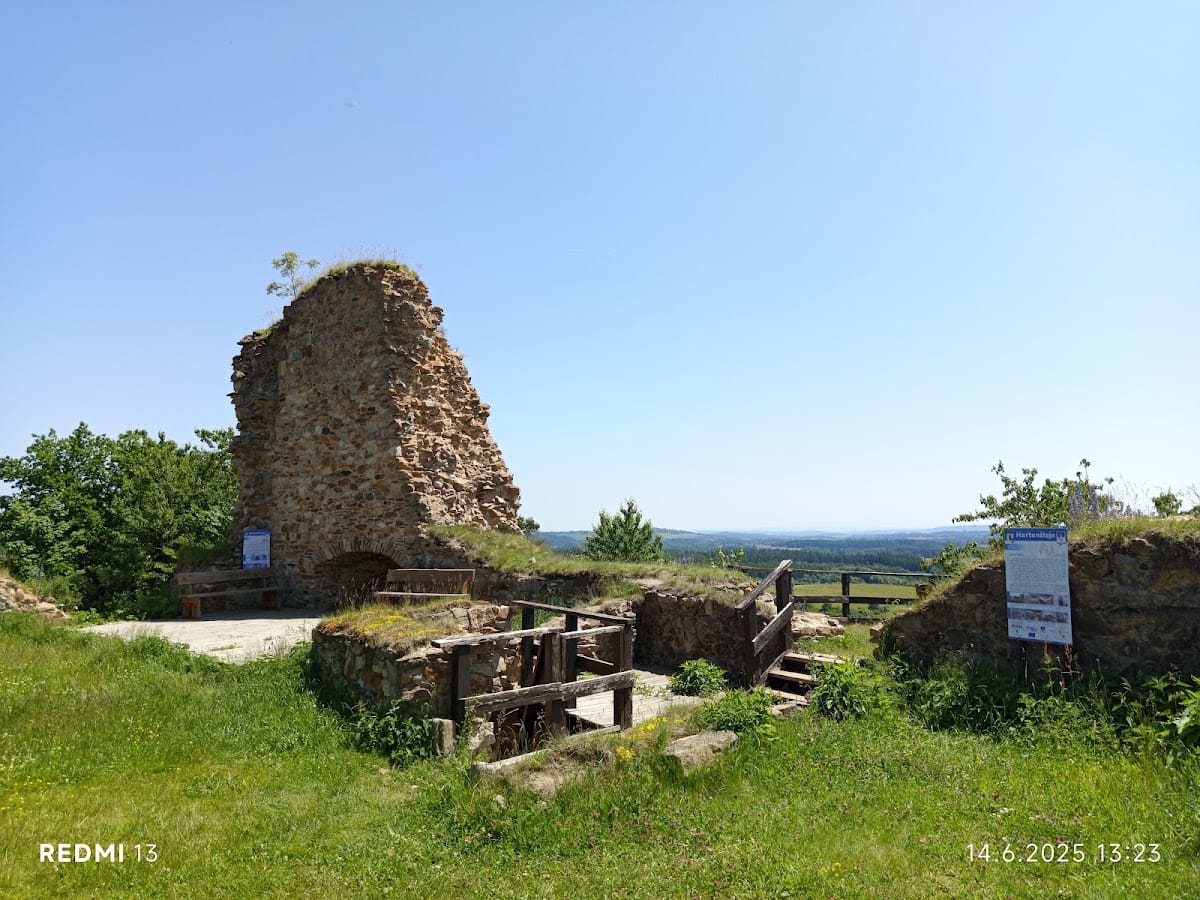
Hartenštejn Castle occupies a roughly square area atop a solitary hill standing about 730 meters above sea level, dominating the summit with its footprint. Its design reflects the late Gothic approach to fortification, with stone masonry forming its main defensive walls and structural elements. The castle’s layout was strategically planned to maximize defense from all sides, taking advantage of its elevated location.
The defensive system originally included three semi-circular battery towers jutting out from the curtain walls on three sides of the castle. To the west, a large polygonal bastion provided substantial protection, while near the main entrance gate on this same side, a smaller semi-circular bastion added further security. These bastions were part of innovations allowing defenders to fire upon attackers with artillery and small arms while remaining protected.
Within the castle, a small palace occupied the southwestern corner, likely serving as the residential quarters for the ruling family. Other peripheral buildings once stood around the courtyard, although they have not survived to the present day. Archaeological work in the 1930s uncovered a well on the northeastern side of the courtyard, revealing a deep water source reaching 34 meters below ground level, essential for the castle’s self-sufficiency during sieges.
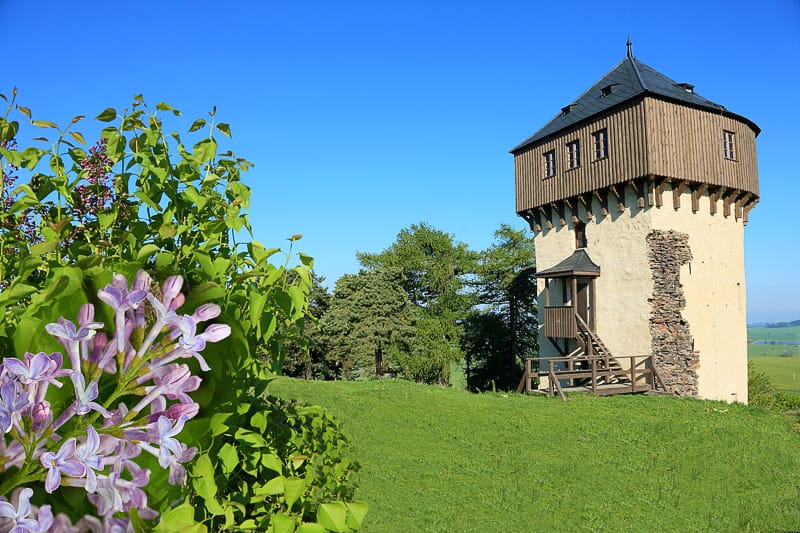
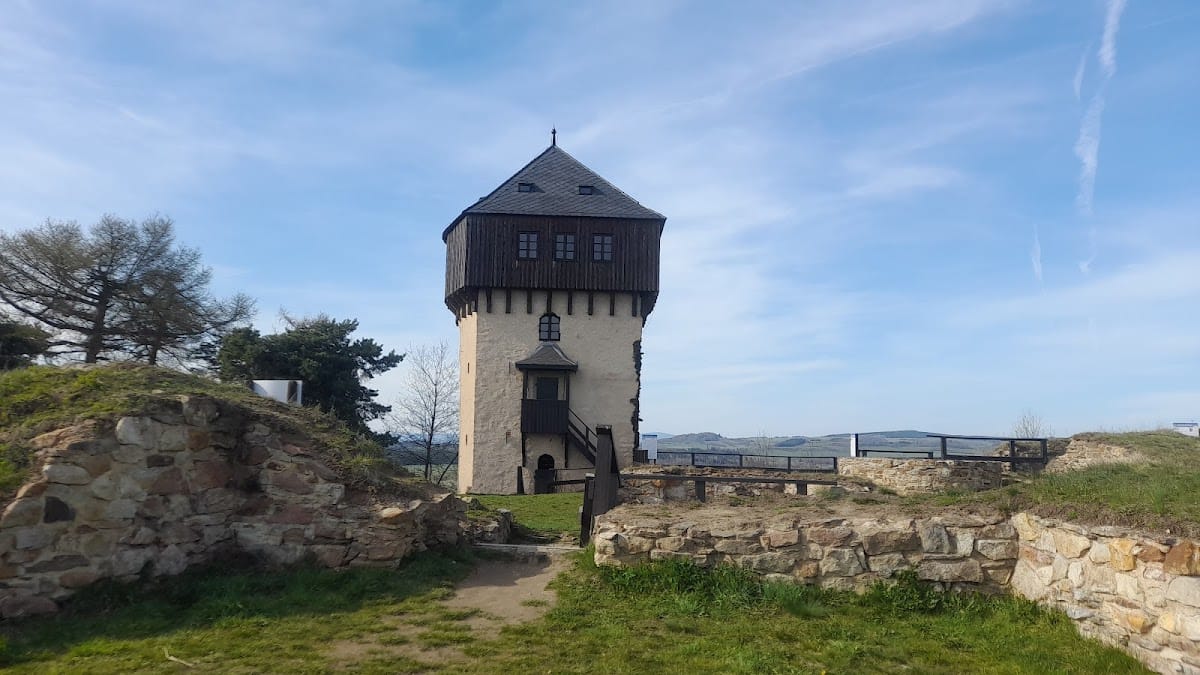
Additional fortifications included two towers that stood along the northern and southern sides of the structure, reinforcing the castle’s defense. Near the southern bastion, a vaulted building featuring a cellar was identified, possibly used for storage or secure shelter. Through the centuries, although many structures fell into ruin, parts of the walls, bastions, and towers remain visible today. Conservation efforts in the last century have restored some bastions, helping to preserve the fortress’s imposing silhouette. A marked route near the town of Bochov allows access to the site, connecting visitors with the physical remnants of this historic stronghold.
Nearby sites