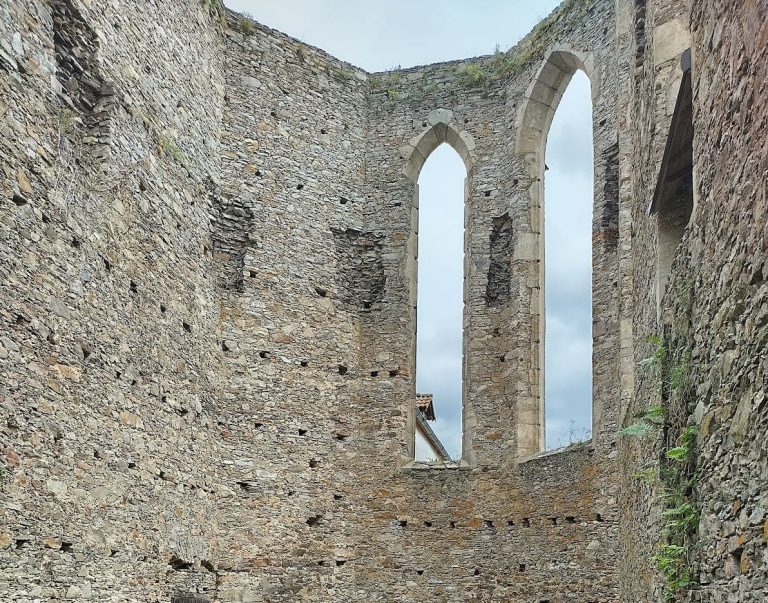
Hus: A Gothic Watch Castle in Czechia


Site at a Glance
- Rating
- 4.4
- Popularity
- Low
- Country
- Czechia
- Primary era
- Medieval
- External website
- Open
- Eras represented
- Medieval
- Civilizations
- Holy Roman Empire, Kingdom of Bohemia
- Site type
- Military
- Remains
- Castle
On this page8 sections
History
Hus is a Gothic castle ruin in Czechia, authorized in 1341 by King John of Luxembourg for the Janovice brothers. Built to protect newly established villages around Záblatí, it also watched over the Golden Trail, a major medieval route linking the Bohemian lands with the Alpine region, between Volary and Prachatice.
Royal Foundation and Janovice Lordship
John of Luxembourg reserved free access to the castle if hostile forces from Bavaria invaded. In 1359, Emperor Charles IV confirmed Pešek of Janovice’s feudal possession of Hus and its domain. The lordship included 23 localities, among them the small towns of Husinec and Záblatí, the villages of Křišťanovice, Milešice, Mlynářovice, Řepešín, Zábrdí, and Zvěřinec, as well as the separate estate of Lažiště.
The castle first appears under the Czech name Huscz in 1361. It remained with the Lords of Janovice until 1363, when the male line ended and the lordship returned to the royal chamber.
Hus in the Hussite Era
Around 1390, King Wenceslas IV pledged Hus and its lordship to his favorite, Zikmund Huler of Orlík. Huler was removed from office and deprived of his property in 1394, and he was executed in 1405.
Around the turn of the fifteenth century, Wenceslas appointed Nicholas of Pistné as burgrave of Hus. A burgrave administered and defended a castle or castle district. From 1404, Nicholas used the designation “of Hus.” He supported the teachings of Jan Hus, the Bohemian religious reformer whose ideas helped inspire the Hussite movement. Expelled from Prague in 1419 after advocating Communion under both kinds, the giving of both bread and wine in the Christian Eucharist, Nicholas became one of the leading captains of the Taborites during the Hussite Wars. These were early fifteenth-century religious and political conflicts connected with the Hussite reform movement. Nicholas died in Prague on Christmas Eve 1420 after falling from a horse.
Siege, Destruction, and Abandonment
Before his death, Nicholas transferred Hus to Jan Smil of Křemže, a Bohemian nobleman. Jan Smil entered repeated feuds with Oldřich of Rožmberk. In 1439, he was lured to Krumlov Castle and imprisoned. He ceded his possessions to Oldřich in 1444 and was executed at Krumlov in 1447.
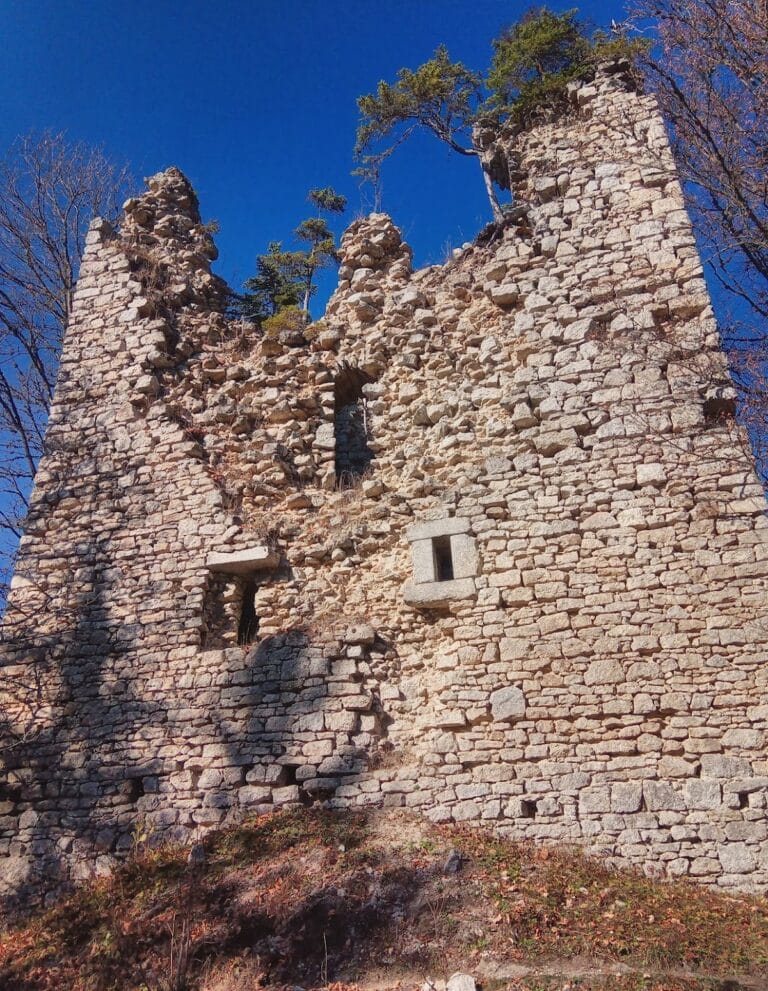
After Jan Smil’s capture, the abandoned castle was seized by the robber knight Habart Lopata of Hrádek. He used Hus as a base for raids on merchants travelling along the Golden Trail. In 1441, forces led by Přibík of Klenová, Petr Zmrzlík of Svojšín, and Jan Sedlecký of Prachatice besieged the castle. The garrison surrendered after suffering starvation, and Hus was burned and demolished. It was never rebuilt, becoming an abandoned ruin after roughly a century of existence. Hus has been protected as a cultural monument of the Czech Republic since 1963 and is owned by Lesy České republiky.
Remains
Spur, Ditches, and Outer Defenses
Hus stands at about 720 to 730 metres above sea level on a narrow, wooded rocky spur projecting from the southern slope of Panský vrch. The Blanice River flows around the spur, while its rear section descends toward the river. The castle was divided into a central core and an outer bailey, the defended area outside the central fortified core, with ditches separating the two parts.
Outer Bailey
The approach ran from the north along the southwestern side of the castle core before entering the outer bailey behind it. Substantial sections of the outer-bailey walls survive, together with overgrown remains of two ditches and further wall fragments. A long building stood beside the southwestern outer-bailey wall. On the eastern side, a wall extended from the outer bailey toward the river and allowed water to be drawn directly from it.
Castle Core
The castle core occupied the highest part of the spur at its front, above a neck ditch that separated Hus from the rest of the ridge. Its exact arrangement remains uncertain because collapsed masonry from the buildings filled the spaces between them and greatly raised the ground level. This created a “closed castle,” a layout in which fallen masonry obscures the original arrangement, although several buildings probably stood within the core.