Zámecká věž: A Historic Castle Tower in Karlovy Vary


Site at a Glance
- Rating
- 4.5
- Popularity
- Low
- Country
- Czechia
- Primary era
- Early Modern
- External website
- Open
- Eras represented
- Medieval, Early Modern, Modern
- Civilizations
- Holy Roman Empire, Kingdom of Bohemia
- Site type
- Military
- Remains
- Castle
On this page8 sections
History
Zámecká věž is a historic tower in Karlovy Vary, Czechia, created through the rebuilding of a residential tower from a Gothic royal castle probably founded around 1358 on the order of Charles IV, the fourteenth-century king of Bohemia and Holy Roman Emperor. The original complex also served as an imperial hunting lodge. The surviving tower reflects the site’s transition from a royal stronghold to a municipal structure above the town’s spa district.
Royal Castle and Schlik Possession
Charles IV stayed at the castle several times between 1370 and 1376. In 1370, he issued a charter there granting the villages of Obora and Drahovice. Wenceslaus IV, his successor as king of Bohemia, confirmed the charter in 1401. Karlovy Vary became a chamber town, meaning a town under the ruler’s direct authority and financial administration, and was administered by the burgrave of Loket, the ruler’s senior official at Loket.
The castle remained in the possession of the Bohemian kings until 1437, when it and the Loket region were pledged to the Schlik family. Around 1475, Matyáš Šlik pledged the castle to the knight Václav Polacký z Polak for 500 imperial florins. Disputes between Polacký and the townspeople sometimes resulted in townspeople being imprisoned in the castle tower. On 10 April 1475, King Vladislaus II Jagiellon ordered the Schliks to pay Polacký 650 imperial florins and release him, after which Polacký was required to settle his debts.
Conflict, Royal Return, and Municipal Use
After Matyáš Šlik died in 1489, the castle passed to Jeroným Šlik and then to his son Šebastián Šlik. The people of Karlovy Vary and Loket rebelled against their overlords, and armed conflict continued between 1502 and 1506. The Schliks captured the castle and town in 1504 but lost them in 1505 and were accused of violating the law. Temporary administration of the castle was entrusted to Jiří Bírka z Násilé, governor of Křivoklát.
Peace was concluded on 21 March 1506, and the castle returned to the Schliks, who attached it to Loket. In 1547, the Schliks joined the Estates’ uprising against Ferdinand I, a Habsburg ruler who held the Bohemian crown. They lost the castle, which returned to royal ownership. By that time, it was unused and falling into decay.
On 13 December 1567, Maximilian II granted the castle to the town. The municipality used it to store firefighting equipment, while Rudolf II granted the surrounding forests to the town in 1598. The castle burned during the town fire of 1604 and was not rebuilt. A Baroque municipal watchtower was erected on the site in 1608. Its trumpeter announced the arrival of important guests and later signalled the opening of the spa season, while a tower watchman reported fires.
Later Alterations and Present Use
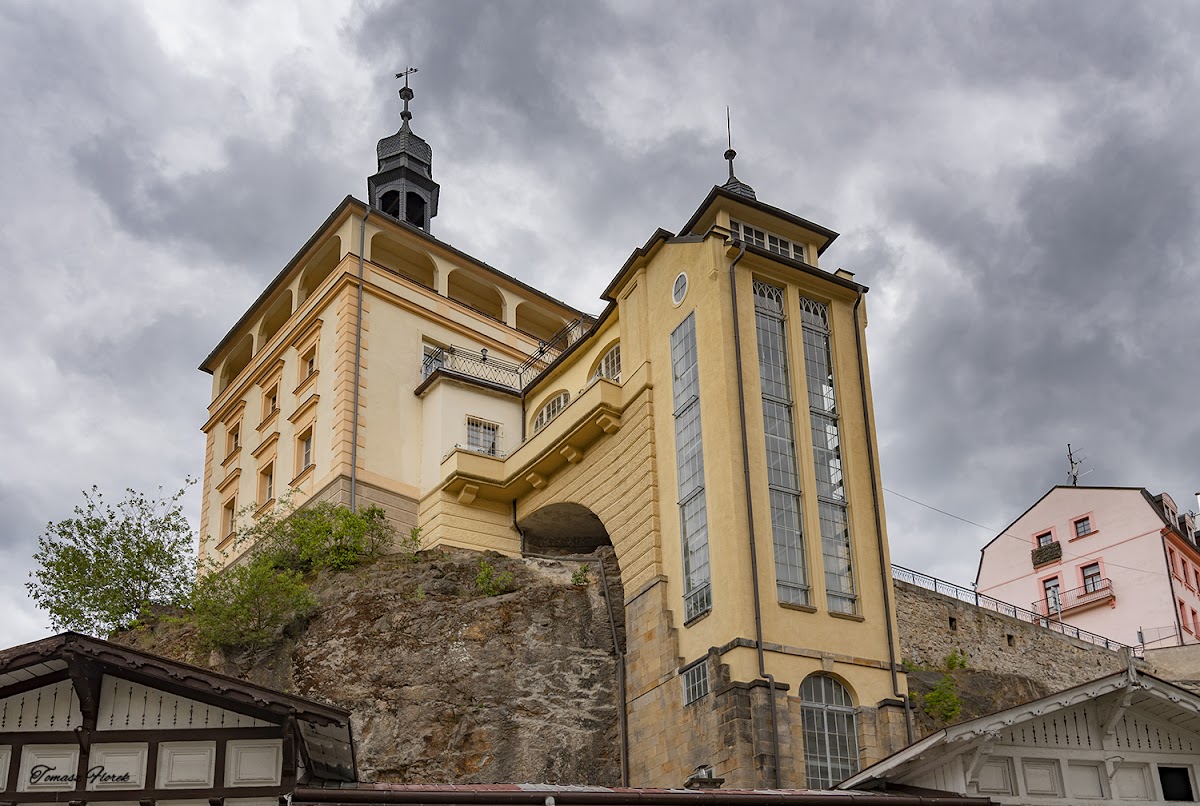
A second town fire in 1759 led to the watchtower’s restoration in 1766. Further alterations during the eighteenth and nineteenth centuries gave the building its present form. An elevator designed by Friedrich Ohmann was added beside the tower in 1911. The latest stated reconstruction took place in 2001, and the building currently accommodates a restaurant, wine bar, and gallery. Zámecká věž has been protected as a cultural monument since 1964.
Remains
Castle Tower and Archaeological Evidence
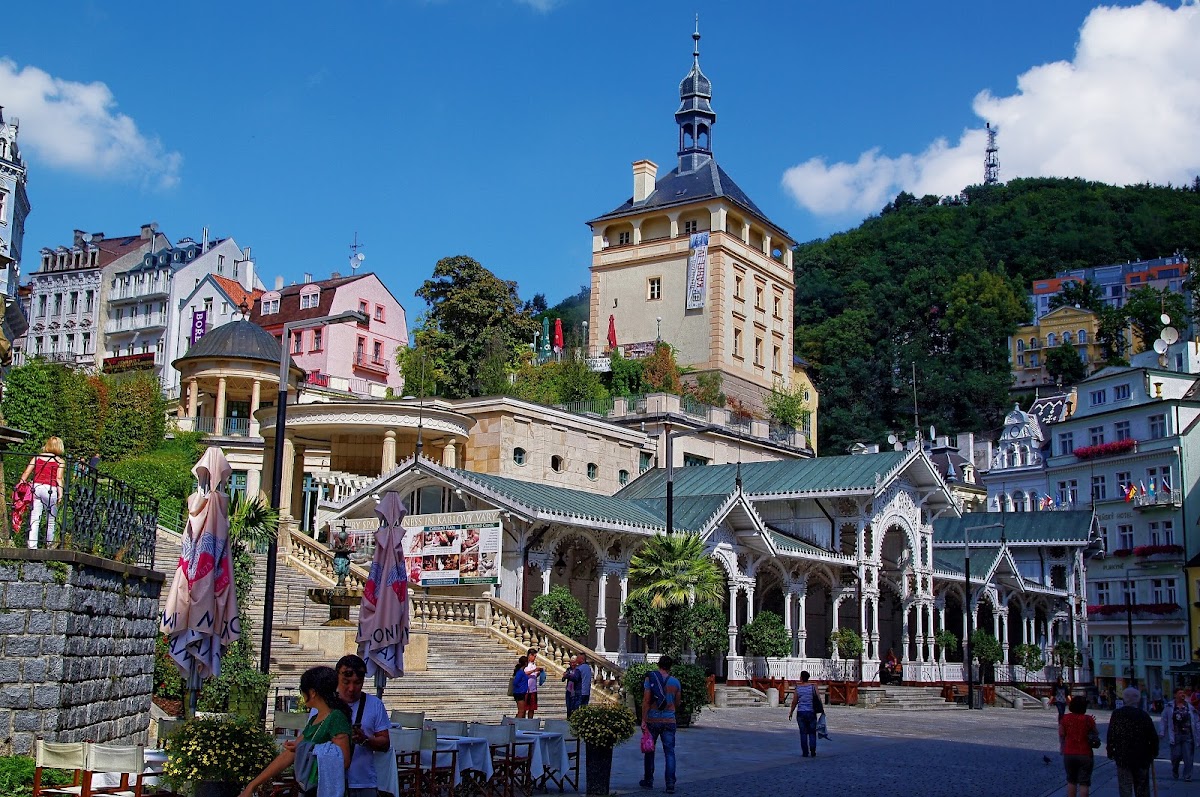
The tower stands on the left bank of the Teplá River, on a rocky spur above the Market Colonnade in Karlovy Vary. Only the heavily rebuilt donjon, the principal fortified tower of a castle, survives from the small castle. A palace once extended to the northwest. Its existence is supported by archaeological investigation, a weak northwestern wall, and a basement with a barrel vault, a continuous curved ceiling, that partly extends beneath the tower.
Baroque Tower Form
The present tower has a simple pyramidal roof, a three-sided arcade gallery on the second floor, and a distinctive Baroque turret above it. These features belong to the building’s later municipal form, which developed after the original castle was destroyed and the watchtower was erected in 1608.
Elevator Addition
The elevator added beside the tower in 1911 was designed by Friedrich Ohmann, an architect associated with historicist and Art Nouveau buildings and architectural additions. Ohmann also designed the Castle Colonnade.