Andělská Hora Castle: A Gothic Hilltop Fortress in Czechia
Site at a Glance
- Rating
- 4.7
- Popularity
- Medium
- Country
- Czechia
- Primary era
- Medieval
- External website
- Open
- Eras represented
- Medieval, Early Modern
- Civilizations
- Holy Roman Empire, Kingdom of Bohemia
- Site type
- Military
- Remains
- Castle
On this page9 sections
History
Andělská Hora Castle is a Gothic hilltop fortress in Czechia, probably erected by the Lords of Riesenburg toward the end of the fourteenth century. Construction predates 1402, when the castle was first mentioned in writing as the property of Boreš of Riesenburg. Together with Bečov Castle, it was intended to protect the Riesenburg estate.
Royal administration and Hussite seizure
In 1406, Boreš’s son transferred the Bečov estate, including Andělská Hora, to Oldřich Zajíc of Hasenburg, probably in exchange for the royal castle of Přimda. Oldřich held the castle until his death in 1414. It then became escheated property, meaning property that reverted to the crown, and passed to the royal chamber, the institution that managed possessions held directly by the Bohemian crown. By 1415, Janek Maleřík, burgrave of Loket, administered it.
The Hussite captain Jakoubek of Vřesovice seized Andělská Hora in 1430. The Hussite movement was a religious and political reform movement in fifteenth-century Bohemia, and its military leaders frequently controlled strategic castles. In the mid-1430s, the castle was pledged to the imperial chancellor Kašpar Šlik, who arranged repairs. After Jakoubek returned it to the royal chamber, Emperor Sigismund granted the Loket region, including Andělská Hora, to Šlik in 1437. Sigismund was both king of Bohemia and Holy Roman Emperor. After Kašpar’s death in 1449, his brother Matyáš took control.
Poděbrady politics and the Plauen claim
For strategic reasons, King George of Poděbrady compelled the Šlik family to surrender the castle in 1461. He granted it as a lifetime pledge, a grant of control lasting for the holder’s life, to Zbyněk Zajíc of Hasenburg. After Zbyněk died in 1463, the king gave Andělská Hora to his son Hynek and enlarged the associated estate with Radošov, Šemnice, and eight other villages. Later that year, Hynek transferred the castle to the royal chamberlain Jan of Štampach, on condition that it remain open to the Poděbrady family.
During the conflict between the king and the Green Mountain League, a political and military alliance opposing George of Poděbrady, Henry II of Plauen captured the castle in 1466 or 1467. Royal forces recovered it in 1469. After Vladislaus II became king of Bohemia in 1471, Henry III of Plauen renewed his family’s claim. Negotiations at Most resulted in the castle’s return in 1482, after Henry had lost Plauen in Saxony and received Bečov and Andělská Hora in Bohemia.
Estate seat and noble ownership
When Henry III sold Bečov in 1496, Andělská Hora became the seat of the Plauen family’s estate. The castle remained with the family until 1565, when it passed to the related Lobkovic family. Mikuláš Hasištejnský of Lobkovice sold it in 1567 to his brother-in-law Jindřich of Fictum. After Jindřich’s death, Kašpar Colonna of Fels acquired the property.
Linhart Colonna of Fels joined the Bohemian Estates’ uprising and was later sentenced to loss of honour and property. In 1622, the imperial councillor Heřman Černín of Chudenice bought Andělská Hora, together with nearby Hartenštejn and Činov, from the royal chamber. He did not live at the castle. After his death, his grandnephew Humprecht Černín of Chudenice inherited the Kysibel lordship, including Andělská Hora, in 1652. The Černíns retained the estate until 1734, when they sold it to the Hartig family. It remained with the Hartigs until 1794, passed through several later owners, and returned to the Černíns in 1868. The property was confiscated from them in 1945.
War, fire, and later protection
Swedish forces captured and plundered Andělská Hora in 1635 during the Thirty Years’ War, the major European conflict fought from 1618 to 1648. The castle was thereafter maintained but no longer regularly inhabited. A major fire in 1718 completed its destruction, and it has remained uninhabitable since that time.
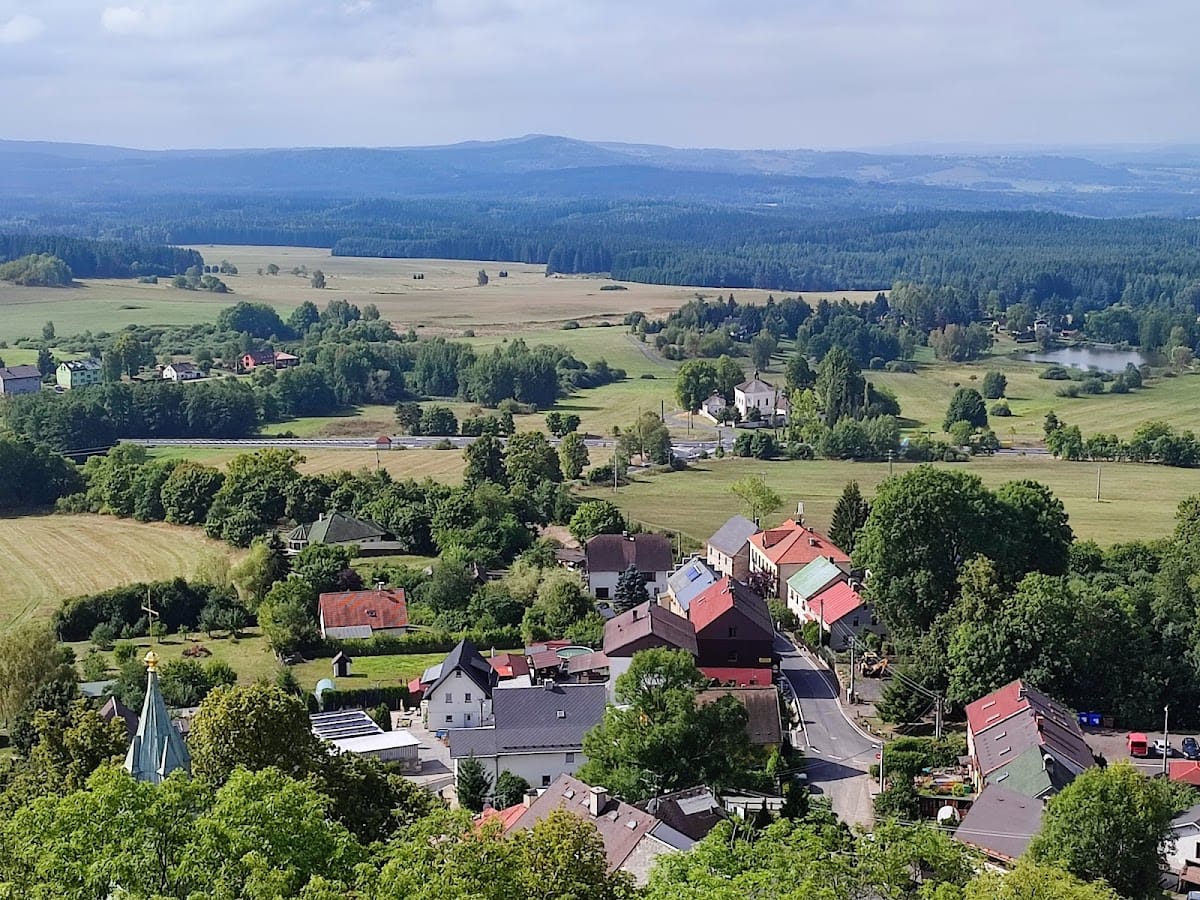
A small town was founded below the castle around 1469 and was historically called Engelstadt. The ruin later attracted visitors from the Karlovy Vary spa, and Johann Wolfgang von Goethe celebrated his thirty-seventh birthday there. Andělská Hora Castle has been protected as a cultural monument since 1964. Plans have been prepared for emergency repairs and conservation, while a Černín restitution claim has left formal ownership unresolved. Pending a court decision, the municipality is described as the owner of the land and the formal owner of the structure.
Remains
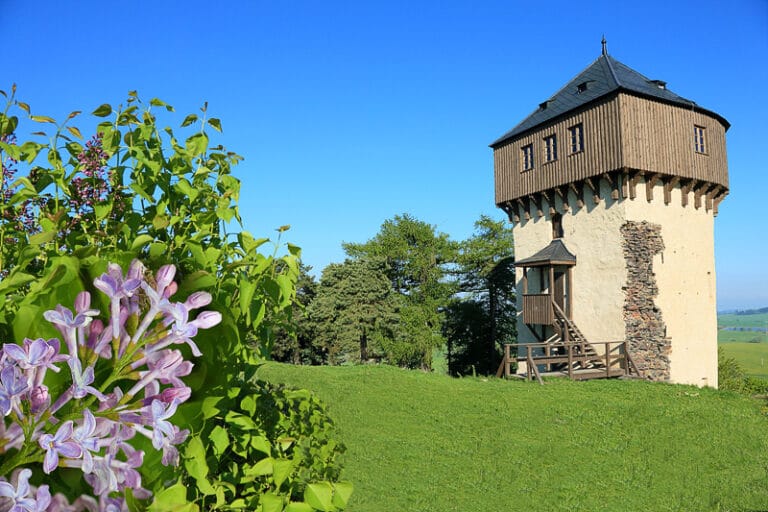
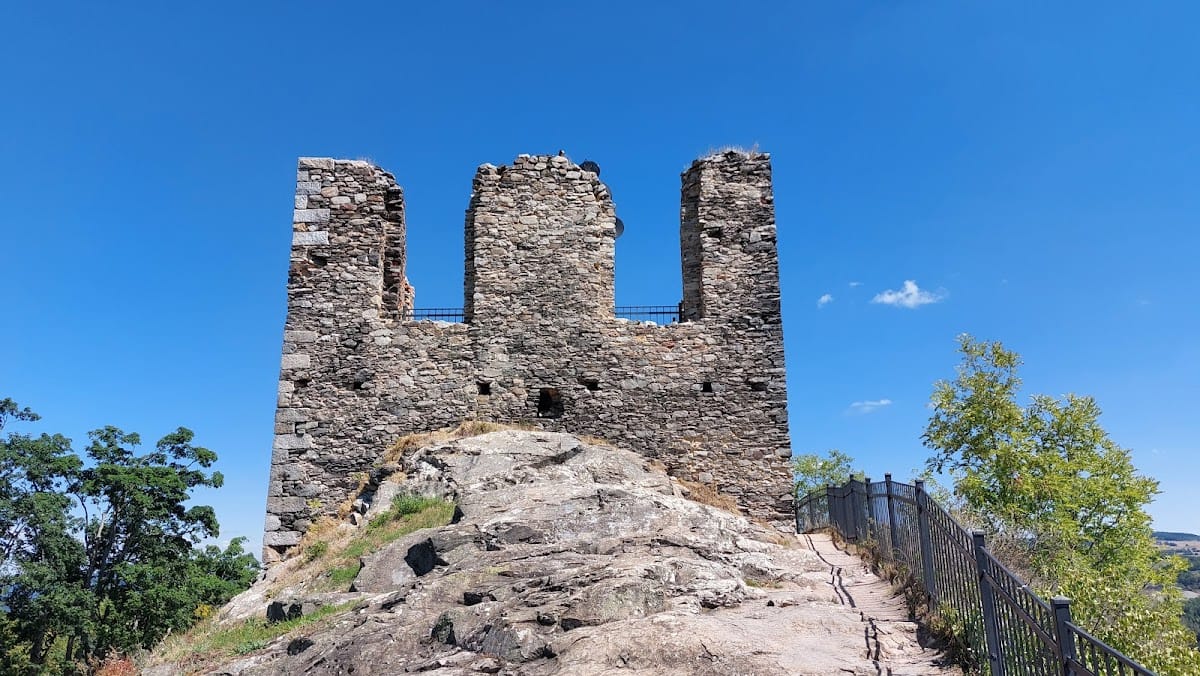
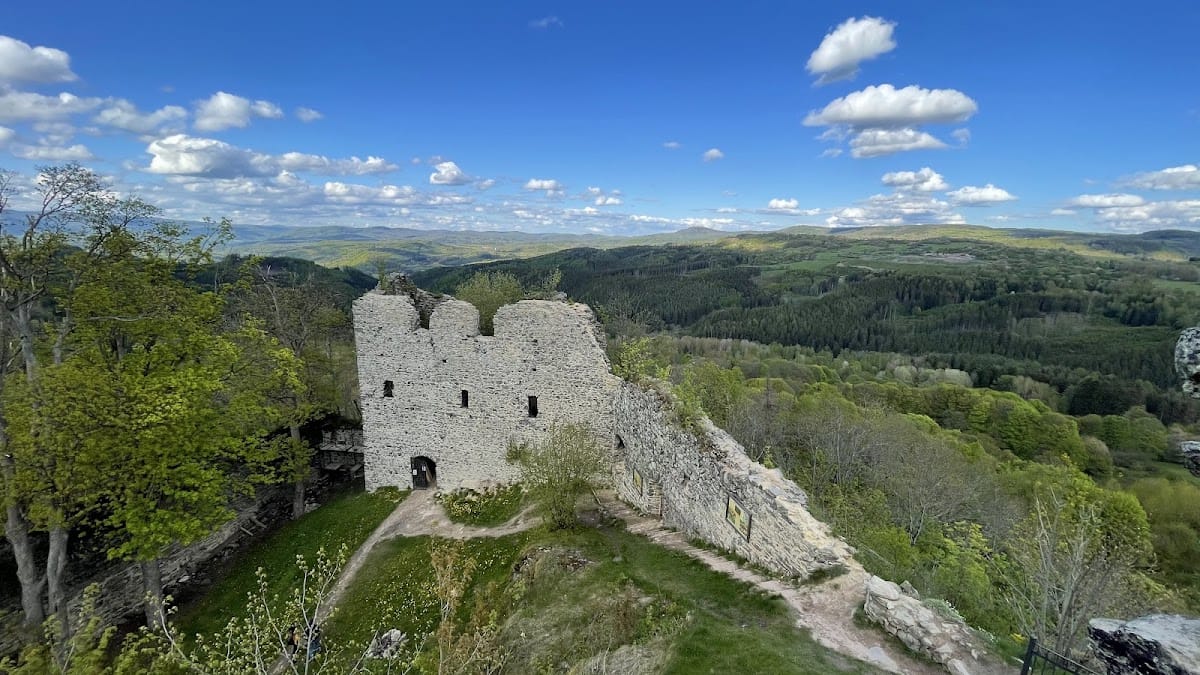
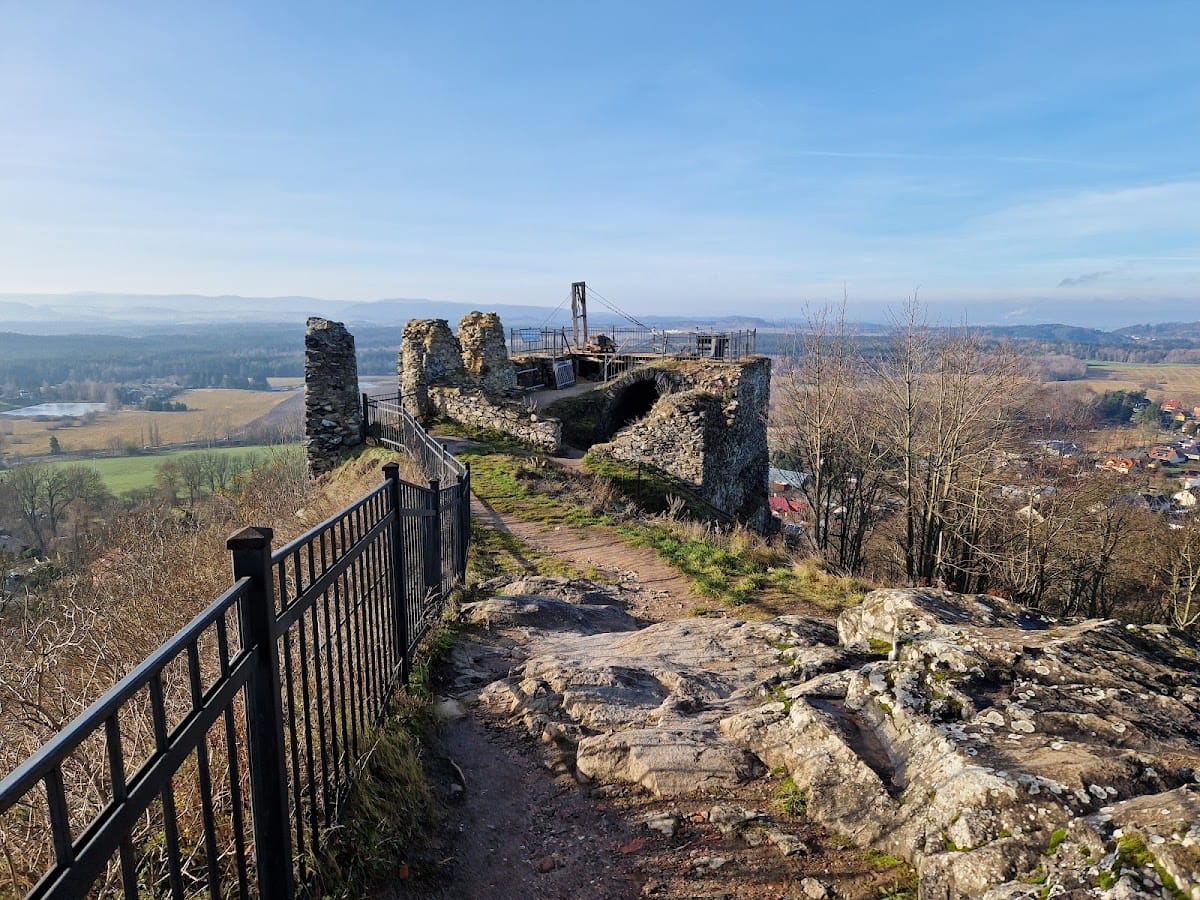
The ruin occupies the highest part of a rocky ridge on the summit of a basalt hill. Its core was an inner, or upper, castle concentrated on the highest point, while additional defenses and an outer bailey extended along the approach. The surviving remains reflect the original Gothic fortress, extensive late-Gothic rebuilding in the 1460s to 1480s, a Renaissance residential addition, and later changes to reduce its defensive capacity.
Upper castle and residential core
The oldest surviving part of the upper castle is a square residential tower standing at the summit of the rock. Another unidentified building occupied the site of the later Renaissance palace. The difficult terrain led to the use of wooden construction in some sections of the fortifications. After the eastern palace was built, a courtyard wall was added below the highest point of the rock and strengthened by a semicircular bastion, a projecting defensive structure. That bastion has since disappeared.
Renaissance palace
Under Henry IV of Plauen, a two-storey Renaissance palace was built in the mid-sixteenth century. Its unusual pentagonal ground plan followed the shape of the terrain, while the upper floor contained cellular vaults, a type of vault divided into small compartment-like sections. The palace formed part of the castle’s later residential development within the older fortified core.
Gates and outer defenses
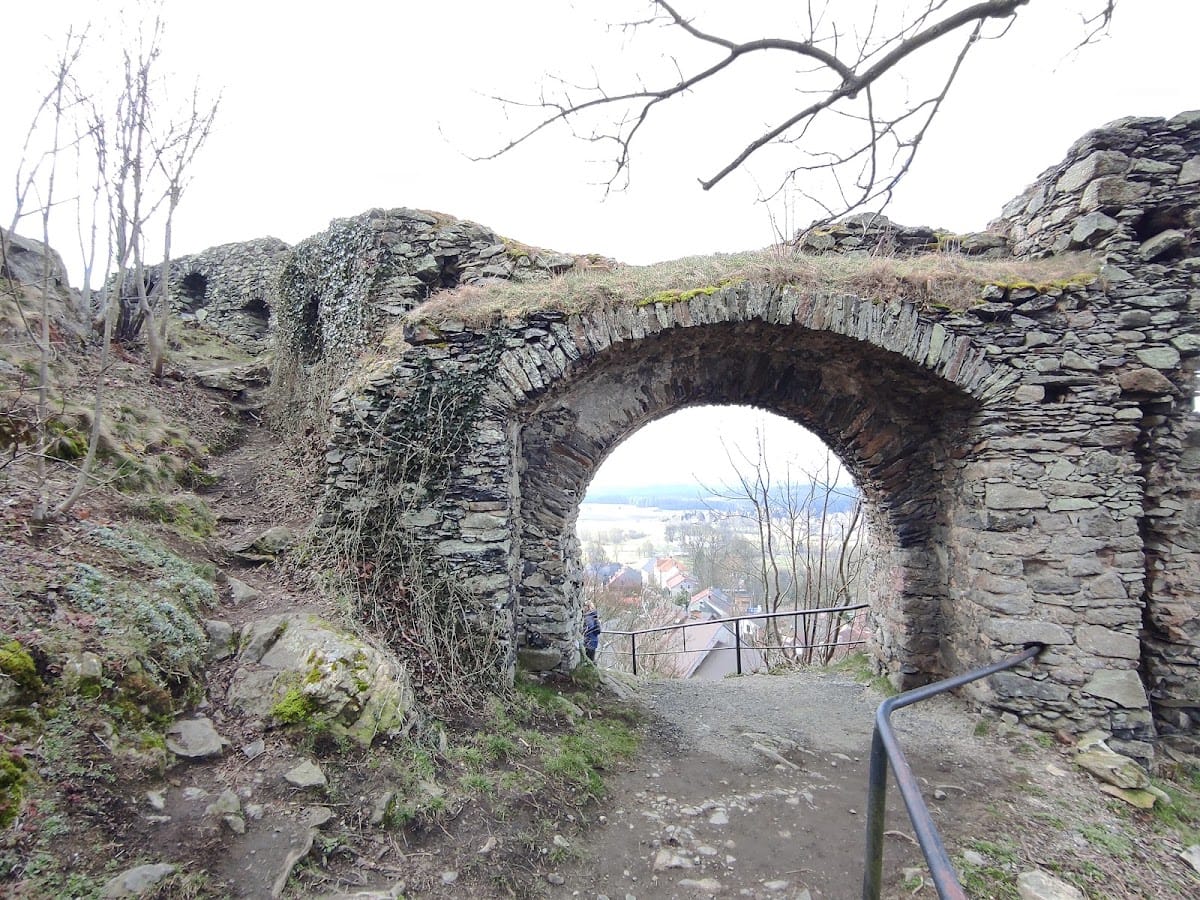
Late-Gothic rebuilding added fortifications and an outer bailey with gates. The courtyard wall continued toward a platform above the first gate, where another building with a basement stood. Defenses along the approach were constructed in two stages. A wall on the front side contained numerous loopholes, narrow openings for firing weapons, and preserved sockets for securing hook guns. A polygonal bastion, a projecting fortification with several straight sides, reinforced this section. Between the first and second gates, the defenses consisted of a wooden wall.
The surviving gate openings belong to alterations made in the mid-seventeenth century. Emperor Ferdinand III ordered these changes to reduce the castle’s defensive capacity, leaving the entrances as physical evidence of a later change in the fortress’s military purpose.