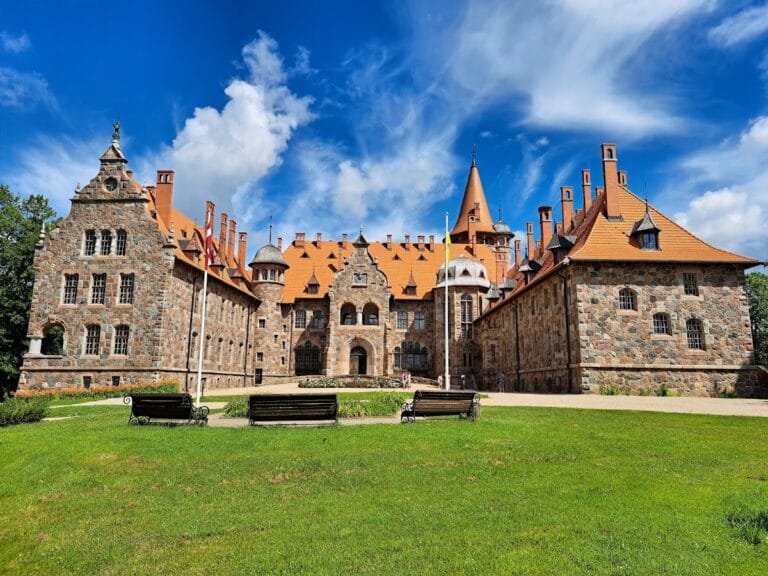
Dzērbene Castle: A Medieval Fortress and Manor in Latvia


Visitor Information
Google Rating: 4.7
Popularity: Low
Google Maps: View on Google Maps
Official Website: www.facebook.com
Country: Latvia
Civilization: Unclassified
Remains: Military

History
Dzērbene Castle is situated near the village of Dzērbene within the municipality of Cēsis in modern-day Latvia. The fortress was established during the Middle Ages by Baltic German builders associated with the Archbishopric of Riga, a powerful ecclesiastical state in the region.
The castle’s origins trace back to around 1357, when Archbishop Fromhold von Vyfhusen is believed to have founded it, although some uncertainty surrounds the precise date and founder. Initially, Dzērbene served as a strategic stronghold and toll station on the southern edge of the Tālava region, lying within contested borderlands of the Livonian Confederation. Its position formed part of the Rauna castle district, close to the neighbouring Autine district. By the mid-14th century, the archbishop used the castle not only for defense but also as an administrative base, evident when in 1361 Fromhold pawned the castle to Barthold von Tiesenhausen, a Riga archbishopric vassal.
The castle’s religious role became more explicit by 1439, as records mention a church at Dzērbene, indicating its importance within ecclesiastical structures. Later, in 1479, amidst conflicts between the Archbishopric and the Livonian Order, the castle was taken without resistance by Master Bernhard von der Borch of the Order. Following their occupation, the Livonian Order is believed to have reinforced and possibly reconstructed parts of the castle. The fortress returned to archbishopric control in 1485, reflecting the shifting powers in Livonia.
During the 16th century, Dzērbene changed ownership several times. In 1530, it belonged to coadjutor Wilhelm von Brandenburg, and by 1555, chancellor Christoph Sturz held it. The castle was surrendered in 1556 to forces of the Livonian Order during the Livonian War, a time marked by intense military campaigning. Shortly after, Russian soldiers attacked and likely occupied the castle during their Livonian campaign in 1559, causing plunder and damage. The decisive destruction came in 1577 when Ivan the Terrible’s army demolished the fortress.
After its ruin, Dzērbene’s lands fell under Polish control. King Stephen Bathory granted the estate to the officer Johann Drobisch in 1580. The 1582 Treaty of Jam Zapolski mentioned the castle as a citadel, showing its continued strategic relevance despite damage. Following the destruction by Ivan IV’s forces, the castle itself was abandoned, with owners relocating to manor houses nearby.
In the 17th century, Swedish King Gustav II Adolf awarded the estate to nobleman Svante Banér. During this period, the castle’s ruins were partially dismantled and their stones used in constructing manor buildings. The estate was divided into “old” and “new” manors, reusing castle walls as part of the new structures. Later, in the 18th century, the Russian Empire granted the property to prominent noble families such as the Waesemskoy and Weissmann von Weissenstein. By 1776, the castle itself was described as no longer standing, and the ruins were reported destroyed by 1786. A small manor house featuring a square tower was erected on the site late in the 18th century.
The manor endured a turbulent modern history, suffering fire damage during the 1905 revolution. It was rebuilt but burned again in the First World War. Restoration efforts culminated in 1929, and later, in 1997, an archaeological survey mapped the castle and manor remains. In 2010, the manor received further restoration work on its facades and interiors. Throughout its history, Dzērbene Castle witnessed the changing tides of control in Livonia, passing through the hands of religious, military, and noble authorities from the Archbishopric of Riga and the Livonian Order to Russia, Poland-Lithuania, and Sweden.
Remains
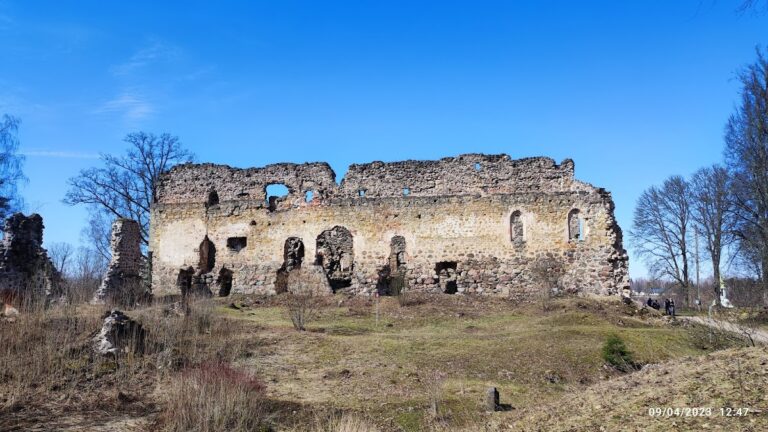
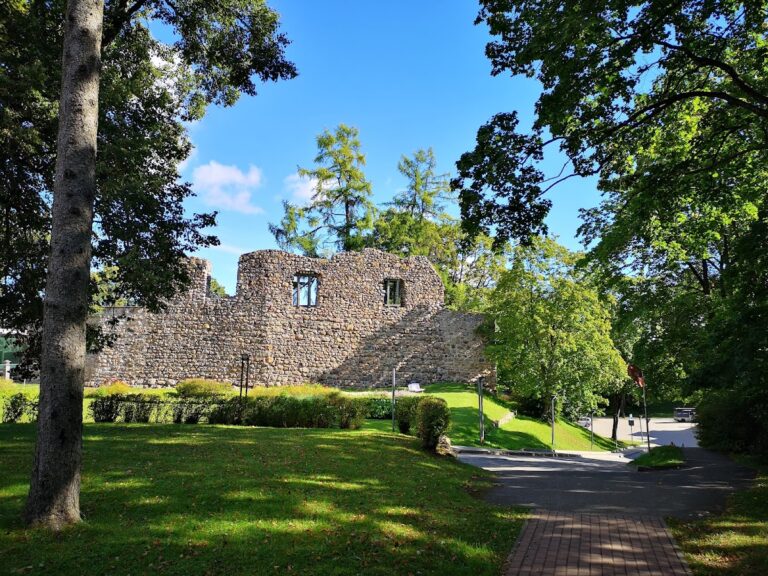
Dzērbene Castle was originally laid out in a strict square plan, approximately 70 by 70 meters, built upon a modest hill. Its design reflects the “lagerkastell” style, a type of medieval military camp castle characterized by a strong, enclosed inner courtyard surrounded by defensive walls. The fortification was bordered on three sides by water-filled moats, serving as essential protective barriers; some of these moats remain visible in the landscape today, half-preserved as part of a park area.
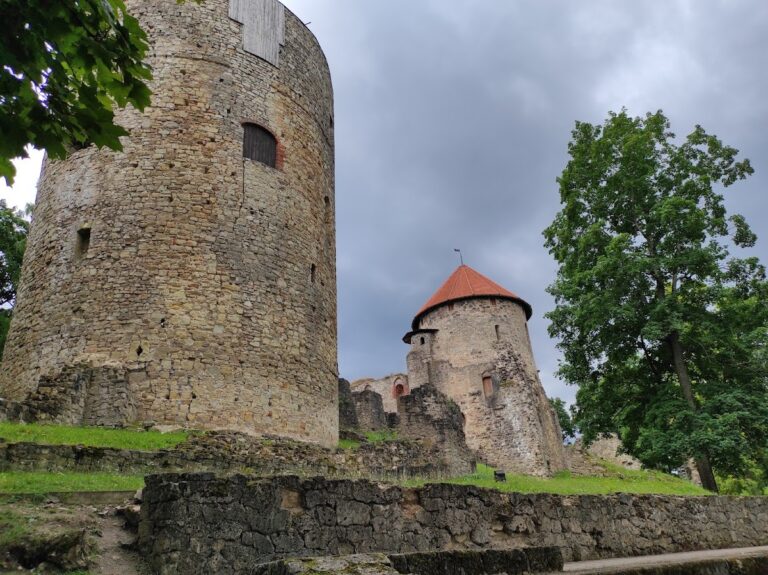
The castle’s corners aligned with the four cardinal points—north, east, south, and west—underscoring its geometric precision. A notable feature was the imposing round tower at the eastern corner, measuring nearly eight meters in diameter. This tower likely dates to the original medieval construction but was reinforced or rebuilt during the 15th century to adapt to early cannon or firearm use, reflecting evolving military technology of the period. The foundational remains of this eastern tower survive near the manor’s east side.
Another round tower was modified or rebuilt and integrated into the northeastern side of the present manor house. Today, this tower, alongside surviving medieval walls, forms part of the manor’s structure, showing the adaptive reuse of castle remains in later estate buildings. The manor itself occupies the northeastern section of the former castle grounds, preserving historic walls within its fabric, although the full extent of these incorporated medieval features has not been detailed in sources.
The castle’s defensive moats remain an important archaeological element, with water-filled ditches still evident. These moats contributed significantly to the original fortification’s defensive strength. In 1997, a comprehensive archaeological survey and mapping effort helped document the layout and condition of the castle and manor site, ensuring preservation insights.
Currently, the manor housed within the former castle precinct serves as a local government facility, community center, music school, and café, illustrating how the historical site continues to function as a focal point for the local population.
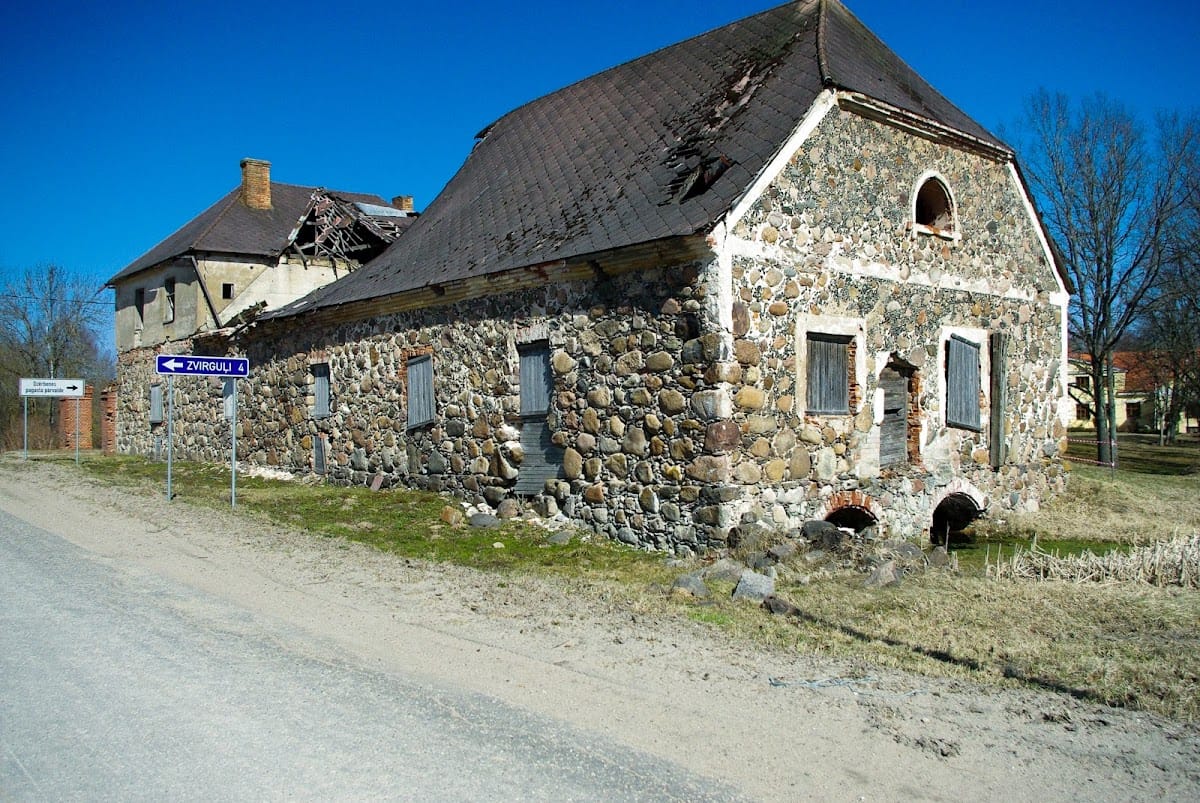
No inscriptions or decorative elements have been recorded from the site, nor have specific artifacts such as tools or ceramics been mentioned in the examined sources. The remains primarily consist of foundational castle structures and the adaptive manor buildings that preserve fragments of the medieval fortress within their walls.
Nearby sites