Clos de la Lombarde, Narbonne: A Roman Suburban District with Late Antique Christian Heritage
Table of Contents

Visitor Information
Google Rating: 4.7
Popularity: Low
Google Maps: View on Google Maps
Official Website: closdelalombarde.com
Country: France
Civilization: Roman
Remains: Burial, City, Domestic, Economic, Religious, Sanitation

Context
The Archaeological Remains of the Clos de la Lombarde are located at 48 Rue Chanzy in Narbonne, a city in southern France near the Mediterranean coast. Positioned within the modern urban environment, the site occupies a low-lying area historically situated in the suburban zone of ancient Narbo Martius. The landscape is characterized by river terraces and alluvial deposits associated with the nearby Aude River, which provided access to freshwater and fertile soils. These natural features influenced settlement patterns and economic activities in antiquity, facilitating both residential development and artisanal production outside the city’s original core.
Clos de la Lombarde was primarily occupied during the Roman period, from the late 1st century BCE through the 3rd century CE, reflecting the expansion of Narbo Martius beyond its initial foundation. The site functioned as a mixed-use district combining domestic quarters with workshops and funerary spaces. After the 3rd century, occupation declined markedly, with no substantial evidence of later reuse. Excavations conducted during urban development in the late 20th century uncovered well-preserved architectural remains, including residential buildings and a paleochristian basilica, offering important insights into suburban life and religious transformations in Roman Narbonne.
History
The archaeological site at Clos de la Lombarde in Narbonne is integrally connected to the foundation and development of Narbo Martius, the first Roman colony established in Gaul in 118 BCE. As the capital of the province of Gallia Narbonensis, Narbo Martius was a significant administrative and commercial center in southern Gaul. The Clos de la Lombarde district represents a suburban extension of the city during the early Imperial period, reflecting residential expansion and artisanal activity. The site’s occupation declined during the 3rd century CE amid regional instability, followed by late antique religious transformations culminating in the construction of a paleochristian basilica. The site was ultimately abandoned by the early 5th century, mirroring broader patterns of urban contraction in post-Roman Gaul.
Roman Foundation and Early Imperial Period (Late 1st century BCE – 2nd century CE)
Following the establishment of Narbo Martius as a Roman colonia in 118 BCE, the city developed as the provincial capital of Gallia Narbonensis, serving as a hub for administration, trade, and military logistics. The Clos de la Lombarde site lay within the suburban zone outside the original city walls, forming part of a residential insula approximately 90 meters long and 23.5 meters wide. Excavations have revealed two prominent domus: the Maison à Portiques, constructed at the end of the 1st century BCE, and the Maison au Grand Triclinium, built in the late 1st century CE and modified into the late 2nd century CE. The Maison à Portiques exhibits architectural features inspired by Pompeian models, including an atrium and a peristyle courtyard opening onto public streets. The Maison au Grand Triclinium is distinguished by a large formal dining room measuring 87 square meters. A votive altar inscribed with the name Marcus Clodius Aestivo was discovered within this house, though the identity of its owner remains unknown.
During this period, a neighborhood bath complex dating from the mid-1st century CE served the local population, providing facilities for hygiene and social interaction. Adjacent to the baths, an artisanal workshop specialized in fish salting and garum production operated until its abandonment in the latter half of the 1st century CE. These features indicate a mixed-use urban quarter combining residential comfort, artisanal manufacturing, and public amenities, integrated into the economic and social fabric of Roman Narbo Martius.
Crisis and Abandonment in the 3rd Century CE
The 3rd century CE was a period of political and military turmoil across the Roman Empire, with Gallia Narbonensis affected by barbarian incursions and internal instability. Between approximately 250 and 260 CE, the residential houses and baths at Clos de la Lombarde were abandoned, likely due to insecurity prompting inhabitants to seek refuge within the fortified city walls of Narbonne. This demographic contraction resulted in the cessation of domestic occupation in the extramural district. However, archaeological evidence indicates that artisanal activity persisted in a limited capacity, as demonstrated by a textile workshop (fullonica) operating in the northern sector of the site during this century. This suggests a partial continuation of economic functions despite the decline in residential use.
Late Antiquity and Christianization (Late 4th – Early 5th century CE)
In the late 4th century CE, the site underwent significant transformation reflecting the Christianization of the Roman Empire and changing urban dynamics. A paleochristian basilica was constructed on the footprint of the former Maison à Portiques, measuring approximately 27.5 by 13.7 meters. The basilica’s architectural style shows affinities with northern Syrian ecclesiastical designs, indicating cultural influences extending beyond the local region. Located outside the city’s defensive walls at this time, the basilica functioned as a suburban funerary church associated with an adjacent cemetery. Its use ceased during the first half of the 5th century, marking the end of substantial occupation at the site.
Within the bath complex, some rooms, including the frigidarium, were repurposed as refuges for pagan cults during the rise of Christianity. An altar dedicated to the goddess Isis was discovered, demonstrating the persistence of traditional religious practices alongside emerging Christian worship. This coexistence reflects the complex religious landscape of late antique Narbonne, where pagan and Christian rites overlapped during a period of transition.
Post-Roman Period and Site Abandonment
After the early 5th century CE, the archaeological record at Clos de la Lombarde shows no evidence of significant reoccupation or reuse. The decline of Roman authority in Gaul and the subsequent Visigothic control likely contributed to the site’s abandonment. No inscriptions or architectural modifications from the late antique or early medieval periods have been identified, indicating that the area remained largely unused or was repurposed in ways that left minimal archaeological trace. The site’s history following the fall of the Western Roman Empire remains poorly documented, consistent with broader patterns of urban contraction in the region.
Modern Rediscovery and Archaeological Investigations (20th – 21st centuries)
Initial evidence of ancient occupation at Clos de la Lombarde emerged in 1910 with the discovery of two sarcophagi during well-digging on private property. Systematic archaeological excavations commenced in the 1970s, revealing a well-preserved insula containing multiple domus, baths, workshops, and the paleochristian basilica. These investigations have provided critical insights into the suburban development of Roman Narbonne and its late antique religious transformations. The site was designated a historic monument in 2007, and ongoing conservation efforts include public access initiatives and restoration projects. Despite challenges such as vandalism and exposure to environmental elements, the remains at Clos de la Lombarde continue to contribute substantially to the understanding of urban and religious history in Gallia Narbonensis.
Daily Life and Importance by Period
Roman Foundation and Early Imperial Period (Late 1st century BCE – 2nd century CE)
During the early Imperial period, the Clos de la Lombarde district functioned as a suburban residential quarter inhabited primarily by Roman settlers and local elites adopting Roman customs. The large domus, including the Maison à Portiques and Maison au Grand Triclinium, likely housed affluent families supported by slaves and freedmen who managed domestic and artisanal tasks. Inscriptions such as the votive altar naming Marcus Clodius Aestivo attest to individual presence, though social status details remain unclear.
Economic life combined domestic comfort with artisanal production. The neighborhood baths provided facilities for hygiene and social interaction, while a nearby workshop specialized in fish salting and garum manufacture, reflecting Narbo Martius’s integration into Mediterranean trade networks. Architectural features included atria, peristyles, and elaborately decorated triclinia with mosaics and frescoes, such as the genius figure in the Maison à Portiques. Gardens with wells and fishponds enhanced domestic environments. Residents accessed goods through local markets, benefiting from Narbo Martius’s position on trade routes connecting the Mediterranean coast and inland Gaul. Religious practices were predominantly pagan, with household shrines and votive offerings, though no dedicated temples have been identified on-site.
Crisis and Abandonment in the 3rd Century CE
The 3rd century brought significant disruption to daily life at Clos de la Lombarde. Insecurity from barbarian incursions and imperial instability led to the abandonment of residential houses and baths, with inhabitants relocating within Narbonne’s fortified core. This demographic shift reduced domestic occupation and altered social organization, with fewer elite households maintaining presence in the extramural zone.
Despite residential decline, economic activity persisted in a limited form. A textile workshop (fullonica) operated in the northern sector, indicating continued artisanal production on a smaller scale. Food consumption and clothing practices likely reflected austerity, though direct evidence is limited. The abandonment of baths curtailed communal social life, and domestic decoration deteriorated as maintenance ceased. Religious life began to diversify, with pagan cults persisting alongside emerging Christian communities, though the latter’s presence at Clos de la Lombarde was not yet prominent.
Late Antiquity and Christianization (Late 4th – Early 5th century CE)
By the late 4th century, Clos de la Lombarde experienced a marked transformation aligned with the Christianization of the Roman Empire. The construction of a paleochristian basilica atop the former Maison à Portiques footprint signaled a shift in religious and social priorities. The basilica served as a suburban funerary church linked to an adjacent cemetery, indicating a community engaged in Christian worship and burial rites outside the city walls. Population density was low, with the basilica and cemetery suggesting a funerary congregation rather than a residential neighborhood.
Evidence from the bath complex reveals that some rooms, including the frigidarium, were repurposed as refuges for pagan cults, exemplified by an altar dedicated to Isis. This coexistence illustrates the complex religious landscape, where traditional polytheistic practices persisted alongside Christian institutions. Economic activities were minimal, with no clear evidence of residential or artisanal production. Civic organization shifted from Roman municipal governance to ecclesiastical leadership, with the basilica serving as a focal point for Christian rites and social gatherings.
Post-Roman Period and Site Abandonment
Following the early 5th century, Clos de la Lombarde ceased to function as a significant habitation or religious center. The decline of Roman authority and the establishment of Visigothic control led to the site’s abandonment, with no archaeological traces of reoccupation or adaptation during the early medieval period. The population likely consolidated within Narbonne’s fortified urban core or dispersed to rural settlements. Economic and social structures dissolved, and the absence of material culture from this era suggests the area remained unused or was converted to agricultural land without permanent buildings. Religious practices transitioned to Visigothic Christianity centered elsewhere, and the site lost its civic relevance.
Remains
Architectural Features
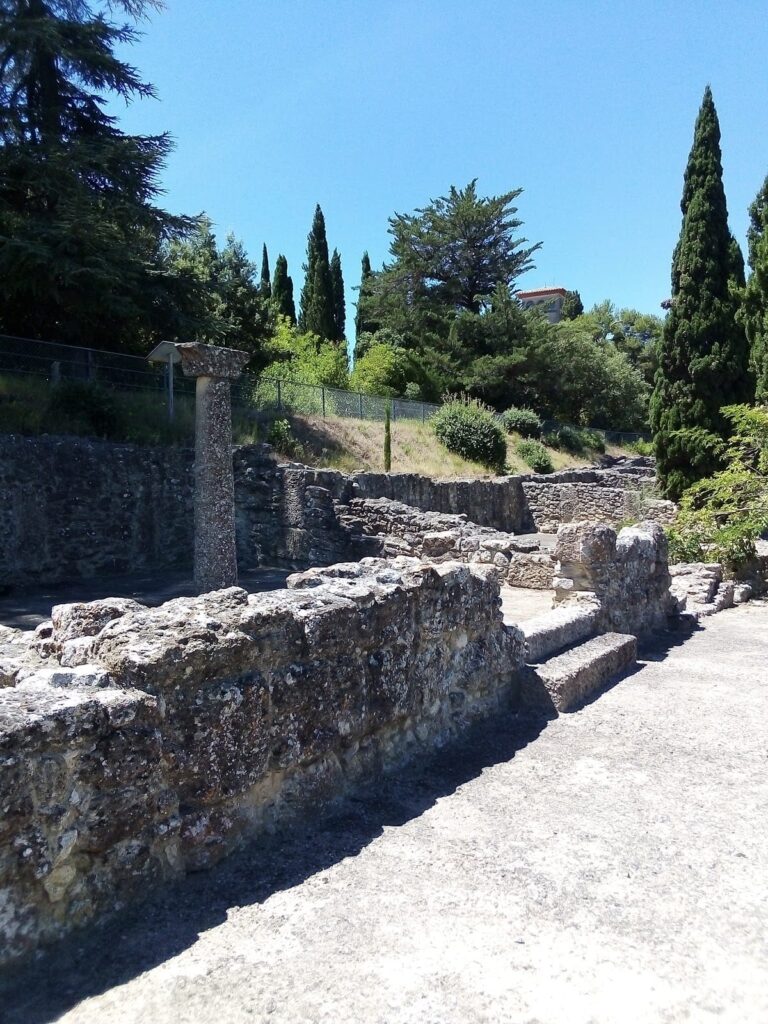
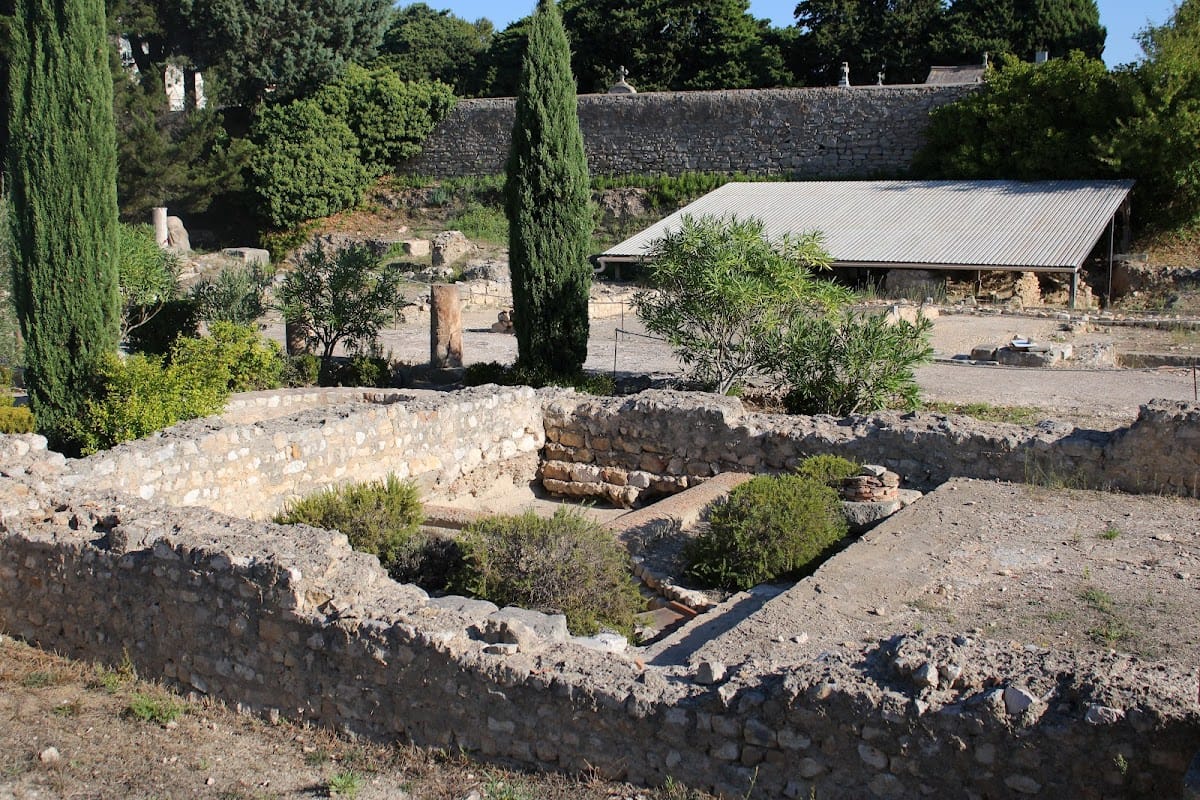
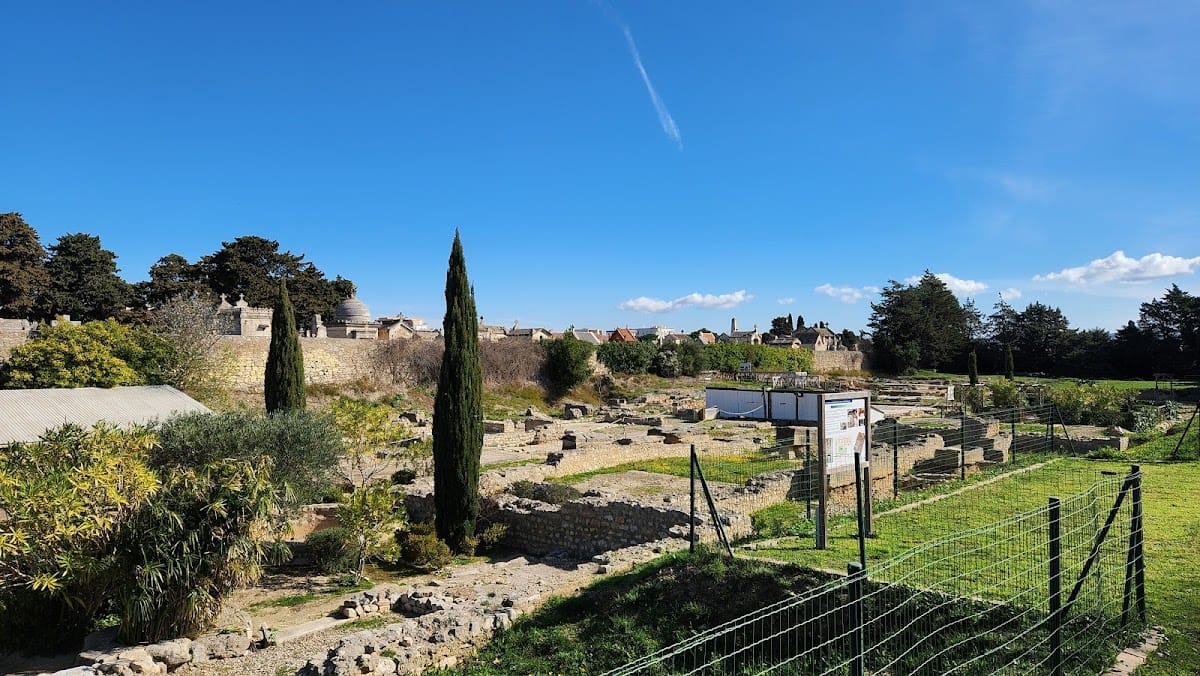
The Clos de la Lombarde site comprises a Roman insula measuring approximately 90 meters in length and 23.5 meters in width. The insula contains multiple residential and artisanal structures arranged along public streets, characteristic of a suburban district of Narbo Martius. Construction techniques include masonry walls and opus spicatum (herringbone brickwork) floors, particularly in garden vivaria. The site’s layout integrates domestic dwellings, workshops, and public amenities such as baths, with occupation phases spanning from the late 1st century BCE through the 3rd century CE. Late antique modifications include the addition of a paleochristian basilica. Many structures survive in varying states of preservation, with some partially buried beneath a modern cemetery.
Key Buildings and Structures
Maison à Portiques
Constructed at the end of the 1st century BCE, the Maison à Portiques covers approximately 975 square meters, measuring 41.5 by 23.5 meters. This large domus features three sides opening onto a public street and includes an atrium and a peristyle courtyard, following architectural models from Pompeii. The house contains a garden with a well and a basin that functioned as a vivarium, with the floor laid in opus spicatum brickwork. Decorative elements uncovered include mosaics and fresco fragments, notably a fresco depicting a genius in the triclinium (formal dining room). The Maison à Portiques was abandoned in the 3rd century CE. At the end of the 4th century CE, a paleochristian basilica was constructed on part of its footprint, which was itself abandoned within the first half of the 5th century.
Maison au Grand Triclinium
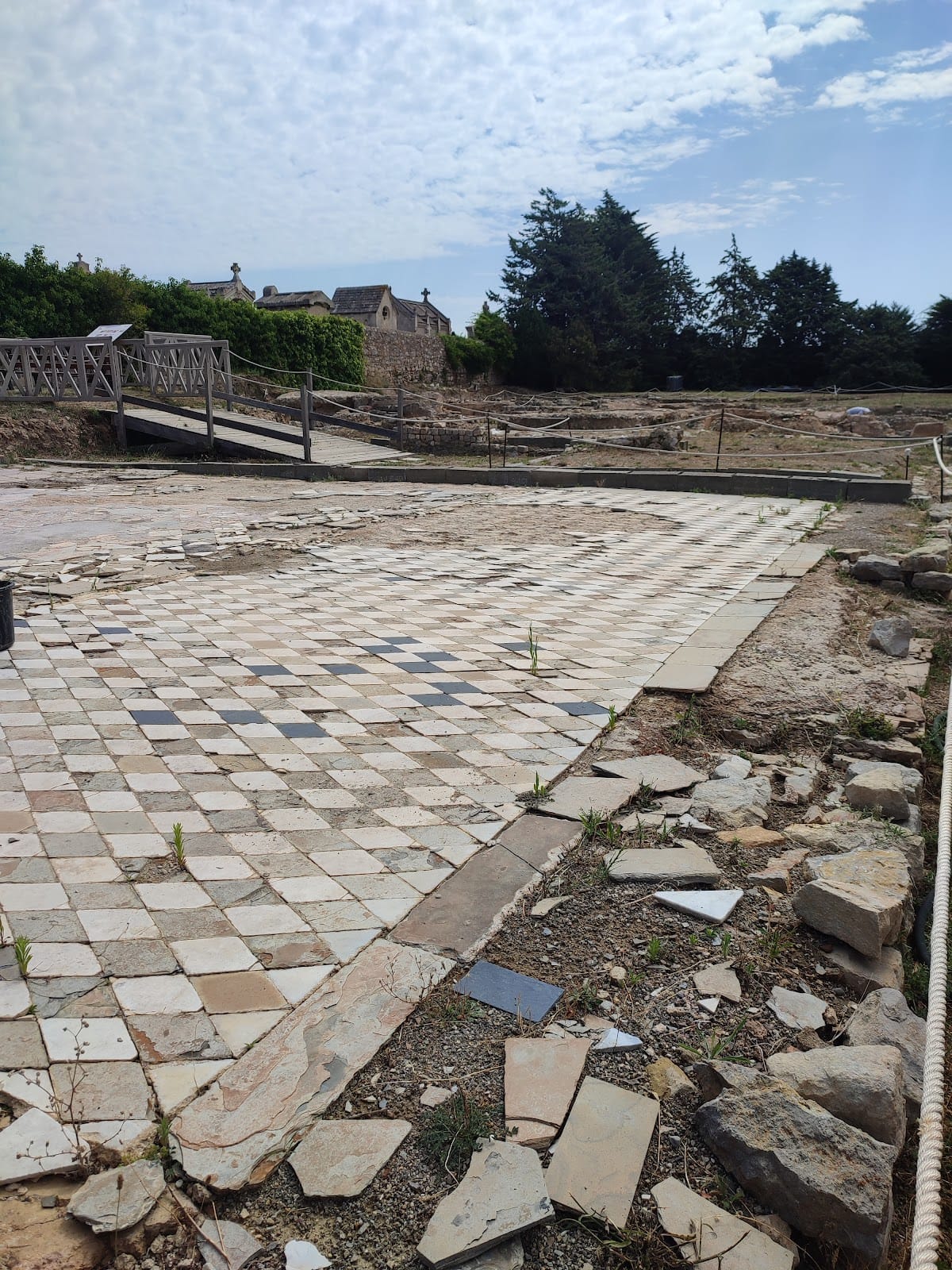
Located southeast and contiguous to the Maison à Portiques, the Maison au Grand Triclinium (also known as Maison III) occupies 705 square meters, measuring 30 by 23.5 meters. Built over an earlier house, its latest architectural elements date to the late 2nd century CE. The house is named for its large triclinium, a formal dining room measuring 87 square meters. A small votive altar inscribed with the name Marcus Clodius Aestivo was found within the walls, though the owner’s identity remains unknown. The house includes a garden and an old vivarium later converted into a room. A statue fragment was discovered in the house’s well. Part of the triclinium’s pavement was restored in 2021 through a crowdfunding initiative. The house was abandoned during the 3rd century CE.
Thermes (Neighborhood Baths)
The neighborhood baths date from the mid-1st century CE and are only partially visible, as much of the structure lies beneath the adjacent cemetery. The complex includes typical bath components such as a frigidarium (cold room). The baths were abandoned in the 3rd century CE. During late antiquity, some rooms, including the frigidarium, were repurposed as refuges for pagan cult practices. Among the cult objects found is an altar dedicated to the goddess Isis, indicating continued religious activity within the bath complex after its original function ceased.
Atelier de Salaison (Salting Workshop)
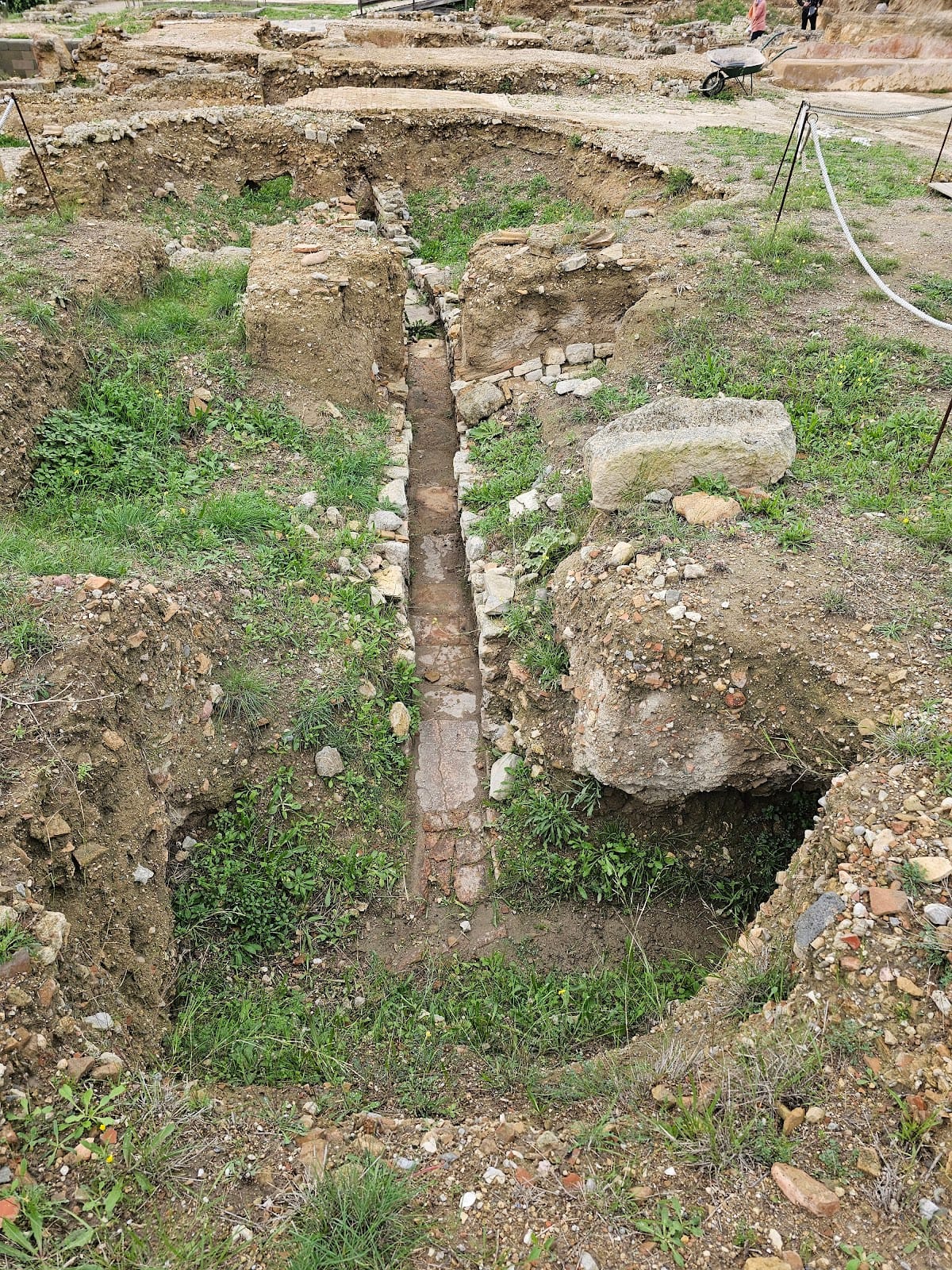
Located south of the baths, this artisanal workshop specialized in fish salting and garum production. It was active during the 1st century CE but was abandoned in the latter half of that century. The workshop’s remains include structural elements associated with processing and storage, though the extent of preservation is limited.
Basilique Paléochrétienne (Paleochristian Basilica)
Constructed at the end of the 4th century CE, the paleochristian basilica measures approximately 27.5 by 13.7 meters. Its architectural style shows influences from northern Syrian ecclesiastical buildings. Situated outside the city walls of Narbonne at the time, the basilica includes an apse and is associated with an adjacent cemetery containing sarcophagi, including the tomb of an adolescent. The basilica served a funerary function and was abandoned during the first half of the 5th century CE.
Other Domus and Workshops
The site contains four additional known houses and an artisan workshop, though many remain only partially excavated. Insula II, located to the west, is largely unexcavated except for Maison II, where a mosaic was discovered but vandalized in 2023. Insula III, to the north and adjacent to the cemetery wall, contains a fullonica (textile workshop) dating to the 3rd century CE. This workshop remained active after neighboring houses were abandoned. Two further domus (Maisons IV and VI) continue along Insula III; Maison IV is noted for its rich decoration. Much of this area is inaccessible due to overlying cemetery grounds.
Archaeological Discoveries
Excavations have yielded a range of artifacts spanning from the late 1st century BCE through late antiquity. Pottery includes amphorae and tableware fragments from domestic and artisanal contexts. Inscriptions are limited but include the votive altar bearing the name Marcus Clodius Aestivo found in the Maison au Grand Triclinium. Coins from various imperial reigns have been recovered, though specific emperors are not detailed in published reports. Tools related to artisanal activities, such as fish salting and textile production, were found in workshops. Domestic objects include lamps and cooking vessels. Religious artifacts comprise altars dedicated to Isis and Christian funerary sarcophagi associated with the basilica and cemetery. Decorative elements such as mosaics and fresco fragments were recovered from several houses, with some conserved in local museums.
Preservation and Current Status
The preservation of the site’s remains varies. The Maison à Portiques and Maison au Grand Triclinium retain substantial structural elements, including walls and floor mosaics, though some areas have suffered from vandalism and exposure to weather. The paleochristian basilica’s foundations and apse remain visible but are fragmentary. The baths are partially buried beneath the cemetery, limiting their visibility. Restoration efforts include the 2021 pavement repair in the Maison au Grand Triclinium’s triclinium, using original materials where possible. The site lacks comprehensive protective roofing, exposing some remains to environmental degradation. Conservation and maintenance are managed by local heritage organizations, with ongoing efforts to stabilize and preserve the ruins. Despite disturbances, the site remains a significant archaeological resource within the urban fabric of Narbonne.
Unexcavated Areas
Several parts of the insula remain unexcavated or only partially studied. Insula II to the west is largely unexplored except for limited work on Maison II. The northern sector, including parts of Insula III, is only partially accessible due to the overlying cemetery. Surface surveys and historic maps suggest additional buried remains may exist beneath modern structures and cemetery grounds. Urban development and conservation policies currently limit extensive excavation in these areas. No detailed geophysical surveys or future excavation plans have been publicly announced, leaving these sectors largely undocumented archaeologically.
Nearby sites