Château de Raeren: A Historic Water Castle in Belgium


Visitor Information
Google Rating: 4.4
Popularity: Low
Google Maps: View on Google Maps
Official Website: www.toepfereimuseum.org
Country: Belgium
Civilization: Unclassified
Remains: Military

History
The Château de Raeren is situated in the municipality of Raeren, Belgium, near the border with Germany. The castle was originally built in the mid-14th century by local builders, forming a water castle typical of the medieval period in this border region.
The earliest record mentioning the castle dates from 1425, describing it as a fortified residence surrounded by two moats and several ponds. At that time, it held the status of a fief under the Mannkammer, the administrative office of Marienstift, a religious foundation in the nearby city of Aachen. The known history of ownership begins with Johann van den Roideren in 1426, whose name also gave rise to the castle’s early name “zen Roideren.” Over the following century, ownership changed hands among various families, passing through the von Nechtersheim, von Kaldenbach, and von Belven families. In 1552, the property came into the possession of Johann von Lomont through marriage.
A significant period of expansion occurred under Philipp von Lomont, a descendant of Johann, starting in 1583. Following a destructive kitchen fire, Philipp undertook large-scale building works that enlarged the residential quarters and added defensive walls, two sizeable utility wings, and corner towers. These additions made use of the local blue limestone, a characteristic building material of the region, reinforcing the castle’s presence and defensive capabilities.
By the late 18th century, the château had fallen into disrepair. Peter Joseph de Nys, who owned the castle from 1757 to 1826, commissioned a remodeling in a romantic style, a popular aesthetic of the time. His and his wife’s coats of arms were placed above the entrance portal, surviving to this day as evidence of this renovation phase.
In 1856, a fire severely damaged the agricultural buildings attached to the castle, destroying all but their foundations. These were rebuilt subsequently, maintaining the continuity of the estate’s agricultural function. The municipality of Raeren acquired the castle in 1960 and established a pottery museum there in 1963, aimed at preserving and exhibiting the renowned regional stoneware tradition.
The castle faced another damaging fire in 1982, leading to careful restoration efforts. Notably, in 1952 it became the first structure in the eastern part of Belgium to receive official protection as a monument, highlighting its historical importance in the region’s cultural heritage.
Remains
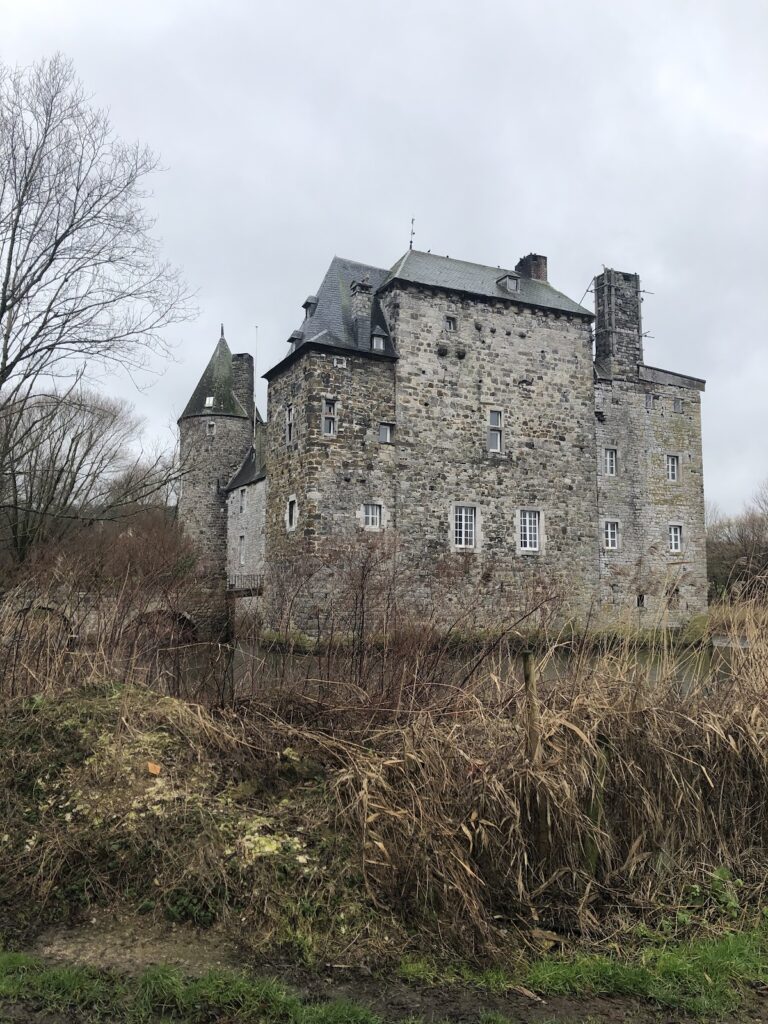
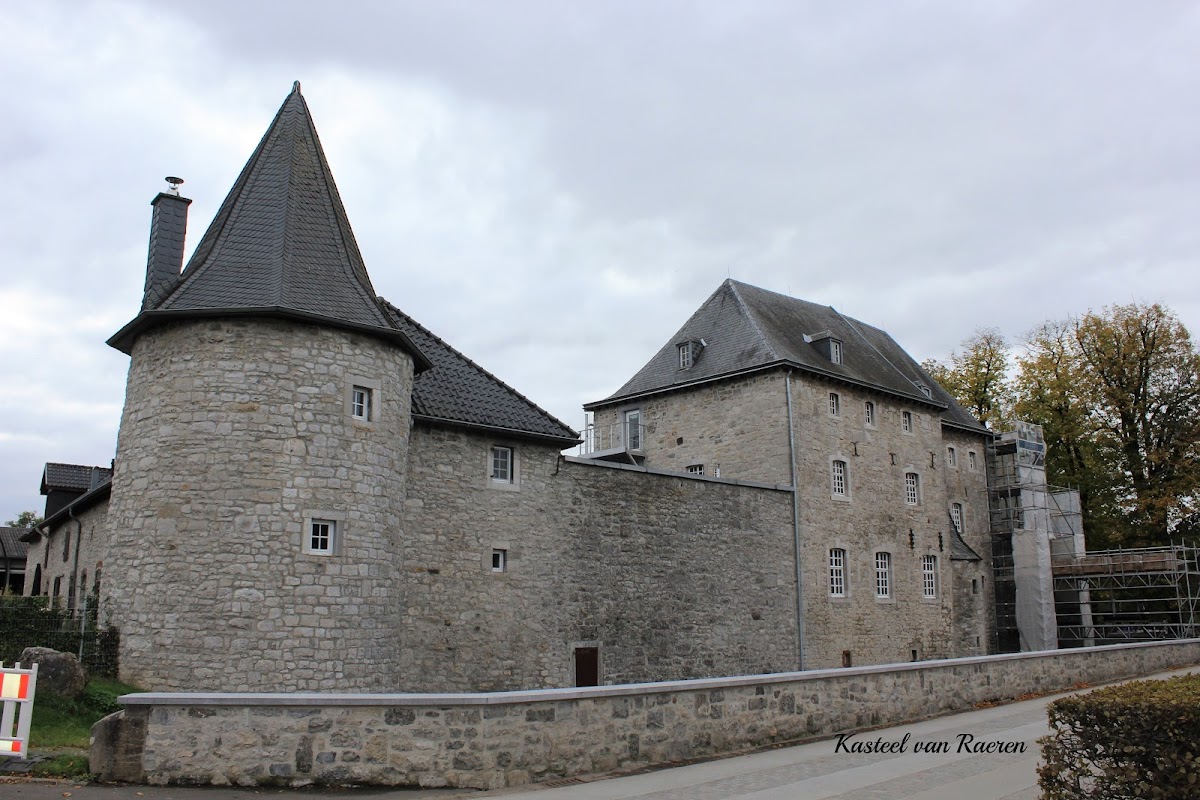
The Château de Raeren stands as a water castle with a rectangular layout formed by buildings arranged around a central courtyard. Its origins lie in a nearly square residential tower constructed in the mid-14th century, characterized by two stories built primarily from the local blue limestone. This regionally typical stone gives the castle its distinctive appearance and speaks to traditional building techniques.
The 16th-century expansions transformed the original tower into a more complex fortified residence. Defensive walls were added, enclosing the courtyard, alongside two large economic wings that served agricultural or practical purposes. Two corner towers were constructed, enhancing the defensive and residential functions of the complex. The use of blue limestone continued throughout these additions, creating a cohesive architectural ensemble.
The castle’s water defenses were notable, with its original setting including two moats and multiple ponds. These water features enhanced protection and reflected the castle’s status as a water castle, designed to use natural elements in its defense system.
Above the entrance portal, the coats of arms of early 19th-century owner Peter Joseph de Nys and his wife remain visible, offering a direct link to the romantic remodeling carried out during his tenure. These heraldic symbols present a tangible connection to the castle’s restorative phase following its decline in the 18th century.
Archaeological investigations conducted in 1968 and 1969 uncovered evidence that before the castle’s construction, around the year 1300, the site was occupied by an iron ore smelting facility. This industrial use predates the castle and indicates the area’s early economic activities prior to the castle’s rise.
The agricultural buildings once annexed to the castle suffered destruction from fire in 1856, with only their foundations surviving. These were carefully rebuilt, preserving the footprint and continuing the functional aspect of the estate within the castle complex.
Today, the château houses a pottery museum alongside the local tourist office. The museum’s collection draws heavily on archaeological finds uncovered in and around the castle grounds. These include pottery from a wide historical span, covering Roman times, the medieval period, the Renaissance, and later historicist movements, illustrating the region’s long-standing tradition of ceramic production connected to Raeren stoneware.
Nearby sites