Burg Rode: A Medieval Frontier and Toll Castle in Germany


Site at a Glance
- Rating
- 4.4
- Popularity
- Low
- Country
- Germany
- Primary era
- Medieval
- External website
- Open
- Eras represented
- Medieval
- Civilizations
- Duchy of Brabant, Holy Roman Empire
- Site type
- Military
- Remains
- Castle
On this page5 sections
History
Burg Rode is a preserved medieval hilltop castle in Herzogenrath, Germany, built before 1104 and situated near the modern Dutch border. It served as both a frontier fortress and a toll castle, controlling movement along important routes and marking territorial and ecclesiastical boundaries.
Early castle and medieval routes
The settlement associated with Burg Rode was first recorded in 1104 in the Annales Rodenses of Rolduc Abbey. The entry describes it as the castle settlement of the counts of Saffenberg, using the name Castrensis Viculis. The site occupied a strategic position beside routes that connected the Rhineland with the Low Countries and northern Gaul.
In Roman times, the Via Belgica, a road linking Cologne with the northern Roman territories of Gaul and the Low Countries, passed near the site at approximately the level of the present town hall. It formed part of a commercial route through Herzogenrath, Heerlen, Maastricht, and Tongeren toward Boulogne-sur-Mer or Amiens. During the early Middle Ages, an older route through Übach-Palenberg was abandoned, redirecting traffic through Herzogenrath. A further medieval route linked Trier, Aachen, Herzogenrath, and Xanten.
Around 1136, the Wurm marked both the boundary between Limburg and the Duchy of Jülich within the Holy Roman Empire, a political order made up of numerous secular and ecclesiastical territories, and a diocesan boundary. The bank beside the castle belonged to the Diocese of Liège, while the parish of Afden in the lower town belonged to the Archdiocese of Cologne.
Limburg, Brabant, and the toll station
In 1136, the marriage of Mathilda von Saffenberg transferred Burg Rode to the Duchy of Limburg as her dowry. Gottfried von Laufenberg, the husband of Adelheidis von Merode, was the first recorded knight associated with the castle, in 1150. In 1229, Harper von Laufenberg, known as Mule, was recorded as castellan, seneschal, and burgrave, or Droste. A castellan administered and defended a castle, while a Droste was a regional administrative and judicial official. Harper Mule von Laufenberg is recorded in the office of Herzogenrath from 1320 to 1342.
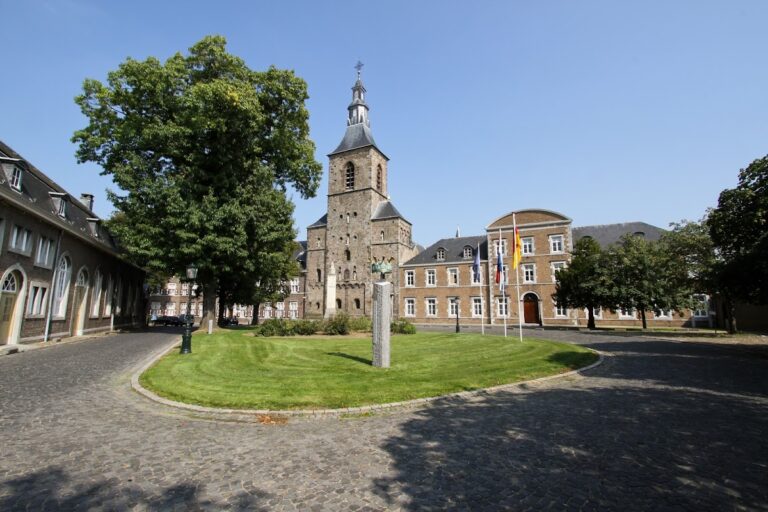
The toll station at Herzogenrath generated more than 3,300 gold florins annually according to Brabant tax lists, over ten times the receipts of the other toll stations in the country. Its revenue reflected the volume and value of movement through the area. Rolduc Abbey, immediately beside Burg Rode, also became the ancestral church of the Dukes of Limburg.
The castle and toll station were drawn into the conflict surrounding the Battle of Worringen in 1288, the decisive engagement in the Limburg Succession War, a struggle over control of the Duchy of Limburg. Brabant forces made several attempts to capture Burg Rode, with the last recorded attempt taking place in 1283. The attempts failed against the strongly developed fortress. The castle’s expansion and its substantial toll income indicate the importance it held for successive rulers.
Later territorial changes
The name Herzogenrath first appeared in 1282 as s’Hertogenrode, meaning “the duke’s clearing.” After the Duchy of Limburg ended and the associated conflict subsided, Burg Rode passed to the Dukes of Brabant. The lords of the castle and the Droste of Herzogenrath also held lordship over Alsdorf Castle.
Burg Rode was temporarily leased to the Duchy of Jülich. From 1544 until the French occupation in 1794, it belonged to the Habsburg Netherlands, the Low Countries territories ruled by the Habsburg dynasty before the French Revolutionary period.
The boundary settlement of the Congress of Vienna in 1815 transferred Burg Rode to Prussia and separated it from Kerkrade and Rolduc Abbey for the first time. The international border now runs between Kerkrade and Herzogenrath. During the twentieth century, the castle was restored in historicizing forms. From 1913 to 1978, it served as Herzogenrath’s town hall.
Remains
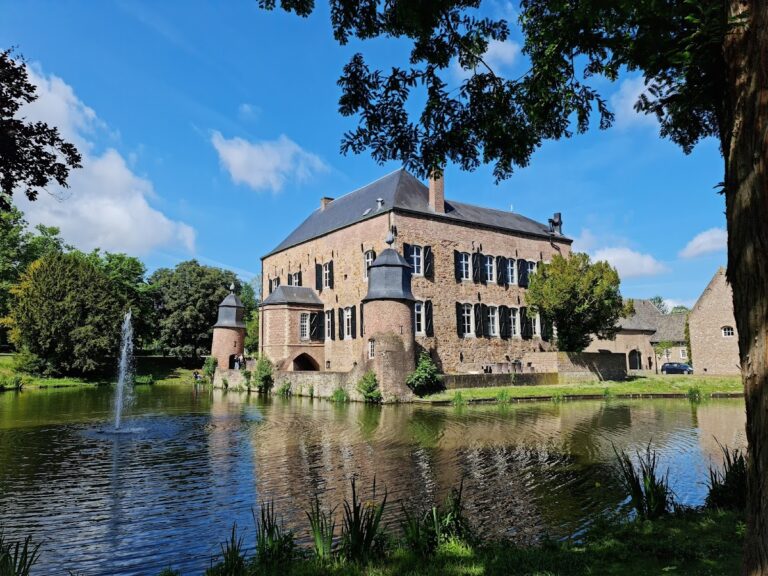
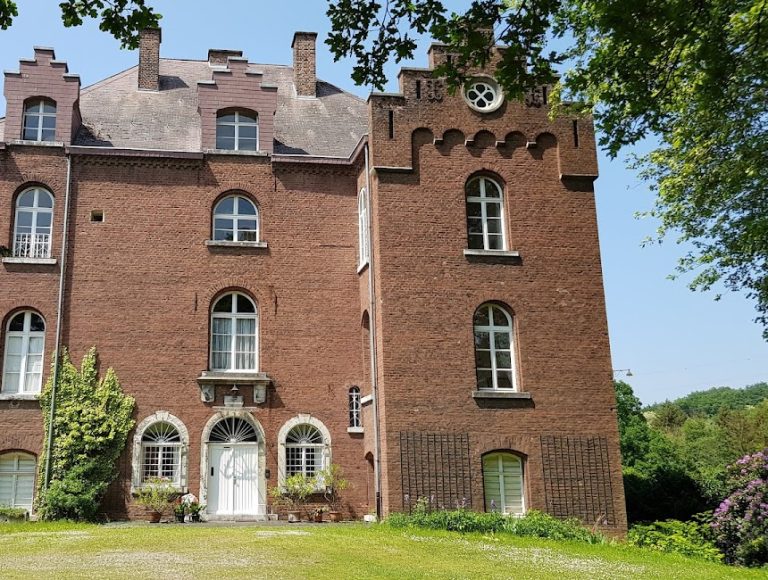
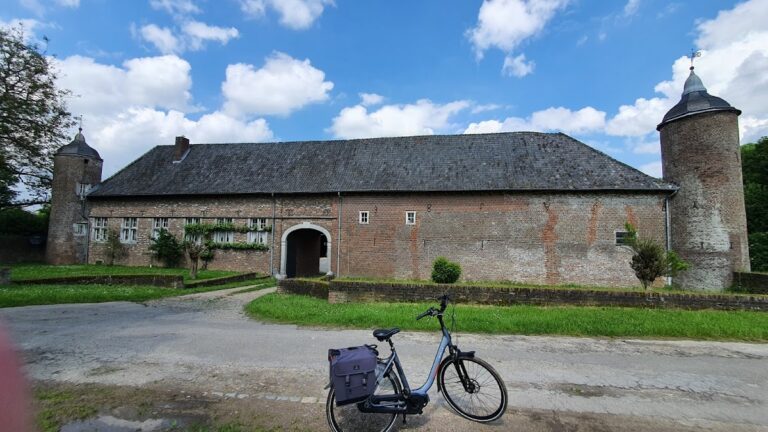
Burg Rode survives as a hilltop castle in the urban center of Herzogenrath, a few hundred meters from the border with Kerkrade in the Netherlands. It is built in brick with bossed ashlar masonry, stonework whose faces are raised or roughly finished to create a projecting surface. Its preserved appearance reflects twentieth-century restoration in historicizing forms. The Wurm runs near the castle and retains the territorial and ecclesiastical boundary role associated with the site’s medieval history. Rolduc Abbey stands immediately beside the castle.