Castle Štafileo: A Venetian-Era Fortress in Kaštel Štafilić, Croatia

Visitor Information
Google Rating: 4.6
Popularity: Low
Google Maps: View on Google Maps
Country: Croatia
Civilization: Unclassified
Remains: Military

History
Castle Štafileo is located in the municipality of Kaštel Štafilić, Croatia, and was established by the Venetian-era Croatian nobility during the early 16th century. The fortress was constructed under the authority of Stjepan Štafileo, a nobleman originally from Crete who settled in the Trogir area in the latter half of the 15th century.
In 1500, Stjepan Štafileo obtained official permission from the prince of Trogir, Aleksandar Viaro, to enclose the land and found a village. This settlement, populated by refugees fleeing the territory of Bijaći, was protected by fortified walls and defensive towers built on three sides, alongside a moat locally known as Foša. The castle itself was completed in 1508 on a group of rocky islets, serving as a defensive stronghold aimed at shielding local inhabitants from Ottoman raids. Upon Stjepan’s death in 1519, the castle and estate passed to his sons, including Petar, who lost his life defending the fortress against Turkish incursions, and Ivan Štafilić, who became a bishop and influential diplomat connected with the Vatican.
Ivan Štafilić distinguished himself in European religious and political circles, acting as a papal legate and engaging in notable diplomatic missions such as managing King Henry VIII’s divorce and receiving baptism by King Francis I of France. He also contributed to the local spiritual life by donating a painting of the Miraculous Virgin Mary, a gift from Polish monarch Sigismund III Vasa, to the castle’s church. In 1693, another fortification was erected on the location of the village’s northwestern defensive tower by Ivan Ferro, as noted on a surviving stone inscription.
While originally named after the founding Štafileo family, the castle later became known as Castle Rotondo, reflecting the long-term residence of the Rotondo family who inhabited it for over four centuries. The castle remains recognized today as a protected cultural monument under official designation.
Remains
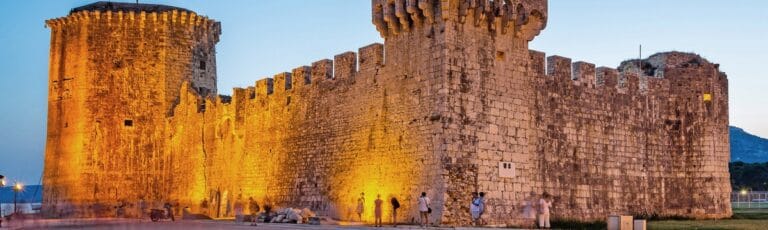
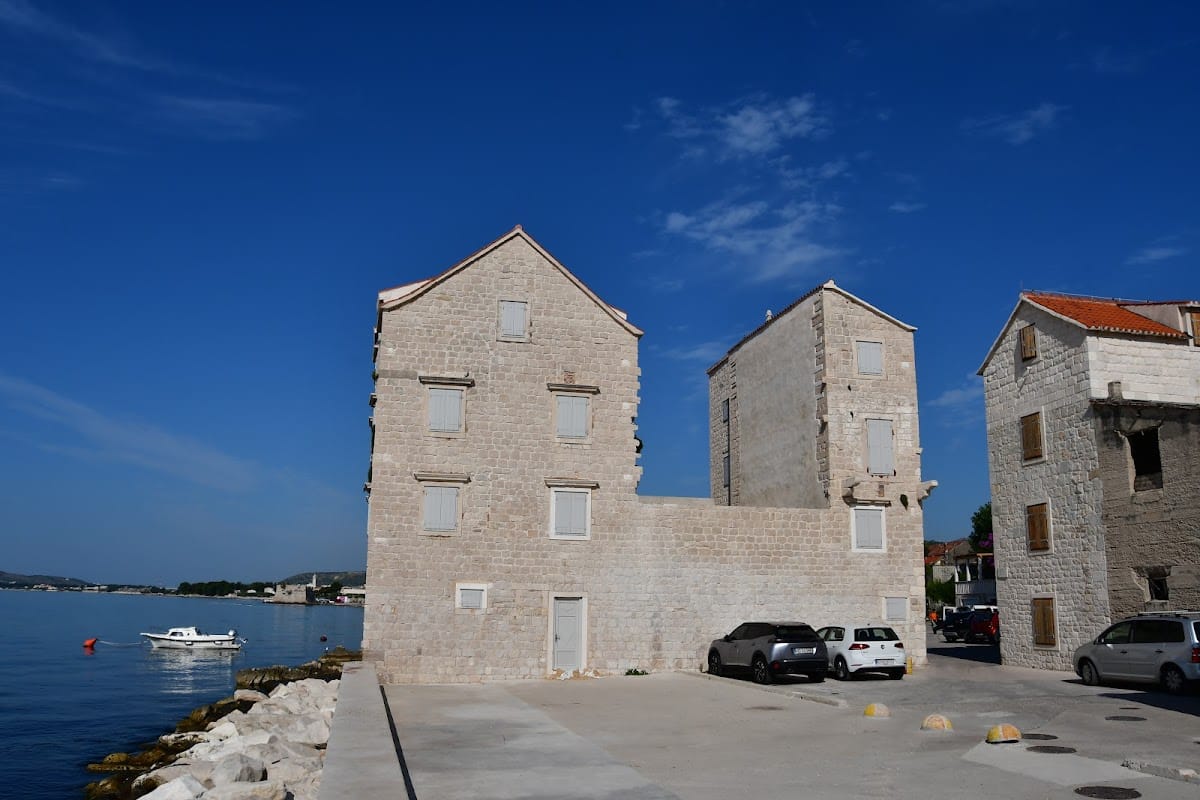
Castle Štafileo presents a rectangular fortress layout, featuring a southern residential wing with living quarters and a northern courtyard enclosed by defensive walls which at one time were topped with battlements. A prominent tall rectangular tower stands aligned with the northern wall, guarding the castle’s entrance that was originally accessed via a movable bridge, underscoring its defensive design against external threats.
The structure occupies roughly 1,127 square meters and rises with a ground floor plus three additional stories above. Excavations conducted in the courtyard and ground floor have revealed stone components associated with olive oil production, indicating that the castle’s inhabitants engaged in local agrarian economic activities. Beneath the modern surface, an original cobblestone floor was uncovered about half a meter deep, preserving part of the site’s authentic historical fabric.
Remnants of a Baroque-style balcony were found on the eastern facade’s northern section, suggesting architectural modifications or embellishments from later periods. The southern wing of the castle contains a well-preserved water gate, which historically would have allowed controlled access to the sea or water transport, blending utility with defense.
A distinctive feature of the castle is the engraved family crest of the Štafileo line, depicting a bunch of grapes. This emblem not only identifies the original owners but also reflects their association with viticulture and winemaking traditions. The same grape motif appears on a fortified Renaissance house nearby, indicating a broader family presence and investment in local architecture and agriculture.
Positioned on a sea-facing cliff in the heart of present-day Kaštel Štafilić, the castle watches over the village that occupies land reclaimed from the sea between an ancient Roman road and the fortress itself, tying this historical site closely to both maritime and terrestrial routes of the past.
Nearby sites