Diocletian Aqueduct in Split: Roman Water Supply to the Imperial Palace


Site at a Glance
- Rating
- 4.5
- Popularity
- Low
- Country
- Croatia
- Primary era
- Classical
- Eras represented
- Classical, Modern
- Civilizations
- Habsburg, Roman
- Site type
- Infrastructure
- Remains
- Aqueduct
On this page10 sections
History
The Diocletian Aqueduct in Croatia is a Roman water-supply system built around AD 300 during the reign of Emperor Diocletian, at approximately the same time as his palace at Spalatum, the Roman name for present-day Split. It carried large quantities of water from the Jadro River to the palace and probably to nearby settlements, forming part of the infrastructure of the late Roman period.
Roman construction and imperial Spalatum
Diocletian was born at Salona, an ancient Roman city near modern Solin. After abdicating as emperor in AD 305, he retired to the palace at Spalatum. A separate aqueduct drew water from the same source for Salona, while the Diocletian Aqueduct supplied the imperial residence and its surrounding community. Its gravity-flow design conveyed water downhill through a carefully graded channel, relying on elevation and slope rather than mechanical pumping.
Damage, reconstruction, and changing use
Sixth-century Gothic invasions damaged the aqueduct, after which it remained unusable for about thirteen centuries. Reconstruction took place during nineteenth-century Austrian and Austro-Hungarian rule. The largest campaign was carried out from 1877 to 1880 under Split mayor Antonio Bajamonti. Some sections returned to operation, although the work did not reproduce the Roman structure in full.
The aqueduct ceased to serve as the city’s water infrastructure in 1932, when the Kopilica pumping station and new supply pipes became operational. Water continued to pass through the old channel only as surplus. Following a typhus epidemic in 1948, its water was prohibited for drinking, and the aqueduct was completely interrupted in 1979.
Preservation and heritage status
Later reconstruction has focused on preserving the Roman aqueduct as a historical monument rather than returning it to service. The final section rebuilt, in the Bilice neighborhood, was completed in 1999 after some nineteenth-century sections had been dismantled, and restoration continues. The historic center of Split, including Diocletian’s Palace, has been a UNESCO World Heritage Site since 1979. A 2015 proposal to extend that listing to Salona and the aqueduct remained on Croatia’s tentative list in early 2024. In Croatia, the aqueduct is protected as an immovable cultural property and archaeological site under designation Z-6026. It is regarded as the best-preserved archaeological monument of its type in Dalmatia and one of the best-preserved late-antique water-supply systems in Croatia.
Remains
The aqueduct survives as a gravity-flow channel extending about 9 kilometers from the Jadro River near Solin to Diocletian’s Palace in Split. Across a height difference of roughly 33 meters, its route uses open cuts, tunnels, elevated arcades, and sections buried in or laid directly on natural rock. About 7.1 kilometers were above ground, 1.7 kilometers passed through tunnels, and 0.6 kilometers crossed bridges. The channel averaged approximately 0.7 by 1.6 meters, although its cross-section varied along the route. Its late-antique capacity was approximately 715 liters per second, or about 61,000 cubic meters per day.
Channel route and surviving tunnel
The channel’s gradient changed according to the terrain. It measured about 0.65 to 0.78 percent near the beginning, 2.38 percent at Mostine, 2.25 percent in the Ravne Njive tunnel, approximately 0.88 to 0.90 percent at Kopilica, and 1.18 percent near the terminal water reservoir in the city. A tunnel section survives in the basement of the Atrium Hotel, with access from Put Brodarice behind the hotel. Downstream, the route has been physically interrupted beyond the present-day intersection of Domovinskog rata and Put Stinica.
Elevated sections and bridges
Dujmovača elevated section
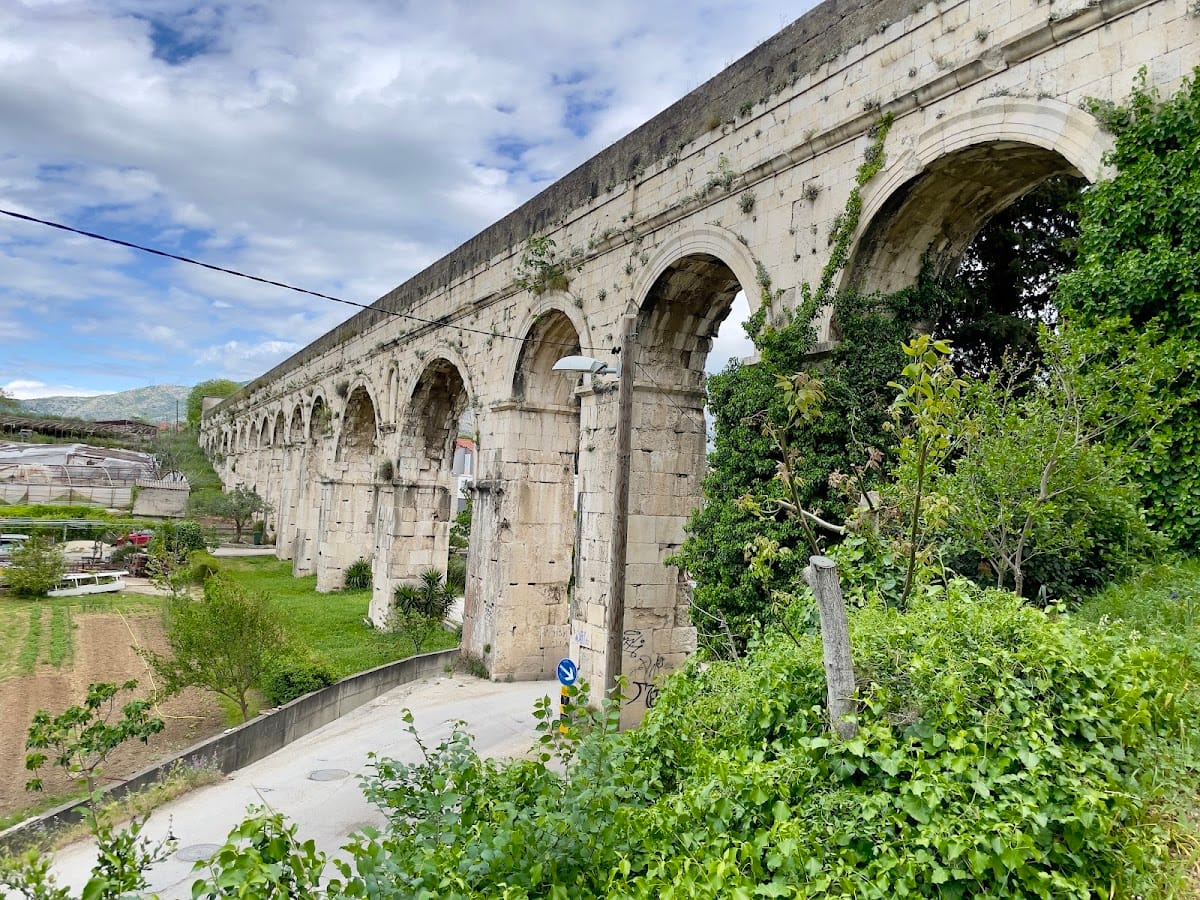
The most prominent surviving elevated section lies near Dujmovača in Solin. It extends for about 180 meters and rises to 16.5 meters. This section is currently undergoing restoration and remains one of the clearest surviving examples of the aqueduct’s elevated construction.
Mostine bridge
The Mostine aqueduct bridge in Bilice reaches a maximum height of 15 meters and extends for 234 meters. Its spans are approximately 2.4 meters wide. Other identified bridge sections include Karabaš, which is 156 meters long, Bilice at 69 meters, and Smokovik at 114 meters.
Roman and nineteenth-century construction
The nineteenth-century reconstruction retained much of the Roman route but simplified the elevated portions by reducing the number of arches. Where the channel ran at ground level or underground, original vaulted masonry was replaced with simpler flat stone slabs. The surviving fabric therefore combines the ancient water system with later alterations that enabled limited reuse before the aqueduct became a preserved archaeological monument.