Castle Sween: An Early Scottish Stone Castle in Argyll



Visitor Information
Google Rating: 4.6
Popularity: Low
Official Website: www.historicenvironment.scot
Country: United Kingdom
Civilization: Unclassified
Site type: Military
Remains: Castle

History
Castle Sween is situated on the eastern shore of Loch Sween within the municipality of Lochgilphead, Scotland. It was constructed by the Gaelic clan of the same name, the MacSweens, who descend from Suibhne (Sween), an Irish nobleman linked to royal lineages in Ulster and Ireland.
The castle’s origins trace back to the late 11th or late 12th century, making it one of Scotland’s earliest stone castles. It was built by Suibhne, the grandson of Hugh the Splendid, who died in 1047. The MacSween clan, his descendants, gained control over Knapdale and neighboring territories, with their influence reaching north to Loch Awe and south to Skipness Castle throughout the 12th and 13th centuries.
By the latter half of the 13th century, control over the lands surrounding Castle Sween shifted to the Stewart or Menteith family. John Menteith appears as the holder of the castle by 1310. That year, Edward II of England granted John MacSween and his brothers their ancestral lands on the condition they reclaim Castle Sween from John Menteith. This episode possibly inspired the Gaelic poem “Dál chabhlaigh ar Chaistéal Suibhne,” which may celebrate a MacSween campaign to retake the stronghold.
Following John Menteith’s death in 1323, the lordship of Arran and Knapdale remained with his heirs. In 1376, Robert II of Scotland granted half of Knapdale, including Castle Sween, to John MacDonald I, Lord of the Isles and Robert’s son-in-law. During the MacDonald tenure, lasting from the 14th into the late 15th century, management of the castle was entrusted successively to clans such as the MacNeils and later the MacMillans. Notable figures from this period include Hector Torquil MacNeill in 1472, and Alexander MacMillan, who is credited with constructing a tower at the castle and commemorated by a cross originally located nearby.
In 1490, King James IV of Scotland transferred ownership of Castle Sween to Colin Campbell, the 1st Earl of Argyll. The castle remained in Campbell hands for over a century and a half. Its use came to an abrupt end in 1647 when Alasdair MacColla, leader of forces allied with the Irish Confederates, attacked and set the castle ablaze during the Wars of the Three Kingdoms. Since that time, Castle Sween has stood in ruin.
The site passed into care of the Historic Building and Monuments Directorate in 1933 and is now protected by Historic Environment Scotland. Archaeological excavations conducted in the 1980s and 1990s have informed understanding of the castle’s history and evolution. A recent report from 2018 has raised concerns about the castle’s vulnerability to ongoing coastal erosion linked to climate change.
Remains
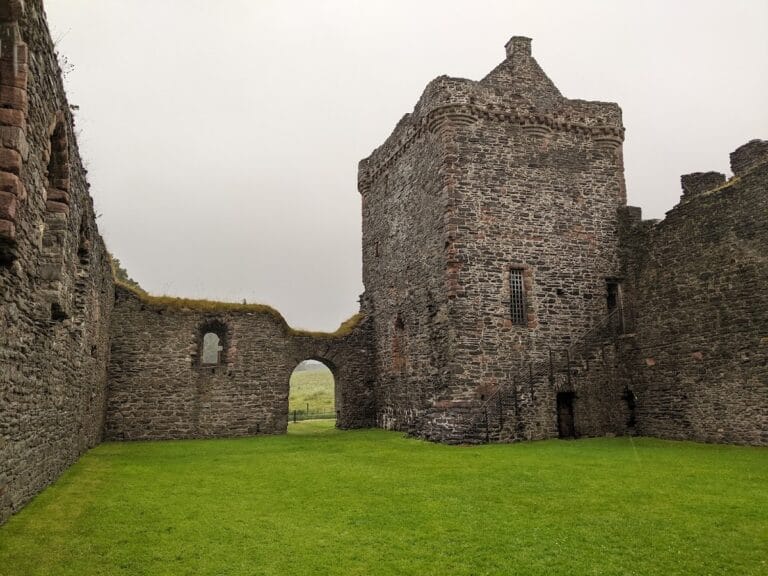
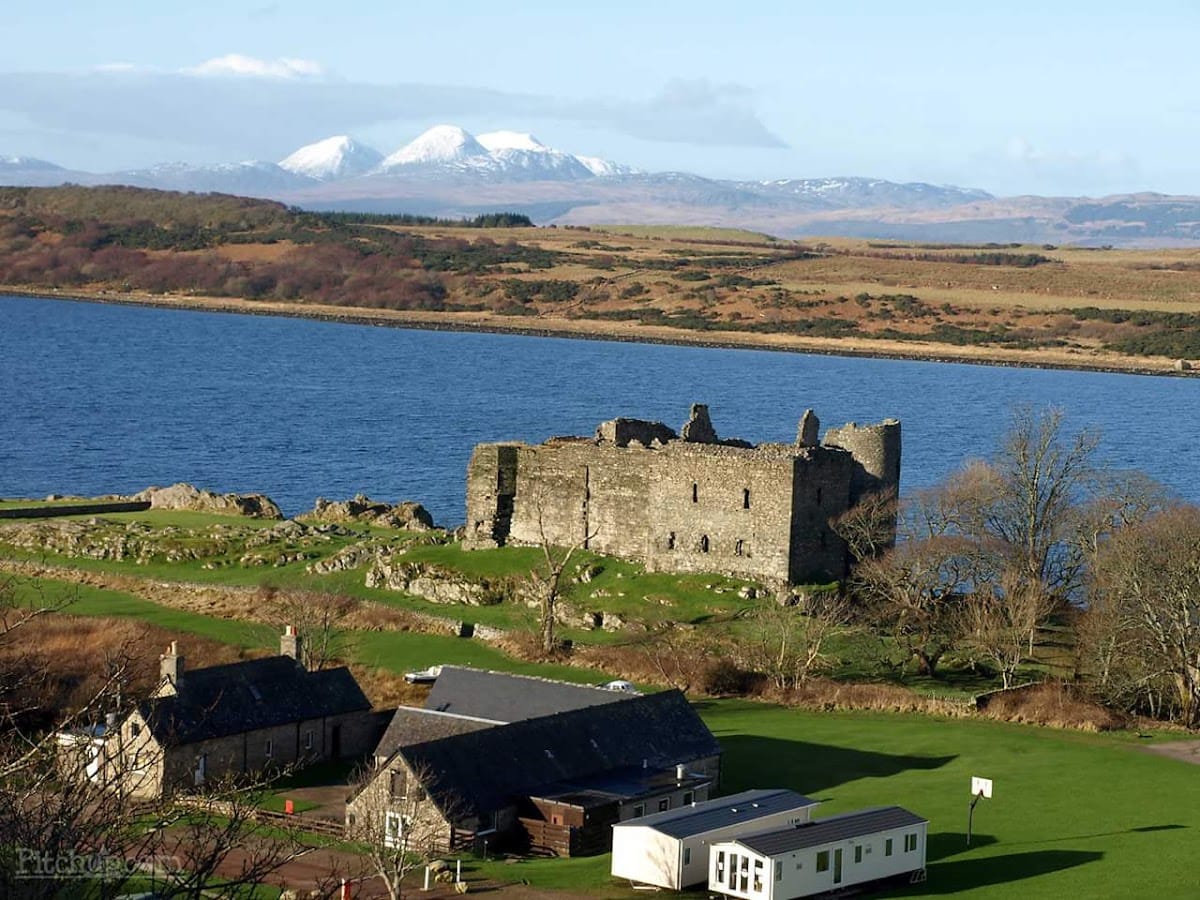
Castle Sween occupies a roughly square-shaped site fortified by thick stone walls about three meters wide. Built primarily of stone, the castle features pronounced external supports known as buttresses which strengthen the walls, and a gatehouse placed along the southern face, serving as the entrance. Surrounding buildings within the castle’s courtyard combined stone constructions with wooden structures. Archaeological evidence suggests the castle was likely never completely roofed, reflecting a mix of materials and uses over time.
A well designed to provide fresh water lies in the northeast corner of the enclosure, while a latrine tower used for waste disposal stands on the southeast corner. In the early 13th century, a rectangular addition was constructed on the west side of the castle. This wing was later rebuilt around 1300 as a three-story tower, a feature that enhanced the castle’s defensive and residential capacities. At the northwest corner of this wing, a round tower containing a latrine was added during the late 13th or early 14th century, demonstrating ongoing alterations in the castle’s layout.
The 15th century saw the addition of MacMillan’s Tower on the outside of the northeast corner. This three-story structure included kitchens on its ground floor, while the upper floors contained separate chambers for the lord and lady of the castle. Built of stone, MacMillan’s Tower reflects the architectural evolution influenced by the MacMillans, who managed the castle during this period.
The castle’s original core consisted of wooden elements that have since vanished, replaced or supplemented by stone towers and walls that survive in fragmentary form. One notable artifact connected to the castle is MacMillan’s Cross, erected in memory of Alexander MacMillan. Originally standing near the castle, this cross was relocated in the 20th century to Kilmory Knap Chapel.
Today, Castle Sween remains a ruin, with much of its stone fabric still visible in situ. Preservation efforts are ongoing to protect the site from environmental threats, including erosion. This historic ruin offers valuable insight into early Scottish stone castle construction and the changing political landscape of medieval Argyll.
Nearby sites