Castle MacEwen: A Medieval Fort and Homestead in Scotland


Site at a Glance
- Rating
- 5
- Popularity
- Very Low
- Country
- United Kingdom
- Primary era
- Medieval
- External website
- Open
- Eras represented
- Medieval, Early Modern
- Civilizations
- Kingdom of Scotland
- Site type
- Military
- Remains
- Castle
On this page8 sections
History
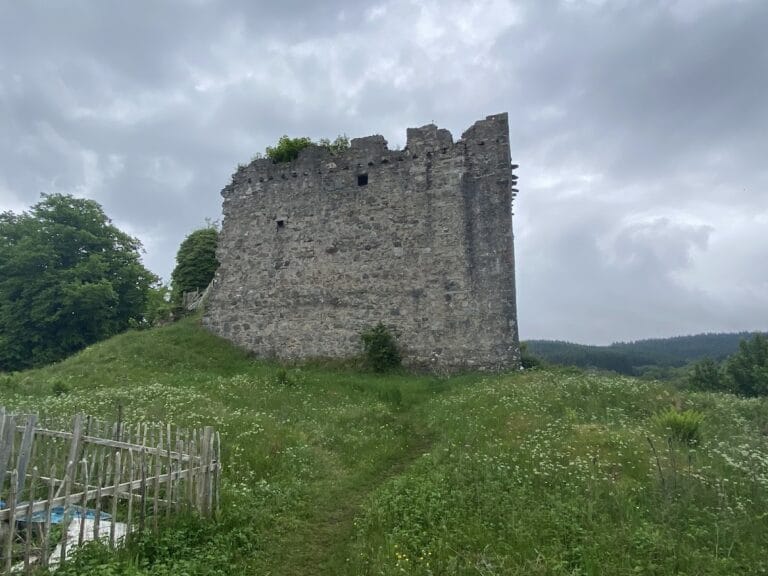
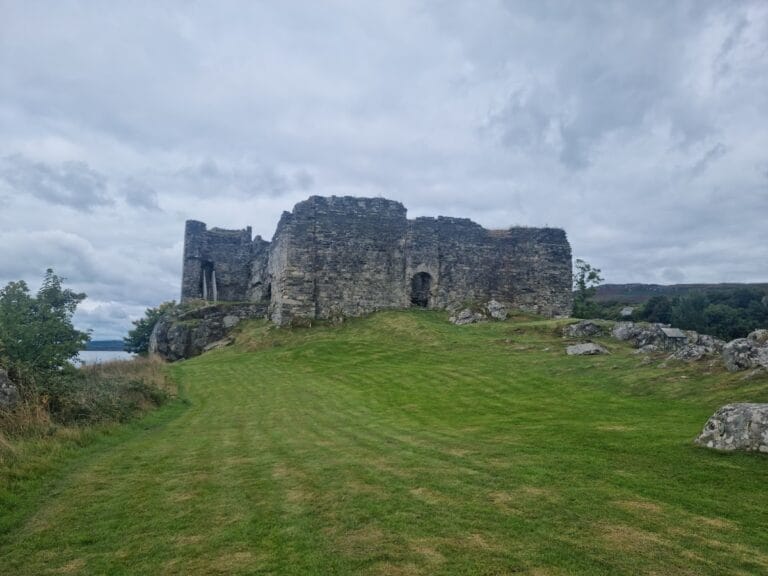
Castle MacEwen is a ruined fort in the United Kingdom, on the Cowal peninsula of Scotland near Kilfinan on the eastern shore of Loch Fyne. Associated with Clan MacEwen and held by Clan Ewen of Otter, the site developed through medieval phases that included a palisaded enclosure, a defensive fort, and a later homestead.
MacEwen and Campbell ownership
In 1432, Swene MacEwen of Otter surrendered his barony to James I, king of Scotland. The king regranted it to Celestine Campbell, with a provision that the barony would pass to Campbell if Swene died without an heir. Swene’s death in 1493 brought the lands and castle to a branch of Clan Campbell, one of Scotland’s kin-based social and political groups.
Archaeological sequence
Excavations by the Cowal Archaeological Society in 1968 and 1969 clarified the site’s development. They revealed an early medieval palisaded enclosure, followed by a promontory fort, a defensive settlement positioned on projecting high ground. The fort was later converted into a medieval homestead, which incorporated earlier walls into its defenses and strengthened them with large rectangular stones.
The excavation also identified passages leading toward the sea on the north and south sides of the site. Postholes contained material dated to the fifteenth or sixteenth century, while vitrified material, altered or partly melted by intense heat, pointed to high-temperature activity at the site.
Remains
Castle MacEwen survives as a fortified settlement organized around a main rampart with a gateway. Its earliest enclosure was protected by a palisade, and later construction created a fort before the site became a homestead. The homestead reused the earlier defensive walls and reinforced them with large rectangular stones. Separate passages extend toward the sea from the northern and southern sides.
Gateway and rampart structures
Round house
A round house was built against the rampart at the gateway. It had a cobbled floor and may have been used as a storehouse, although that function remains conjectural. The structure formed part of the later occupation around the fortified entrance.
Boat-shaped building
A separate building with a form resembling a boat stood just outside the main rampart. Its position beyond the principal defenses distinguishes it from the round house and the structures incorporated into the rampart.
Excavated finds
The excavations recovered a crucifix dating from the twelfth century, a fifteenth-century groat, a medieval and early-modern silver coin, and pottery sherds from the thirteenth and eighteenth centuries. These finds illustrate activity at the site across several periods. The recovered objects were transferred to Glasgow Art Gallery and Museum.
Nearby sites