Castle of San Terenzo: A Historic Coastal Fortress in Lerici, Italy


Visitor Information
Google Rating: 4.4
Popularity: Low
Google Maps: View on Google Maps
Official Website: www.facebook.com
Country: Italy
Civilization: Unclassified
Remains: Military

History
The Castle of San Terenzo stands in the village of San Terenzo within the municipality of Lerici, Italy. It was built in 1360 by the local community to serve as a defensive structure and watchtower. Constructed during a period marked by frequent pirate raids from the Ottoman Empire, the castle’s original purpose was to oversee and protect the bay and the settlement below.
Initially, the castle consisted of a solitary square tower approximately ten meters tall with battlements. This simple fortification lacked artillery, stairs, ammunition, and guards, as recorded in a 1588 document preserved in Genoa’s State Archive. Despite its modest beginnings, it played a crucial role in defending the village from seaborne threats. The nearby coastal cave, known as the “Tana dei Turchi” or “Turks’ Den,” reflects the historic danger posed by pirate incursions.
Over the following decades, the castle underwent significant enlargement to improve its defensive capabilities. It was transformed into a pentagonal bastion, featuring three circular turrets oriented toward the village, an inner defensive wall, and a quadrangular tower with flat battlements and square-shaped machicolations—a medieval architectural feature allowing defenders to drop objects on attackers below. A large barbican, an external fortification, was also constructed to strengthen the wall guarding the moat on the landward side, though the moat itself has since been filled in.
During the 15th century, the Castle of San Terenzo became an integral part of the Genoese Republic’s network of coastal defenses. Notable castellans such as Giovanni da Mongiardino, documented in 1401, commanded a small garrison that included eight crossbowmen. Later, Giacomo Rossi, a native of San Terenzo, distinguished himself fighting against the rival Pisan forces. His efforts won commendation from Simone Boccanegra, the first Doge of Genoa, highlighting the castle’s role within the broader Genoese military system controlling the Gulf of La Spezia.
A report from the late 16th century, authored by Gregorio Cadamartori, the podestà or chief magistrate, was addressed to Genoa’s Doge Davide Vaccari. It described the castle as a modest fortress built years prior by the villagers themselves, emphasizing the community-based origins and steady evolution of the site within the shifting political and military landscape of the Ligurian coast.
Remains
The Castle of San Terenzo occupies a rocky promontory at the western end of the bay near the village it was designed to safeguard. Its layout presents an irregular pentagonal shape, a design adaptation reflecting the expansion from the original square tower phase to a more complex fortification system capable of withstanding attacks from both sea and land.
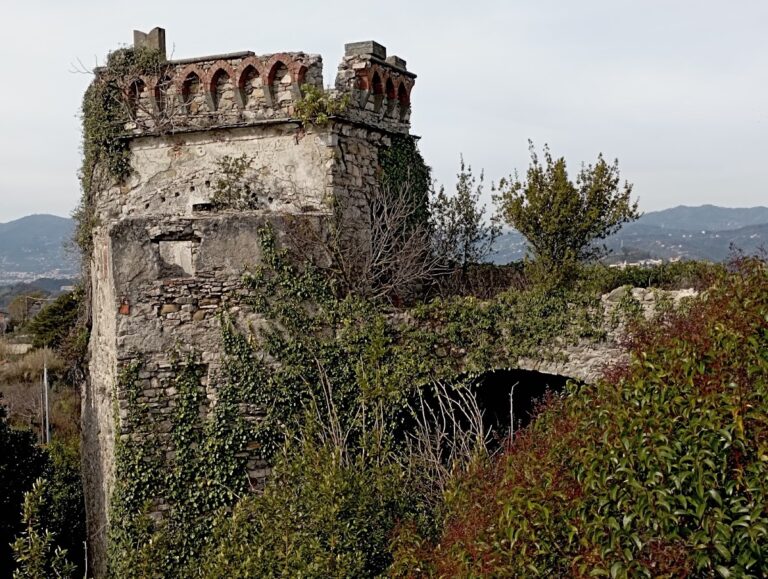
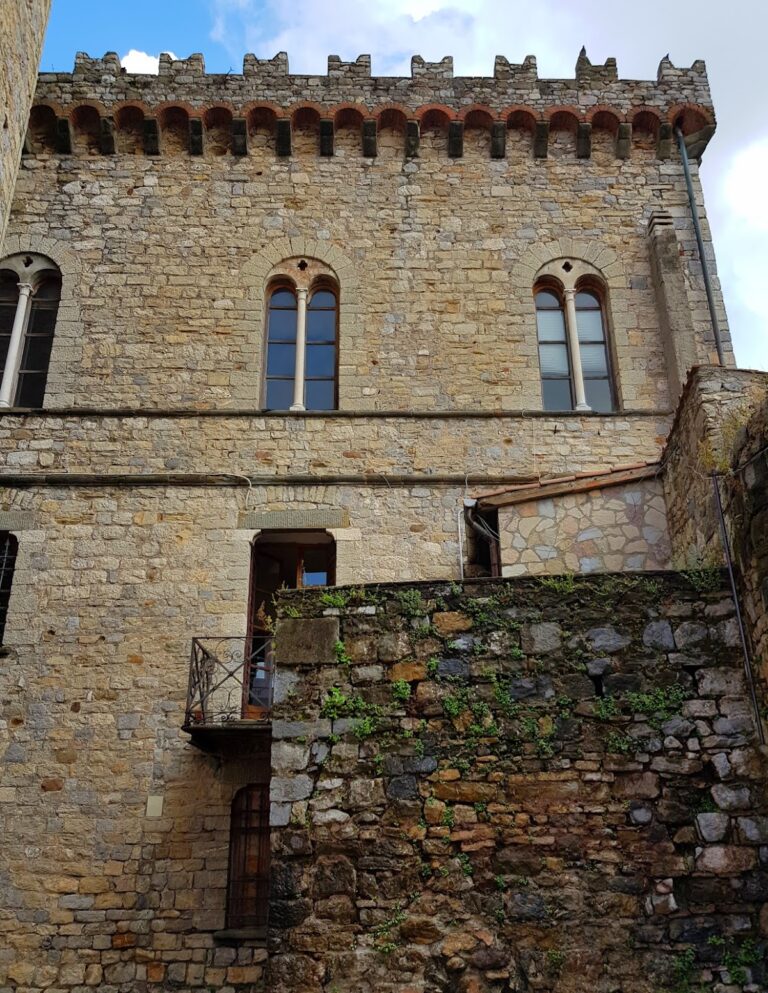
The earliest element still visible is the square tower, originally about ten meters tall, equipped with battlements at the roofline. This structure served as a lookout point, offering a vantage over the bay and surroundings. As the castle was expanded, robust curtain walls forming a second internal perimeter were added. These walls enclosed three circular corner turrets facing toward the village, providing flanking defense and strengthening the castle’s ability to repel invaders approaching from the landward side.
One of the prominent features is the quadrangular tower, which includes flat battlements and square-section machicolations. Machicolations refer to openings in the parapet floor through which defenders could drop stones, boiling oil, or other means onto attackers directly below. This architectural addition marks the castle’s evolution into a fortified bastion rather than just a watchtower.
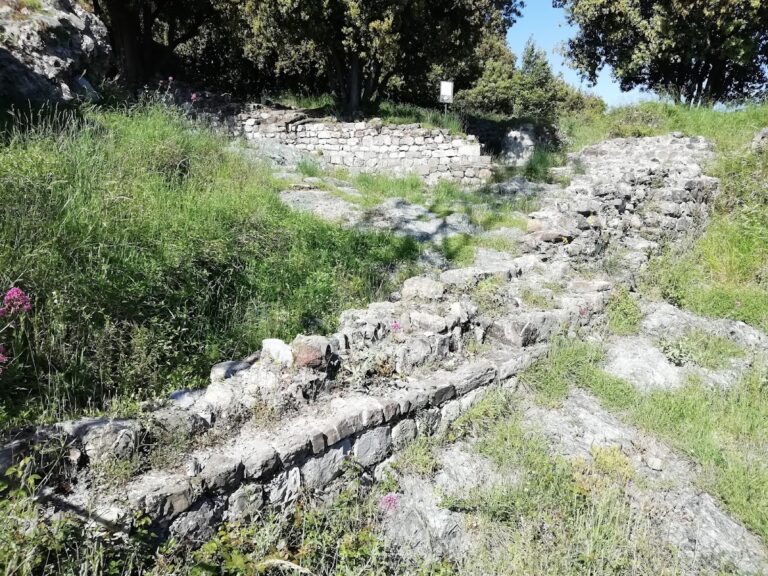
The castle’s entrance is approached via a trail rising from Via Meneghetti through the village’s main square, Piazza Brusacà. Although the moat that once encircled part of the fortress has been filled in, certain defensive elements remain as evidence of its past presence. Notably, a loophole—narrow slits in the wall designed for arrows or firearms—is preserved within the northern bastion, attesting to the castle’s fortified nature.
Over several centuries, the masonry and key defensive components of the castle have been repaired and modified. These interventions, carried out in different periods, have maintained the castle’s harmonious overall appearance without substantially altering its historic character. Since December 2014, the site has been managed by the Italian Ministry of Culture through the Liguria Museum Network, with regional museum supervision beginning in late 2019, ensuring ongoing preservation efforts.
Nearby sites