Arcola Castle: A Medieval Defensive Residence and Town Hall in Italy


Site at a Glance
- Rating
- 4.5
- Popularity
- Low
- Country
- Italy
- Primary era
- Medieval
- Eras represented
- Medieval
- Civilizations
- Holy Roman Empire
- Site type
- Civic
- Remains
- Town Hall
On this page9 sections
History
Arcola Castle is a medieval defensive residence in Arcola, Italy, generally dated to the twelfth century. Its construction accompanied the revival of the hilltop village from the eleventh century onward under the Obertenghi, a medieval ruling dynasty whose territories included parts of Liguria and the Magra Valley. Later building work continued until 1884, and the castle became one of the area’s major defensive centers.
From Obertenghi rule to Genoese control
The castle’s development followed earlier Norman and Saracen invasions and raids in the region. During Obertenghi rule, it served both as a fortified stronghold and as a feudal lordly residence. In the thirteenth century, the Malaspina, a noble family with extensive possessions in the Magra Valley, succeeded the Obertenghi as lords of Arcola and its castle.
In 1278, Genoese forces commanded by Oberto Doria besieged Arcola Castle. The adjacent Obertenghi tower was also drawn into the assaults. After Genoa conquered the castle, the Malaspina sold it to the Republic of Genoa.
Later captures and changing functions
Castruccio Castracani, the lord of Lucca and a prominent military ruler in early-fourteenth-century Tuscany, captured the castle in 1320. In 1430, Nicolò Piccinino, a professional military commander from Perugia campaigning for Filippo Maria Visconti, Duke of Milan, took it for his employer. The Republic of Genoa reconquered the castle in 1436.
After its return to Genoese control, the palace became the seat of the Podesteria of Arcola and Vezzano. A podesteria was a territorial jurisdiction administered by a podestà, an official responsible for local government and justice. The castle’s strategic defensive function ended in the eighteenth century.
Damage, restoration, and civic use
During the wars of the late eighteenth century, fighting between Franco-Genoese and Austro-Russian armies caused severe damage to the castle and the nearby tower. Bombardment contributed to the destruction. In 1884, a complete restoration and rehabilitation began under a project by the engineer Canini. The work transformed the building into the seat of Arcola’s municipal government, a function it still retains. The Municipality of Arcola owns the castle, which has been recognized as Italian national heritage since 1936.
Remains
Arcola Castle survives as a residential castle-palace in the historic center of the hilltop medieval village. It stands in Piazza Ugo Muccini near the ancient Obertenghi tower. Late-eighteenth-century bombardments seriously damaged both structures, while the castle’s conservation work in 1884 helped preserve its present form. The building is currently in good condition and houses Arcola’s municipal offices.
Castle-palace and associated features
Castle-palace
The main surviving building is the castle-palace, whose residential character reflects its dual use as a fortified residence and a lordly dwelling. Its present condition results from the nineteenth-century conservation and rehabilitation carried out after the earlier military damage.
Obertenghi tower
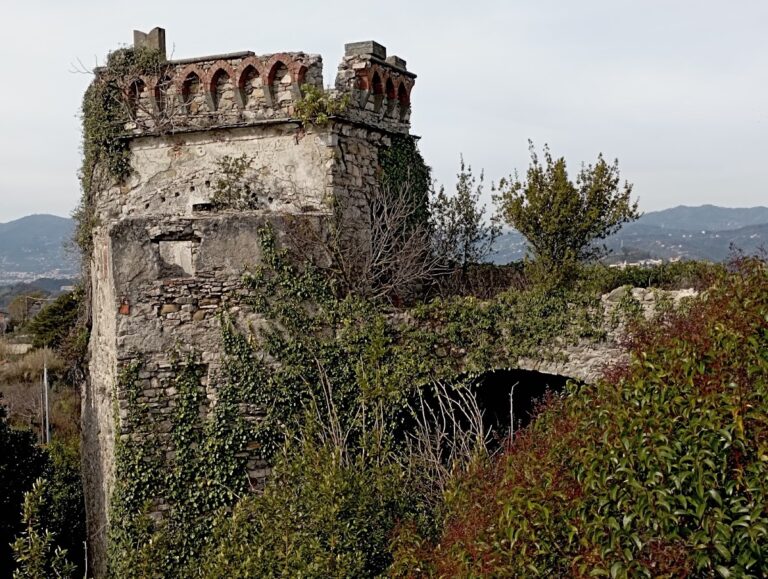
The adjacent Obertenghi tower is a distinct surviving feature associated with the castle. It participated in the attacks of 1278 and later suffered serious damage during the late-eighteenth-century bombardments.
Wine-measuring basin
A basin for measuring half a barrel of wine remains at the castle. It was made in 1601 according to Genoese units of measurement, providing a physical connection with the period of Genoese administration.
Nearby sites