Castle of Penela: A Medieval Fortress in Portugal


Visitor Information
Google Rating: 4.4
Popularity: Medium
Google Maps: View on Google Maps
Official Website: www.cm-penela.pt
Country: Portugal
Civilization: Unclassified
Remains: Military

History
The Castle of Penela is located in the municipality of Penela, Portugal. It was built by medieval Christian rulers as a strategic fortress during the period known as the Reconquista, when Christian kingdoms sought to reclaim territory on the Iberian Peninsula from Muslim control.
The site where the castle stands likely had early significance, with suggestions of pre-Roman occupation. Some historians propose the presence of a Roman military watchtower here due to its commanding view over an important route connecting Mérida, Conímbriga, and Braga, though no physical evidence has confirmed this. Later, during the Muslim invasion of the peninsula, the area may have been fortified, setting the stage for its medieval military importance.
Penela’s transition into Christian hands occurred probably in 1064 when Ferdinand I of León captured it. The following year, a charter was granted to the already fortified settlement, indicating an established community. Count Sesnando Davides administered the region and is noted for populating the castle’s surroundings by 1087. Archaeological findings such as anthropomorphic tombs within the walls date from this early medieval period, reflecting an established settled population.
The castle’s strategic role was challenged during the Muslim offensives of 1116 and 1117, which destroyed neighboring fortresses and threatened Penela itself. While tradition credits Afonso Henriques, the first king of Portugal, with conquering the castle in 1129, documentary evidence confirming this is lacking. However, a 1137 charter and a donation document from 1145 verify the castle was occupied and functioning by that time. These records suggest the fortress was firmly under Christian control well before 1148, the year often cited for its conquest.
Under Afonso Henriques and his successors Sancho I and Dinis I, the castle underwent important rebuilding efforts. King Dinis I, ruling in the early 14th century, is credited with constructing the keep tower and reinforcing the town walls. The castle’s significance is further highlighted by its role as the birthplace and final residence of Infante Afonso, who would become King Afonso IV (1325–1357).
During the political crisis between 1383 and 1385, the castle’s commander initially supported Castile, but local inhabitants resisted and killed him, subsequently declaring loyalty to Portugal. This episode reflects the castle’s role not only in military defense but also in local governance and allegiance during turbulent times.
The 15th century saw major developments under Duke Pedro of Coimbra, who directed significant building works including the construction of the ducal palace, the Church of São Miguel, and renovations of the keep tower and main town gate. In 1433, Penela obtained a fair charter that facilitated economic growth. Later, in 1465, the town was elevated to a county, with Afonso Vasconcelos e Meneses as its first count. Eventually, ownership passed to the influential House of Aveiro.
Under King Manuel I (1495–1521), the town received a new charter in 1514, and adjustments were made to the castle’s defenses to accommodate artillery, reflecting the evolution of military technology. By the 18th century, the castle had diminished in military importance. The devastating earthquake of 1755 destroyed the original keep tower, known as the Clock Tower, and one of the gates; the tower was rebuilt in 1760 using stone taken from a third gate. Around this time, the House of Aveiro, then owners of the castle, ceased to exist.
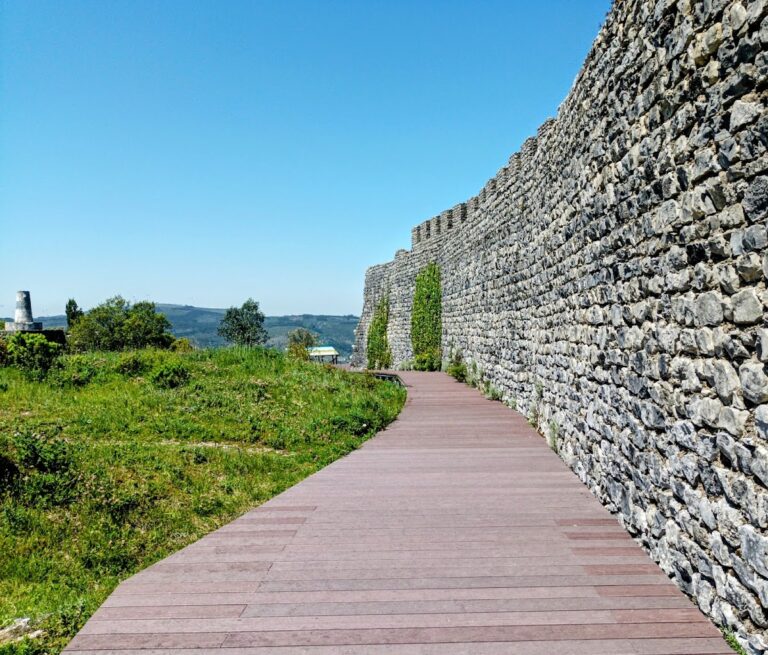
By the early 20th century, the Castle of Penela had fallen into ruin. It was declared a National Monument in 1910. Restoration efforts began in the 1940s, focusing on stabilizing the walls and battlements, rebuilding damaged sections, and removing houses that had been constructed on the castle walls. An 18th-century bell tower once part of the complex was dismantled during these restorations.
More recent conservation work starting in 1992, guided by the Portuguese Institute of Architectural Heritage, improved visitor access and structural integrity by paving pathways, cleaning and consolidating walls, and enhancing the battlement walk. Today, occupation within the castle is limited to the Church of São Miguel and a parish house serving as a museum space, maintaining a link with the site’s rich historical past.
Remains
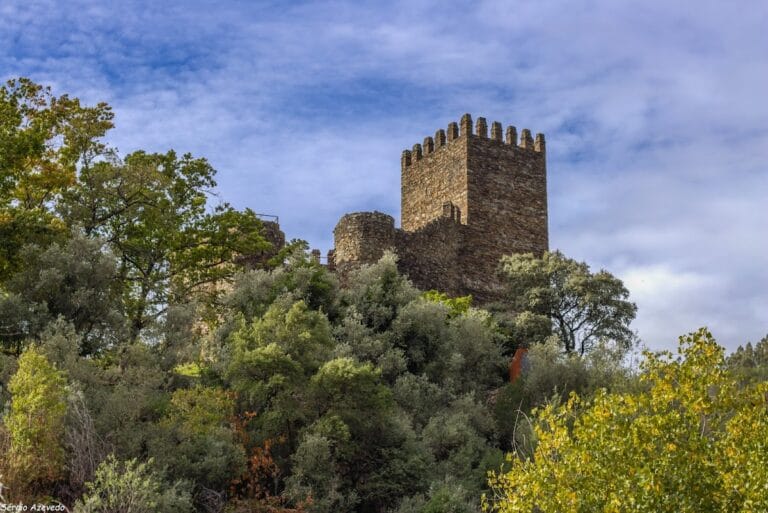
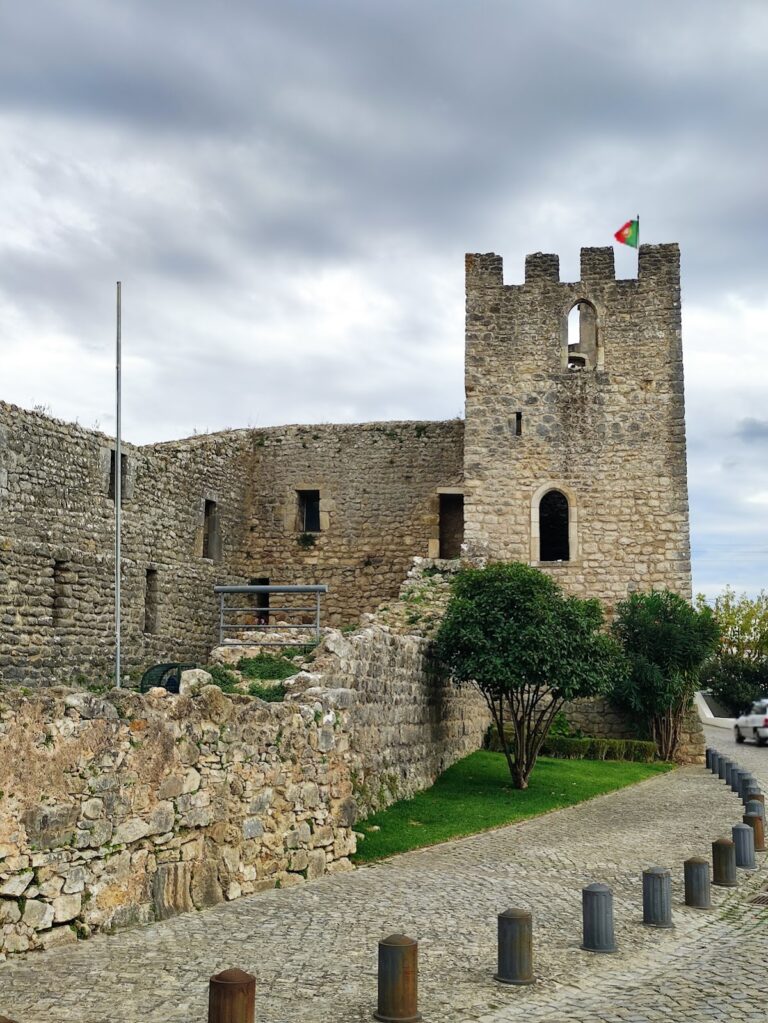
The Castle of Penela is a granite-built fortress situated on a limestone hill, covering roughly half a hectare (about 1.23 acres). Its layout follows an irregular polygonal shape, carefully adapted to the natural terrain and oriented in a north-south direction. The structure displays a blend of architectural styles from the Romanesque, Gothic, and Manueline periods, showcasing its centuries-long evolution.
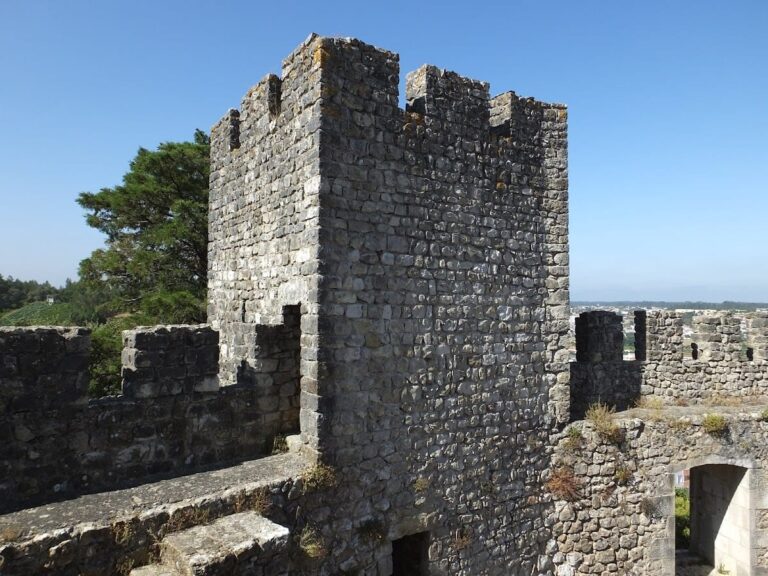
The curtain walls, constructed mainly in the 14th century, originally included twelve towers—four of which survive today. These walls rise between seven and nineteen meters in height, emphasizing their role as formidable defensive barriers. In the 15th century, additions such as the Porta da Vila (also called Porta do Cruzeiro), a rounded arched gate on the southwest side, and the castelejo (a small castle or secondary keep) were added. These elements represent an evolution of the fortress’s original keep tower.
The keep tower, dating from around 1300, now survives only as an entrance doorway featuring a round arch and two artillery openings designed for bombards, early forms of cannon. This tower was part of the castelejo, which was remodeled and reinforced in the 15th and 16th centuries to adapt to changing military needs.
Two main gates pierce the medieval town walls. The Porta da Vila, on the southwest side, provided entrance to the town’s suburb, a settled area that developed peacefully outside the castle. On the northeast wall stands the Porta da Traição, or Gate of Treason (also known as the Fields Gate), notable for its double bent opening within a quadrangular tower. The form of this gate preserves elements of Muslim architectural tradition, demonstrating continued influence even after Christian control.
Local legend tells that Afonso Henriques seized the castle through the Porta da Traição by surprising its defenders as they had opened the gate to allow their cattle to drink. Today, this gate grants access to a narrow battlement pathway running along a sheer ninety-meter cliff, offering expansive views of the surrounding landscape.
The most accessible current entrance is the “Brecha das Desaparecidas” or Breach of the Disappeared, located in the southern part of the walls. This area was formerly the location of a third southern gate, protected by a five-sided tower known as a torre quinária. This gate once connected the suburb directly to the Church of São Miguel inside the castle.
Within the castle grounds, a square cistern carved directly into the rock illustrates an essential feature for water collection and storage, enabling the fortress to withstand sieges.
The Church of São Miguel stands as the main religious building inside the castle. First documented in 1137, the church was rebuilt in 1420 by Duke Pedro of Coimbra and remodeled in the late 16th century. Its simple Renaissance style includes three naves separated by two arcades supported on octagonal columns crowned with Renaissance-style capitals. The chancel contains Baroque woodwork dating from the 17th and 18th centuries, with two side altars featuring gilded woodwork from the reign of King Pedro II. Among its treasured artworks is a sculpture of the Madonna and Child carved from local Ançã stone by João de Ruão around 1530, displayed on the church’s left altar. Two vaulted chapels with Renaissance arches flank the interior, further enriching the architectural complexity of this historic site.
Nearby sites