Castle of Miranda de Ebro: A Medieval Fortress in Spain




Visitor Information
Google Rating: 4.1
Popularity: Low
Google Maps: View on Google Maps
Official Website: www.mirandadeebro.es
Country: Spain
Civilization: Unclassified
Remains: Military

History
The Castle of Miranda de Ebro is a medieval fortress situated in the town of Miranda de Ebro in Spain. Its earliest origins likely reach back to the Early Middle Ages, suggested by references from the Chronicle of Alfonso III and documents dating to the twelfth century, which indicate the presence of a fortified settlement in this border region.
The fortress as it is known today began to take shape in the 14th century. On October 15, 1358, Count Don Tello, who was Lord of Biscay, formally requested the Bishopric and Chapter of Calahorra—then the authorities over Miranda—for the land of the primitive church of Santa María. The aim was to build a more substantial defensive structure on this site. However, building did not start immediately, and it was not until 1449 that Pedro Sarmiento, Lord of Salinas, took possession of the church to commence construction despite opposition from local inhabitants. This work continued over several decades and was led into 1485 under the supervision of master mason Juan Guas.
Ownership of the castle remained with the Sarmiento family and later was shared with the Dukes of Híjar. It eventually passed to the city council of Miranda de Ebro in 1772 following legal disputes. Situated near contested borders, the castle frequently found itself involved in military conflicts. It endured significant damage during both the Peninsular War and the Carlist Wars, events which contributed to its ruinous condition by the 19th century.
A notable historic moment occurred on September 5, 1808, when King Joseph Bonaparte signed within the castle a decree authorizing the circulation of French currency in Spain—an act reflecting the castle’s role in the turbulent Napoleonic era.
By the early 20th century, the decayed state of the fortress led the city council to order its dismantling in 1903, reusing stones to build a bullring that no longer exists today. Additionally, large portions of the structure were buried beneath earth for further leveling. In 1913, water tanks were installed on much of the castle’s original footprint, reducing visible remains mainly to divided walls, towers, and a buttress along the northern side.
The Castle of Miranda de Ebro gained legal protection as a cultural heritage site under Spain’s Bien de Interés Cultural status in 1949 and again reaffirmed in 1985. Archaeological research began in 2006 in partnership with the University of Burgos, uncovering evidence of an 8th-century settlement potentially related to the early Miranda village as well as the remains of a 16th-century fortress constructed in the Italian style, complete with bastions designed to resist cannon fire.
Between 2009 and 2013, ongoing excavations and restoration work stabilized existing walls, recovered ancient pathways, and introduced access features. The castle reopened to the public in July 2013 as a site for cultural and historical engagement. More recently, in late 2019, a cavity near the upper fortress area revealed a previously unknown chamber adjacent to the former prison, offering fresh insights into the castle’s internal layout.
Remains
The castle’s layout follows a roughly trapezoidal plan with four or five corners, reflecting multiple phases of construction over the centuries. Archaeological findings have confirmed earlier components, including a fortress designed in the Italian style during the 16th century, notable for its bastions or ravelins—triangular defensive projections typical of that period intended to protect against artillery attacks.
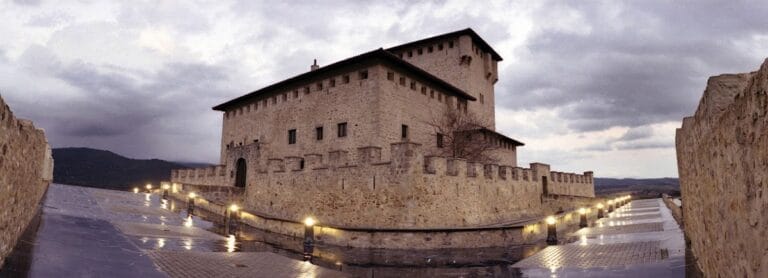
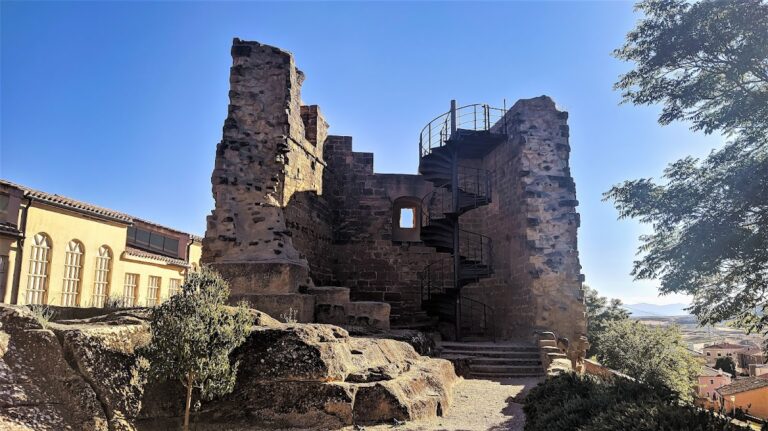
Currently visible structures primarily include sections of the northern and eastern curtain walls. Among these are two significant towers known as the King’s Battery and the Queen’s Battery, which likely served as platforms for artillery and lookout positions. Additionally, a round tower stands at the southwest corner, although it is partially hidden beneath vegetation and situated on private land.
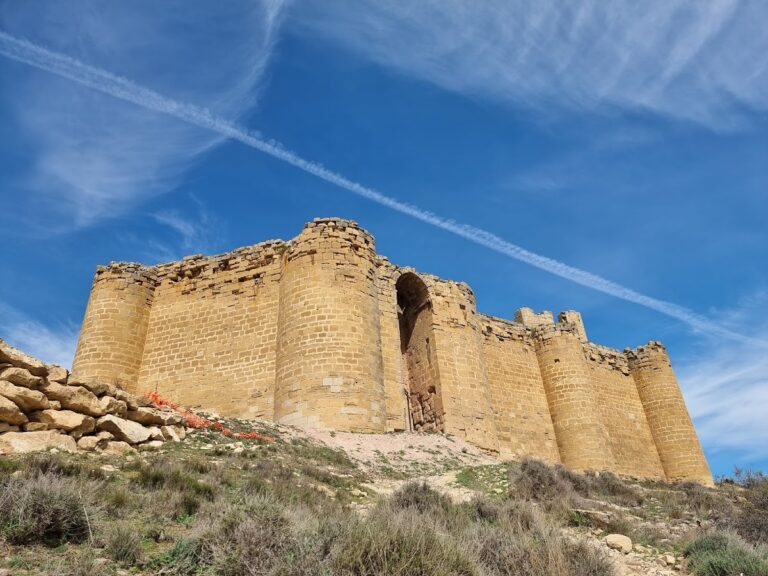
Entrance to the castle was secured through a barbican, a small fortified outwork that controlled access. Reaching this gate involved navigating a zig-zag path that ascended the hillside, designed to slow and expose any approaching attackers. The main gate featured two separate openings: a larger one for carts and a smaller pedestrian access, both defended by a surrounding moat. Another moat extended along the castle’s western side, where the walls faced the rest of the La Picota hill, adding a further defensive barrier.
The construction materials reveal careful engineering choices: the external walls consist of finely cut ashlar stone for durability and strength, while internal sections employ rubble masonry using irregular stones bound with mortar. Archaeological excavations have also uncovered medieval graves within the site, alongside Romanesque remains likely associated with the original Santa María church, providing a glimpse into the castle’s ecclesiastical beginnings.
Modern interventions include the addition of an external elevator linking the fortress with the nearby Botanical Garden terraces and the historic city center, complemented by ramps and a second elevator to ensure access for visitors with mobility difficulties. The castle grounds benefit from nighttime illumination and have been adapted for educational purposes, with a visitor interpretation center (CIMA) in the old town serving as the main point of orientation.
Together, the surviving walls, towers, gate systems, and archaeological discoveries compose a layered story of a strategic fortress that evolved over centuries in response to shifting military technology and political realities.
Nearby sites