Castillo de Briones: Medieval Fortress in La Rioja, Spain


Site at a Glance
- Rating
- 4.3
- Popularity
- Low
- Country
- Spain
- Primary era
- Medieval
- External website
- Open
- Eras represented
- Medieval
- Civilizations
- Crown of Castile
- Site type
- Military
- Remains
- Castle
On this page7 sections
History
Castillo de Briones, also known as the Fortress of Briones, is a medieval military fortification in Briones, Spain, whose present form dates from the thirteenth century. It reinforced the town’s defenses after Briones expanded under a medieval municipal charter.
The earlier fortification and the thirteenth-century castle
An earlier stronghold occupied the site in the eleventh century, when Briones came under the control of the López de Haro family, a powerful noble lineage associated with Biscay and northern Iberian lordships. The fortification became one of the family’s most important buildings, but Fernando III of Castile destroyed it in 1240.
In 1256, Alfonso X of Castile granted Briones the Charter of Vitoria, a municipal charter that provided legal and administrative privileges. The town then increased in size and population, and its defensive importance led to the construction of a new fortress. This later building corresponds to Castillo de Briones.
Changing lordships
The castle subsequently passed among several families and lords. Fernando Alfonso of Castile, an illegitimate son of Alfonso XI, held it until 1366. In that year, Sancho of Castile, the brother of Enrique II of Trastámara, acquired the territory and confirmed the town’s charter.
The lordship later passed by inheritance to Leonor of Alburquerque, who was married to Fernando I of Aragon. Their son, Juan II of Aragon and Navarre, inherited the lordship, bringing the castle under the Navarrese Crown before it later returned to the Kingdom of Castile.
In 1459, Enrique IV of Castile ceded the castle to Pedro Girón, master of the Order of Calatrava, a medieval military order that held territories and lordships in Castile. Girón’s family retained possession until 1818, when the castle was ceded once more to the Crown.
Decline and protection
By the nineteenth century, the castle was in very poor condition, although its former principal entrance could still be seen. During the twentieth century, the entrance area collapsed completely, and the enclosure was used as a cemetery.
The castle and the town walls form part of Briones’ historic old town. Castillo de Briones is protected under the generic declaration established by the decree of 22 April 1949 and under Spain’s Historical Heritage Law 16/1985.
Remains
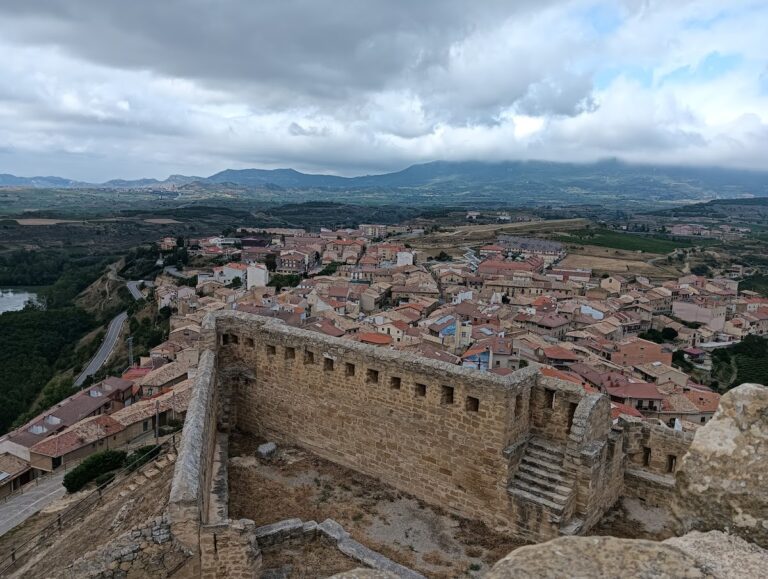
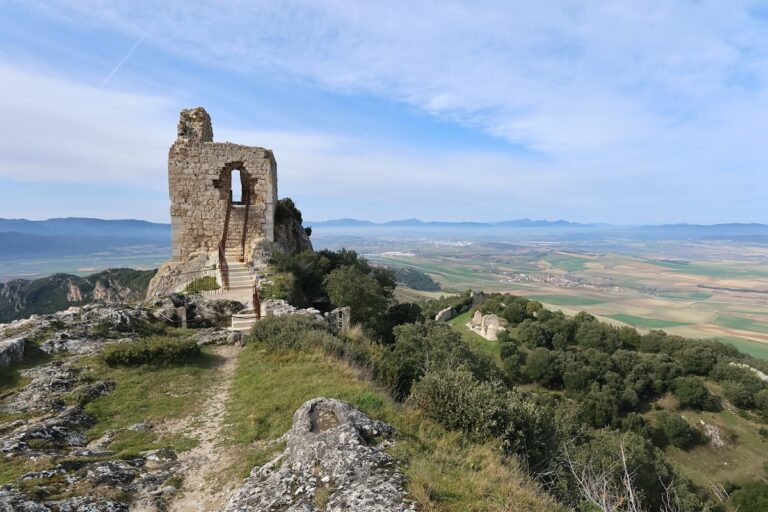
The surviving remains are concentrated in the ruined keep, built with stone ashlar masonry. The structure has a trapezoidal plan oriented from northeast to southeast, and three walls of the original castle remain standing. At their base, the walls rest directly on the stone through a masonry section, above which carefully laid, regular ashlar blocks form the principal visible fabric.
The keep
The keep’s cornices were originally believed to have been protected by a machicolation, a projecting defensive structure with openings through which defenders could drop objects or pour liquids onto attackers below. That feature has been lost. A later alteration added a metal spiral staircase with 49 steps, giving access to the upper part of the keep.
The former principal entrance
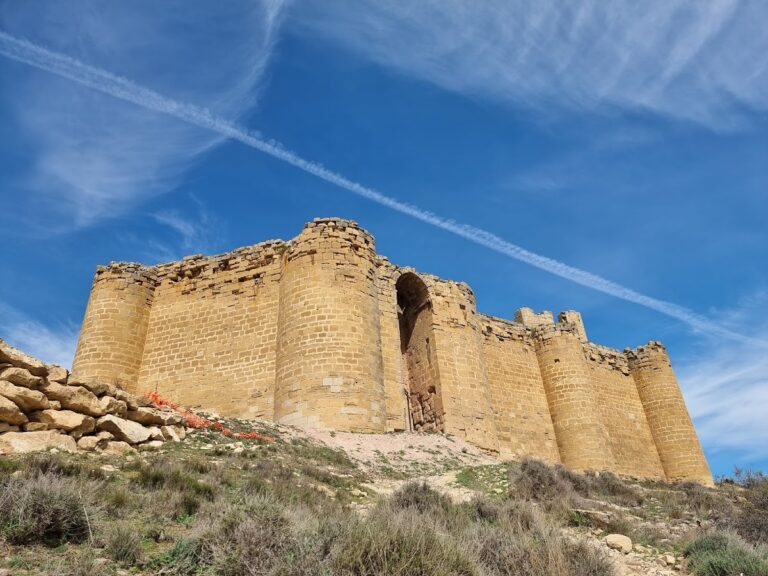
The former main entrance consisted of a pointed arch flanked by two turrets. It remained visible in the nineteenth century, but the entire entrance area later collapsed during the twentieth century.
Nearby sites