Castle of Herrera del Duque: A Historic Fortress in Spain


Visitor Information
Google Rating: 4.3
Popularity: Low
Official Website: www.herreradelduque.com
Country: Spain
Civilization: Unclassified
Site type: Military
Remains: Castle

History
The Castle of Herrera del Duque stands near the town of Herrera del Duque in Spain, constructed by the local nobility during the transition from the late Middle Ages to the early modern era. Its origins trace back to the 15th and 16th centuries under the stewardship of the Sotomayor family, an influential noble lineage active in the region.
Historical records first mention the fortress in the 15th century, particularly when it was granted to the Order of Alcántara, a military and religious group tasked with defending Christian territories during the Reconquista and subsequent border conflicts. The castle’s rapid construction involved skilled Mudéjar artisans—Muslim craftsmen working during Christian rule—under the direction of Maestre Gutierre, who governed the area in 1446. At that time, he also authorized the building of the nearby Castle of Puebla, indicating a strategic effort to fortify the lordship.
Throughout its history, the fortress played a critical role in local power struggles within the County of Belalcázar, a territory marked by periodic military actions and a degree of noble independence before the centralization reforms of the Catholic Monarchs. It functioned both as a defensive stronghold and as a seat of authority for the Sotomayor family and their successors. Control of the castle shifted over time, passing into the hands of the Dukedoms of Osuna and Béjar as well as the Viscountcy of Puebla de Alcocer, with an appointed governor overseeing its administration until the early 19th century.
A significant transformation occurred when Doña Elvira inherited the lordship, leading to interior modifications that introduced Gothic elements and converted part of the fortress into a palace. These renovations were overseen by Commander Arias Pérez, adding a residential character alongside the castle’s military functions. Since then, the castle has remained a notable historical monument tied to the region’s layered feudal and military past.
Remains
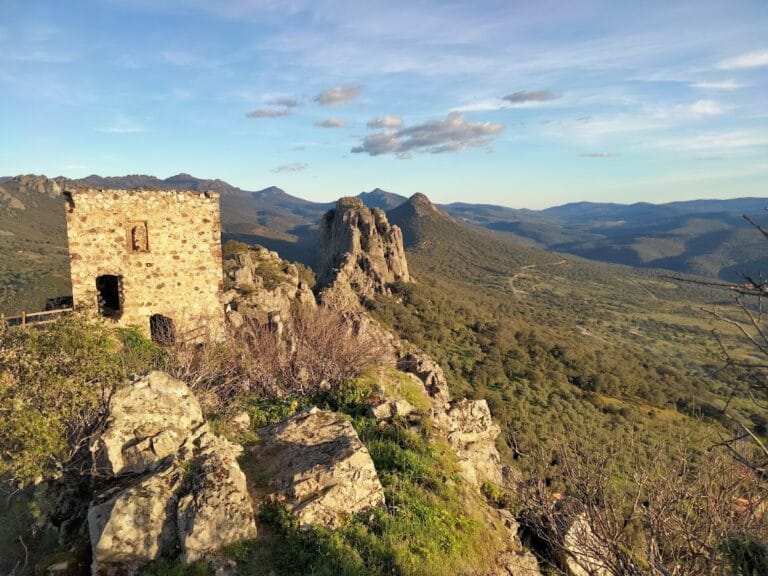
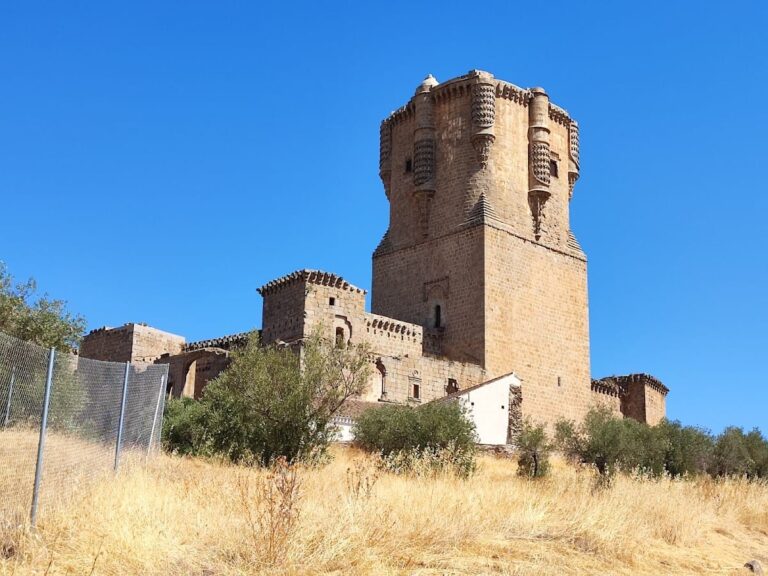
The Castle of Herrera del Duque is built as an irregular octagonal fortress, its eight sides stretching around 183 meters in total. It rises prominently atop a natural rocky outcrop, ensuring a strong foundation. The exterior walls, averaging 15 meters tall and 3 to 4 meters thick, combine stone blocks and masonry, with larger dressed stones reinforcing the corners—an architectural technique that strengthens the structure. Brick was used extensively for windows, doors, vaulted ceilings, and arches, particularly showcasing Mudéjar influence.
The main entrance faces east, marked by a large semicircular brick arch roughly 8 meters high and 3 meters wide. Behind this arch lies a vaulted gate chamber that measures about 22 square meters, housing three separate doors leading inward to a square keep tower, the palace quarters, and the internal courtyard. Above this entrance chamber, access connects to a machicolation chamber—a defensive passage designed to allow defenders to drop objects or pour substances on attackers below—and further leads to the battlements on the walls.
The only tower of the castle, discreet from the outside, stands at the northern angle of the enclosure. It is square-shaped with sides about 13.5 meters long and reaches 25 meters high. The thick walls, between 2 and 4 meters, formed four floors approximately four meters tall each, although none of these levels remain fully intact today. This tower was a key defensive position protecting the approach to the castle’s inner courtyard.
On the north side, the fortress features two curtain walls almost 30 meters long set at an open angle, while the west façade contains two walls rising 16 meters high and stretching 36 meters across. These walls include narrow arrow-slit windows with stone lintels and brick frames, typical of medieval fortifications designed for archers to fire while remaining protected. The south side mirrors this with two lengthy curtain walls of 29 meters, containing two similar arrow-slit windows and a larger window that once illuminated the keep’s rooms.
The palace section of the castle occupies a prominent position, composed of two large halls stacked one above the other, each about 60 square meters. These halls open to the west with porticos supported by columns and connected by an external staircase. Remnants of horseshoe-arched brick doorways and decayed windows point to the Gothic-style renovation made under Commander Arias Pérez during Doña Elvira’s tenure.
The courtyard lies at the heart of the fortress, bordered by three wings that open onto it through pointed arches, which help reconstruct the original layout of the castle’s service and living quarters. Nearby ruins south of the curtain wall suggest the presence of former stables, linking to the castle’s function as both a defensive post and noble residence.
Additional structural features include a large underground cistern, called an aljibe, designed to collect and store water. This cistern remains in good condition, protected by a barrel-vaulted brick ceiling and accessible through an entrance carved into the rock. At the top of the walls, triangular brick vaults served as artillery platforms, reflecting adaptations made to accommodate gunpowder weapons. Although the battlements and parapets have partly deteriorated, sections of the wall walk survive, allowing a sense of how defenders once patrolled the castle’s perimeter.
This combination of stone, brick, and masonry construction, along with its strategic siting and interior modifications, illustrate the castle’s evolution from a fortified refuge to a noble residence. The preservation of key elements such as the gate chamber, keep tower, palace quarters, and underground water supply provide valuable insight into its multifaceted role across several centuries.
Nearby sites