Castle of Dos Hermanas: A Medieval Frontier Fortress in Spain


Site at a Glance
- Rating
- 4.5
- Popularity
- Low
- Country
- Spain
- Primary era
- Medieval
- Eras represented
- Medieval
- Civilizations
- Crusader, Knights Templar
- Site type
- Military
- Remains
- Castle
On this page7 sections
History
The Castle of Dos Hermanas is a medieval fortress in Spain, near Navahermosa in Toledo Province, built during the eleventh or twelfth century in the frontier world of the Reconquista, the long medieval expansion of Christian kingdoms across Muslim-ruled territories in the Iberian Peninsula. Its precise origin remains uncertain, but the castle is regarded as one of the oldest in Toledo Province.
Origins and Frontier Role
One interpretation places its construction in the twelfth century and attributes it to the Knights Templar, a military-religious order that defended frontier territories and operated fortified administrative estates known as commanderies. Under this view, Dos Hermanas formed part of a chain of watchtowers and garrisons around the Templar commandery of Montalbán, helping to protect Toledo. The same theory proposes that it may have been built over a pre-Roman fortified settlement, or castro, established before Roman rule in the Iberian Peninsula.
A different interpretation identifies the fortress as an Arab frontier bastion. In that role, it would have guarded the natural boundary formed by the Montes de Toledo. The castle housed a garrison of approximately 20 to 30 men and their families, while also protecting the nearby village of Dos Hermanas. The village stood below the rocky outcrop and was inhabited by shepherds and beekeepers.
Transfers of Ownership
In 1210, the castle was ceded to the knight Alfonso Téllez, who was repopulating this frontier territory beside lands under Muslim control. Alfonso Téllez sold it in 1222 to Rodrigo Ximénez de Rada, Archbishop of Toledo. King Fernando III the Saint, the thirteenth-century ruler of Castile and León, later acquired the fortress and in 1246 sold it to the city of Toledo together with the Castle of Malamoneda at Hontanar and the surrounding mountains.
Abandonment
As the authorities of Toledo came to regard the area as pacified, they ordered the castle’s garrison disbanded in 1444. This decision contributed to the depopulation of Dos Hermanas. Its inhabitants dispersed, establishing the first houses of Navahermosa and enlarging settlements elsewhere in the surrounding area. The move was also encouraged by Navahermosa’s better opportunities for cultivation. The castle was abandoned and gradually deteriorated, with its ruinous condition estimated to date from the fourteenth century. It is designated a Property of Cultural Interest.
Remains
Fortress Layout and Construction
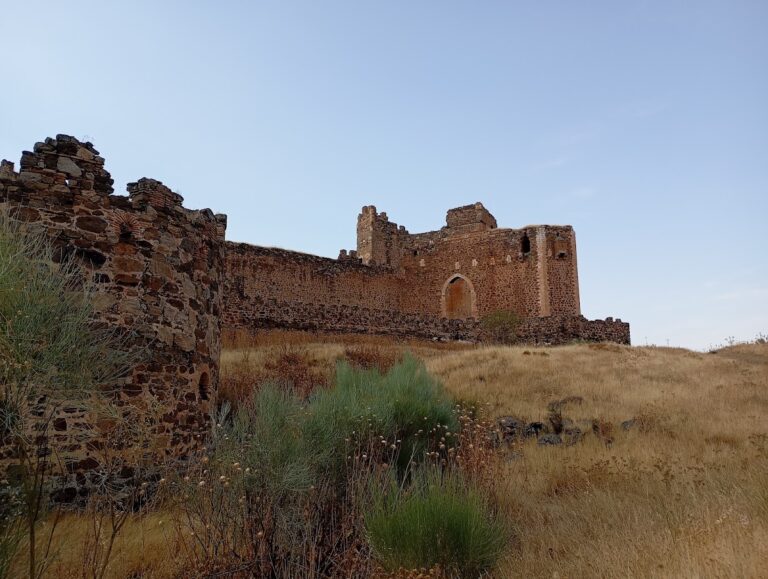
The castle occupies one of two twin rocky outcrops, separated by the Marlín stream, approximately 3 kilometres from Navahermosa. Its elongated, narrow, and irregular plan follows the shape of the outcrop. Three of its four façades survive, with rounded corners and masonry walls. A single entrance has a pointed arch, and a small arms courtyard in front of it was protected by a barrier or outer wall.
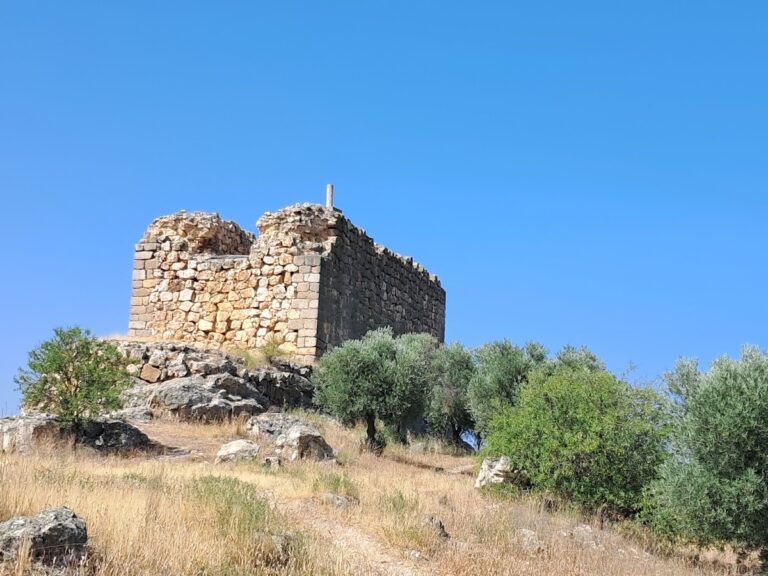
No interior structures survive. The outer walls retain holes near the former wall-top walkway used by defenders, but no projecting defensive structures or machicolations, which were platforms with openings for attacking people below, remain. The fortress is in an advanced state of ruin.
Remains of the Settlement
Foundations and faint traces of human activity surround the rocky outcrop, marking the former settlement associated with the castle. These traces merge visually with the stony ground, while the surviving fortress provides the principal physical evidence of the medieval occupation.
Nearby sites