Chalmazel Castle: A Medieval Fortress and Talaru Residence in France


Site at a Glance
- Rating
- 4.2
- Popularity
- Low
- Country
- France
- Primary era
- Medieval
- External website
- Open
- Eras represented
- Medieval, Early Modern
- Civilizations
- French
- Site type
- Military
- Remains
- Castle
On this page12 sections
History
Chalmazel Castle, also known as Château des Talaru, is a medieval fortress in France, in the commune of Chalmazel in the Haut-Forez. Construction began in 1231 on a forested site overlooking the Lignon valley. Guy IV du Forez, the medieval count who ruled the territory, financed the work and ordered Lord Arnaud de Marcilly to build a stronghold intended to counter the neighboring lordship of Couzan, held by the Damas family and linked to the Germanic emperor.
From Marcilly fortress to Talaru stronghold
The first fortified residence was developed into a larger medieval fortress. Its remote setting made the site difficult to reach and strengthened its defensive value. Chalmazel was initially held by the Marcilly family, but after Antoine II de Marcilly died without direct heirs around 1371 or 1372, the lordship passed to his sister Béatrix, the last of the Marcilly line. Her marriage to Mathieu de Talaru in 1364 brought Chalmazel to the Talaru, an old noble family from Lyonnais.
After the destruction of the Château de Marcilly, the Talaru family withdrew to Chalmazel. In 1400 they reinforced the castle with a five-sided enclosing wall and added machicolations to the keep. A machicolation is a projecting defensive gallery with openings through which defenders could attack people below the walls. These works strengthened Chalmazel as the family’s principal fortified residence.
Royal service and Renaissance transformation
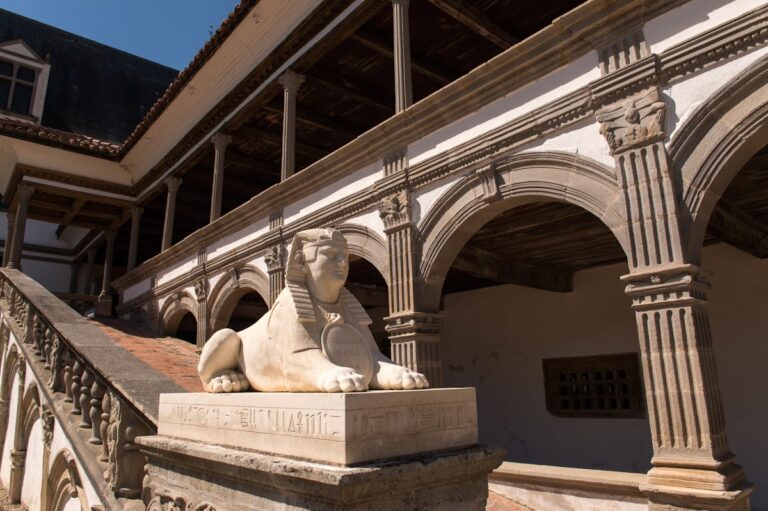
Forez entered the royal domain after the confiscation of the Constable of Bourbon’s possessions between 1523 and 1531. The Talaru then served the king in his armies. During the Renaissance, a Marquis de Talaru returning from the Italian Wars commissioned a series of improvements that softened the castle’s earlier severe appearance. Work included the facade, galleries around the inner courtyard, the chapel, and sculptural decoration. The Renaissance was a European cultural and artistic period that revived interest in classical forms, and at Chalmazel it was expressed through openwork facade elements, courtyard galleries, paintings, and sculpture.
From 1533, harsh winters encouraged the Talaru to favor residences at Château d’Écotay and, after its acquisition through marriage in 1559, at Saint-Marcel-de-Félines. Chalmazel became a summer residence and was increasingly neglected. The family later inherited Château de Chamarande near Arpajon, south of Paris, and moved closer to Versailles. Louis de Talaru held important positions at the royal court and in the army. The family abandoned Chalmazel in 1650, undertaking only urgent repairs, and the castle gradually deteriorated.
Hospital, school, and preservation
In 1850, Louis-Justin, the last Marquis de Talaru and twenty-fifth lord of Chalmazel, left the castle and its woods to the Sisters of Saint Joseph. A peer of France and ambassador of France to Spain, he had no heirs and intended the property to support a hospital for the canton and care for the sick.
The Sisters repaired parts of the building and adapted it for hospital use, adding institutional spaces for that purpose. They later converted the castle into a boarding school for children from the school at Chalmazel. The sisters left permanently in 1972 and leased the property to the commune on the condition that it would be maintained and opened to the public during the summer season.
Alain Suguenot and his family bought Chalmazel Castle in 2002 with plans for restoration, public opening, and bed-and-breakfast accommodation. The castle remains privately owned, with guest rooms and public access. Its facades, roofs, and surrounding land entered the register of historic monuments in 1949. The interior chapel and its decoration, together with the room known as the justice room, received separate protection in 2000.
Remains
Fortifications and defensive structures
Enclosing wall and towers
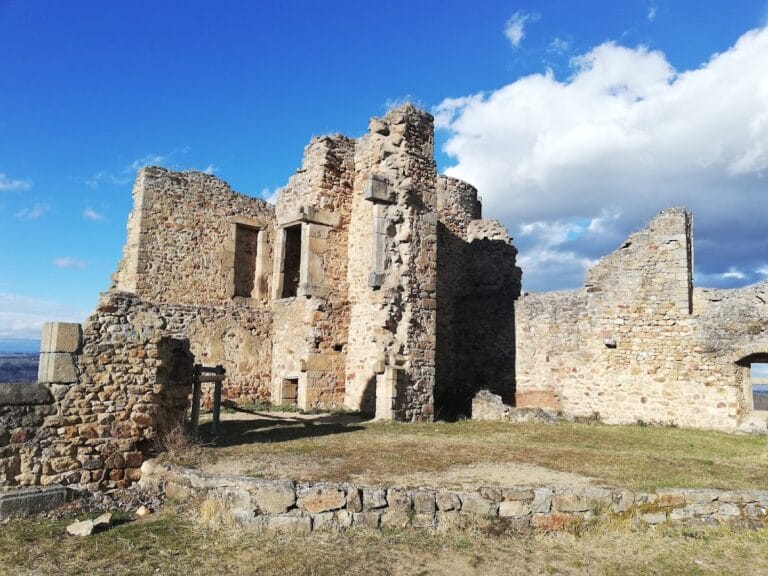
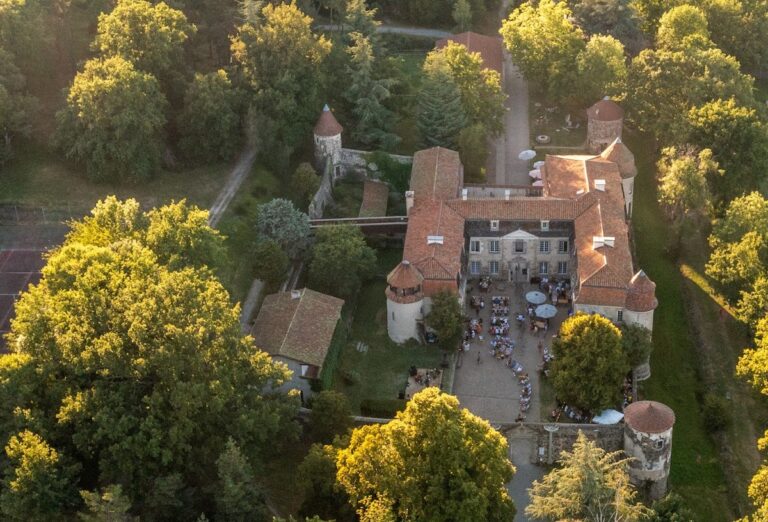
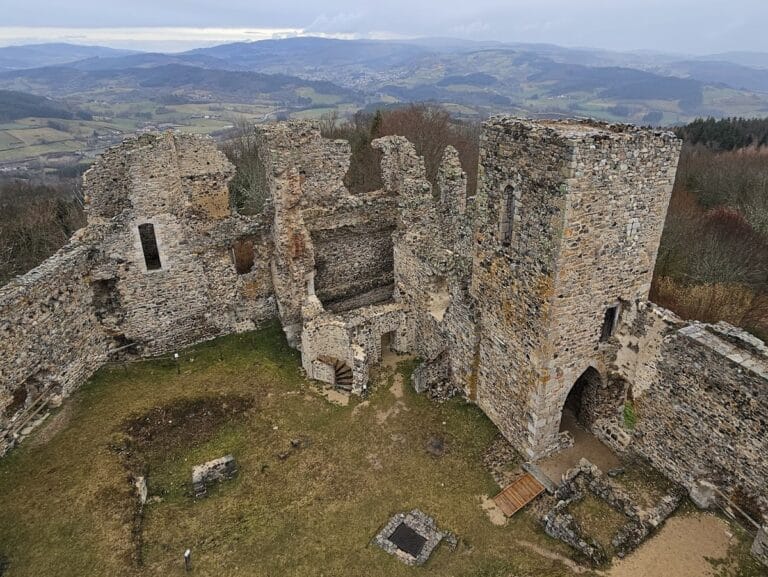
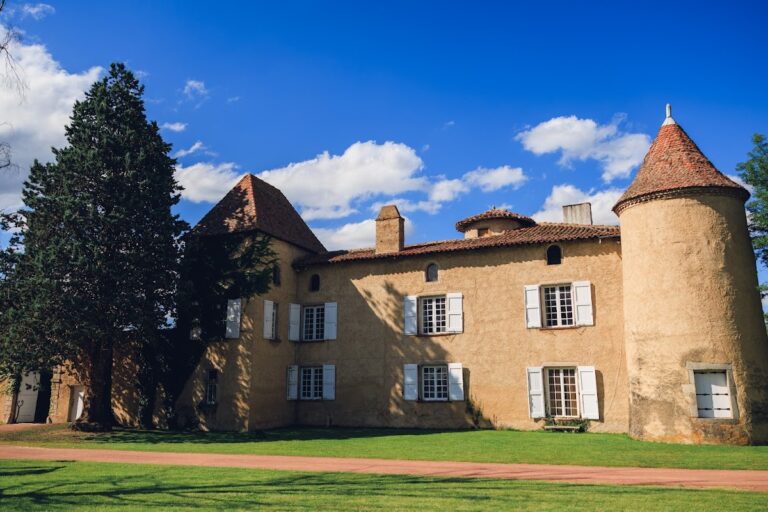
Chalmazel Castle occupies a forested site above the Lignon valley. Its medieval defensive layout centers on a pentagonal enclosing wall and four round towers. The original fortress was described as dark and severe, with the round towers dominated by a square keep. The Talaru strengthened this arrangement in 1400 by constructing the pentagonal enclosure and adding machicolations to the keep. The Sisters of Saint Joseph later rebuilt one of the towers and repaired the wall-walk, a passage along the top of a defensive wall used for movement and defense.
Square keep
The square keep dominates the castle’s towered form. Its strongly defensive character belongs to the medieval phase, while the machicolations added in 1400 represent a later strengthening by the Talaru. The keep formed the central defensive element of the complex and remains part of the castle’s surviving fortified structure.
Renaissance and institutional interiors
Facade and inner courtyard
Renaissance alterations changed the appearance of the medieval fortress through an openwork facade and galleries arranged around the inner courtyard. Sculptural decoration formed part of the same campaign of improvement, linking the castle’s defensive fabric with the residential ambitions of the Talaru family.
Chapel and justice room
The interior chapel retains decoration associated with the Renaissance transformation, including paintings and sculpture. The room known as the justice room is another protected interior space. Both the chapel and its decoration, as well as the justice room, are covered by historic-monument protection.
Hospital and boarding-school adaptations
The Sisters of Saint Joseph repaired the roof and wall-walk and rebuilt one tower. When the castle became a hospital, they added hospice rooms and service facilities. The later boarding school continued the building’s institutional use before the property returned to private ownership and public cultural use with guest accommodation.