Castle of Brescia: A Historic Fortress on Cidneo Hill in Italy


Visitor Information
Google Rating: 4.7
Popularity: High
Google Maps: View on Google Maps
Official Website: www.bresciamusei.com
Country: Italy
Civilization: Medieval European
Remains: Military

History
The Castle of Brescia is situated on the Cidneo hill near the historic center of Brescia, Italy. The fortress has its origins in the medieval period, but the site has been significant since prehistoric times, with evidence of settlements dating back to the Bronze Age in the 9th century BCE.
Early on, the hill hosted a small temple dedicated to Bergimus, a Celtic deity. Later, the Romans incorporated the Cidneo hill within the city’s fortifications at the end of the 1st century BCE. During the 1st century CE, they built a monumental temple whose foundations and supporting walls still survive beneath what is now the Visconti mastio. The area grew increasingly sacred over time, as shown by the presence of a paleochristian martyrium followed by a large basilica. This basilica, which stood until the 18th century, was eventually demolished due to damage from a powder magazine explosion. Notably, the Mirabella tower, reputedly built atop an earlier Roman tower, remains from this period.
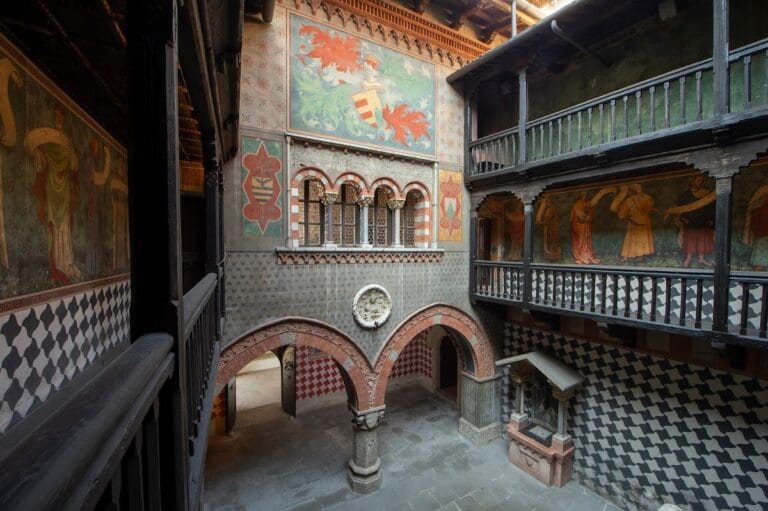
During the early Middle Ages, written records are limited, but beginning around the year 1000 CE, the site’s defenses were expanded. Between 1237 and 1254, city walls were constructed on the hill. Under the Visconti family’s rule starting in 1337, the Cittadella Nova—meaning “New Citadel”—was built to enclose important religious and civil structures. The mastio (main tower) served as the captain’s residence and was adorned with colorful bands, geometric, and floral designs; fragments of these decorations are still visible today. This mastio was defended by six towers, covered corridors, and possibly drawbridges. Additionally, a northern escape path called the Strada del Soccorso was created, which later grew in size and became a frequent point of entry during military conflicts.
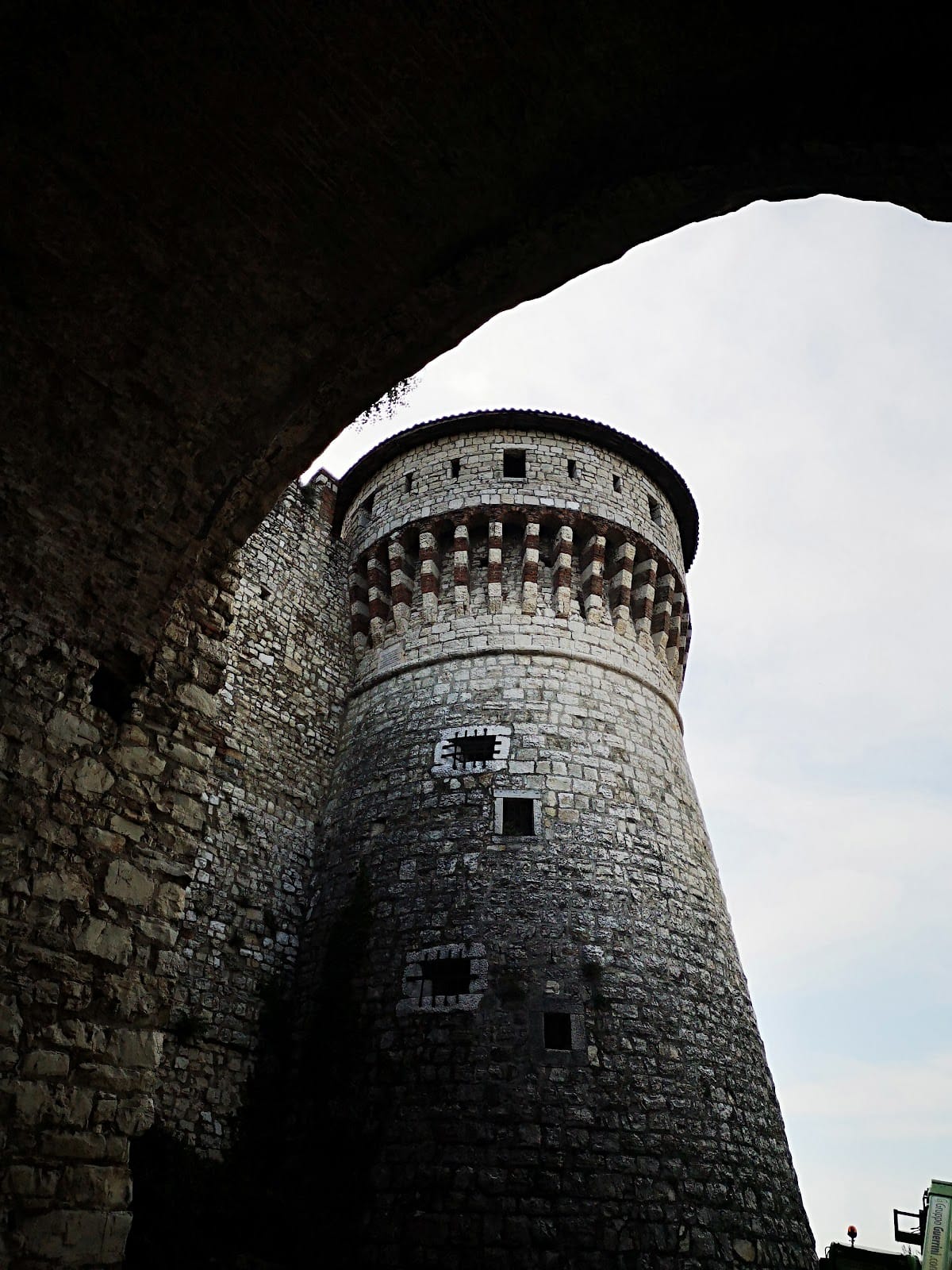
In 1426, Venetian forces took control of Brescia. They repaired damages caused by previous wars and, in 1466, reinforced the city’s defenses by lowering the walls and adding earthworks and moats. The previously square towers were reshaped into circular forms for greater strength, though only one of these northern towers remains today. French troops briefly occupied the fortress in 1509 but did not complete their planned expansions. They demolished the San Martino monastery to make way for new fortifications, which were ultimately left unfinished.
During the conflict between French and Venetian forces, Brescia was brutally sacked in 1512. Attackers used the Strada del Soccorso to infiltrate the fortress. Venetian control was later restored, and in the late 1500s, new bastioned walls—fortifications designed to better resist artillery—were built around the castle. These included the bastions of San Pietro, San Marco, San Faustino, and della Pusterla. Alongside these walls, several support buildings were constructed, such as storage facilities, ovens, barracks, religious buildings, cisterns for water, and powder magazines for munitions.
The castle’s military importance declined in later centuries as strategic defenses shifted eastward. It was then repurposed as a prison and barracks under both French and Austrian rule. In 1849, during the Ten Days of Brescia uprising against Austrian control, Austrian soldiers besieged the city from the fortress. They used the Strada del Soccorso once again to enter and quash the rebellion.
Following the Second Italian War of Independence in 1859, the castle continued to function as a military prison. Eventually, the municipality took ownership of the hill and initiated restoration efforts, transforming the area into a site for public events and exhibitions. In the early 20th century, notable events included the 1904 Industrial Exhibition inaugurated by King Victor Emmanuel III and a 1909 exhibition on electrical energy.
In recent years, the Castle of Brescia has housed museums such as the Museo del Risorgimento and the Luigi Marzoli Arms Museum, as well as the Specola Cidnea and large railway model displays. Guided tours offer access to hidden passages explored by local speleologists. On November 25, 2023, the castle was awarded the Blue Shield, an international symbol recognizing efforts to protect cultural heritage during armed conflicts.
Remains
The Castle of Brescia occupies nearly the entire summit of the Cidneo hill, covering an area approximately 300 by 250 meters. Its extensive layout reflects a complex network of military and religious structures integrated into the urban environment, rather than featuring a noble residence typical of feudal castles.
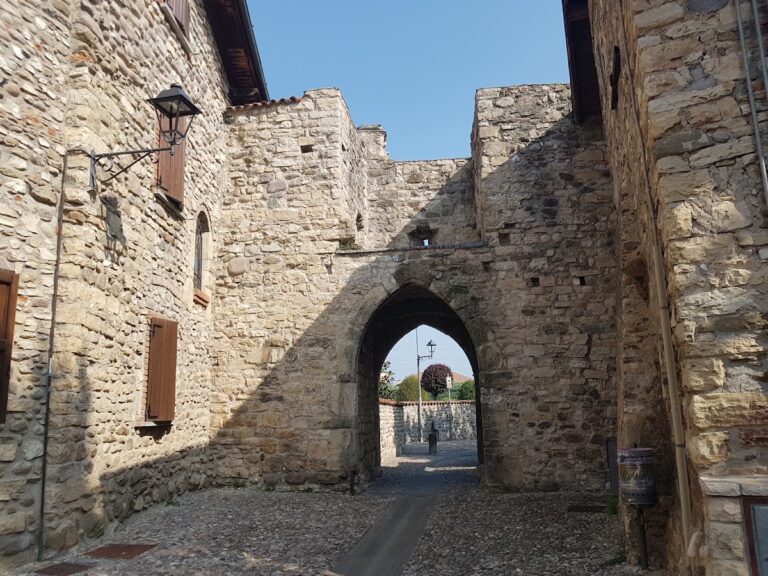
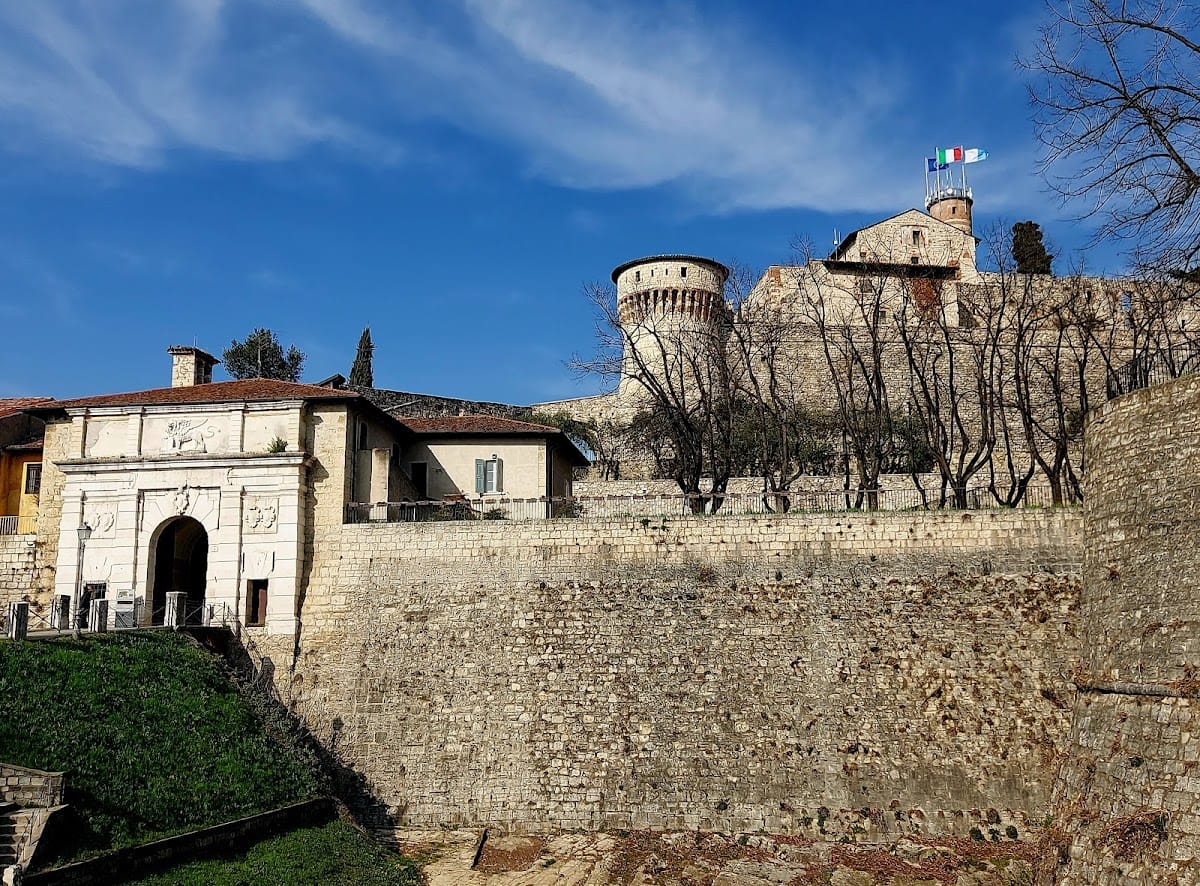
Visitors enter through a monumental portal built in the 16th century, attributed to Giulio Savorgnan and inspired by the military architectural style of Michele Sanmicheli. This imposing gateway is decorated with a large lion symbolizing Saint Mark, the patron saint linked to Venetian rule, along with the coats of arms of the Venetian rulers. Flanking the entrance are the bastions (fortified projections) of San Faustino on the left and San Marco on the right, forming part of the defensive system.
Near the entrance, to the right, stands the bastion of San Pietro, adjacent to a 16th-century well crowned by two stone lions sculpted by Domenico Ghidoni in 1890. To the left lies the bell tower of the former Santo Stefano Nuovo sanctuary, followed further along by the Haynau building, named after the Austrian marshal who led the 1849 siege operations.
A steam locomotive displayed on a large square above the San Faustino bastion symbolizes the early 20th-century Brescia-Edolo railway, highlighting the site’s connection to industrial progress. Near the entrance to the Strada del Soccorso, a long officers’ building guides visitors toward the Piccolo Miglio, now repurposed as an exhibition area, and the Grande Miglio, which houses the Museo del Risorgimento dedicated to the Italian unification period.
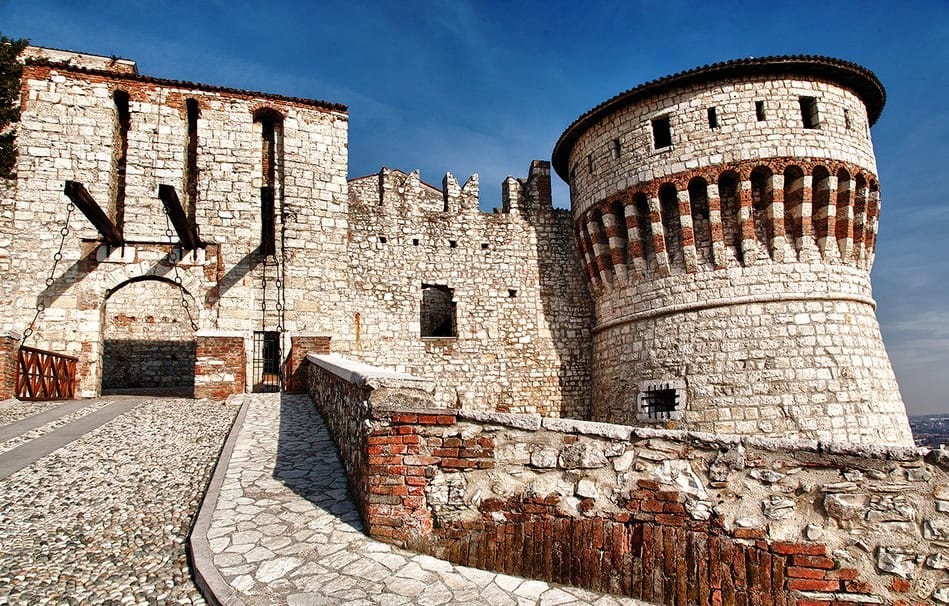
The 15th-century Coltrina tower is accessible through a covered passageway from the Grande Miglio. Among the medieval fortifications, the 14th-century walls retain a double drawbridge near the Prisoners’ Tower. The mastio, which once served as the main defensive and residential tower, exhibits remnants of Ghibelline battlements—characterized by swallowtail-shaped merlons—indicative of its medieval origins.
On the northern side, the gardens enclose the summit of the Coltrina tower, the Martyrs’ ditch—where executions of Resistance fighters took place in 1945—and the so-called French tower. The drawbridge in this area leads to the rocca (fortress head), including the Mirabella tower square. The Mirabella tower, likely constructed over an original Roman watchtower, stands close to visible remains of the Roman temple’s foundation walls.
The original defensive system surrounding the mastio comprised six towers, covered passageways for protected movement, and probably drawbridges to control access. The later addition of bastioned walls in the late 16th century significantly reshaped the fortress’s profile. These fortifications, including the bastions of San Pietro, San Marco, San Faustino, and della Pusterla, were complemented by auxiliary buildings such as ovens, barracks, storage areas, religious structures, cisterns for water collection, and powder magazines for storing gunpowder.
Today, the preservation of the castle varies across its elements. Some medieval and Renaissance structures remain partially intact, such as the mastio with its decorative polychrome bands, the Mirabella tower, and the northern tower from the Venetian period modifications. The site has undergone restorations which have softened its once purely military character, adapting the fortress for cultural and public use while retaining key archaeological features.
Nearby sites