Parco archeologico di Brixia romana: Roman Archaeological Park in Brescia


Site at a Glance
- Rating
- 4.7
- Popularity
- Low
- Country
- Italy
- Primary era
- Classical
- External website
- Open
- Eras represented
- Classical, Medieval
- Civilizations
- Lombard, Roman
- Site type
- City
On this page17 sections
History
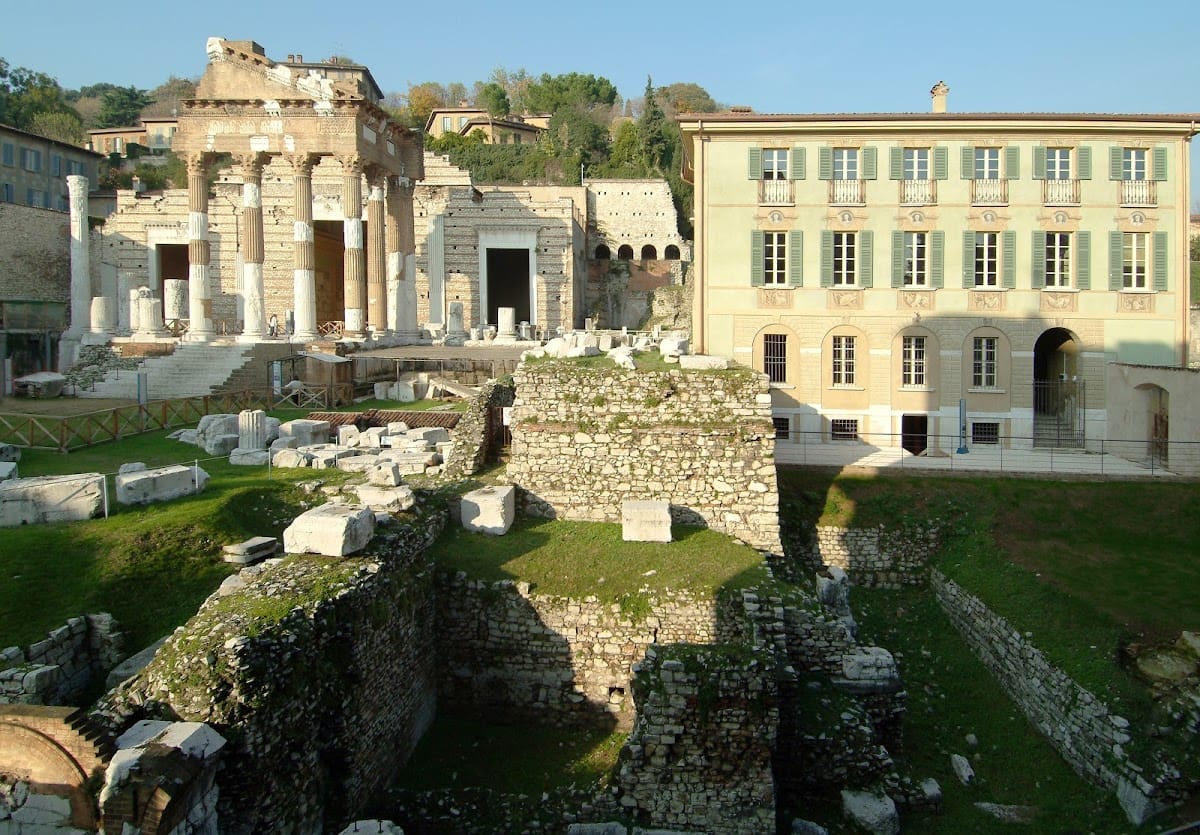
The Parco archeologico di Brixia romana preserves the monumental remains of ancient Brixia in Brescia, Italy. Founded by the Cenomani Gauls, the settlement entered the Roman sphere between the third and second centuries BC and developed into an important religious and civic centre of northern Italy. Brixia received Latin municipal status around 89 BC, Roman citizenship for its inhabitants in 49 BC, and colonial status in 27 BC as Colonia Civica Augusta Brixia.
From Cenomani settlement to Roman colony
Brixia’s integration into the Roman world brought major changes to its institutions and urban form. Under Augustus and Tiberius, the city acquired an orthogonal street plan arranged around the cardo and decumanus, the principal intersecting streets of a Roman town. An aqueduct, substantial walls, and public buildings were added, while regional routes connected Brixia with surrounding communities. These included the Via Gallica, the Via Mediolanum-Brixia, and the Via Brixiana.
The city was also an important religious centre within Regio X Venetia et Histria, the Roman administrative district covering northeastern Italy and the northern Adriatic region. Its principal religious area occupied the broad terrace between the Cidneo hill and the decumanus, now represented by Via dei Musei.
The Republican sanctuary
An earlier sanctuary was built from the second century BC as a monument to the alliance between Rome and the Cenomani. It was later demolished when Brixia became a Latin municipium, a town whose inhabitants held defined rights under Roman law. A new sanctuary was then constructed during the Sullan period, shortly after the grant of Latin rights in 89 BC.
The Republican sanctuary expressed Brixia’s adoption of Roman cultural models. Its construction is attributed to highly skilled craftsmen from central Italy, and its richly decorated rooms show the influence of Hellenistic design as adapted by Roman builders.
The Flavian city
The Capitolium, the principal temple of a Roman city and a centre of worship for Jupiter, Juno, and Minerva, was built by order of Emperor Vespasian in AD 73 or between AD 73 and 74. Vespasian, founder of the Flavian dynasty, ruled from AD 69 to 79. The temple rose above the earlier Republican sanctuary after his victory over Vitellius and became the chief temple of Roman Brixia.
The theatre remained in use until Late Antiquity, probably until the end of the fourth or the beginning of the fifth century. Between the eleventh and twelfth centuries, its stage collapsed, probably during an earthquake. The abandoned structure was then used as an open-air quarry for building stone. Public hearings took place there in the twelfth century, after which landslides and soil washed down from the Cidneo hill progressively buried the theatre.
Rediscovery and later interpretation
Systematic investigation began in 1823, when the Ateneo di Scienze, Lettere e Arti di Brescia initiated archaeological work through a public subscription. Excavations revealed the Capitolium, its furnishings, the Roman theatre, and a deposit containing large bronze sculptures. In 1830, the restored temple became the Museo Patrio, Brescia’s first municipal museum of Roman antiquities.
In 1826, members of the Ateneo found the Winged Victory within the walls of the ancient Capitolium, together with six imperial heads and hundreds of other bronze objects. After interdisciplinary study and restoration by the Opificio delle Pietre Dure of Florence between 2019 and 2021, the statue returned to the Capitolium.
The archaeological area also preserves evidence of occupation after the Roman period. Early medieval ceramic kilns, burials, and modest dwellings demonstrate the continued use of the site. Since 25 June 2011, the archaeological park and the San Salvatore-Santa Giulia monumental complex have formed part of the UNESCO World Heritage serial site The Longobards in Italy: Places of Power, 568-774 AD.
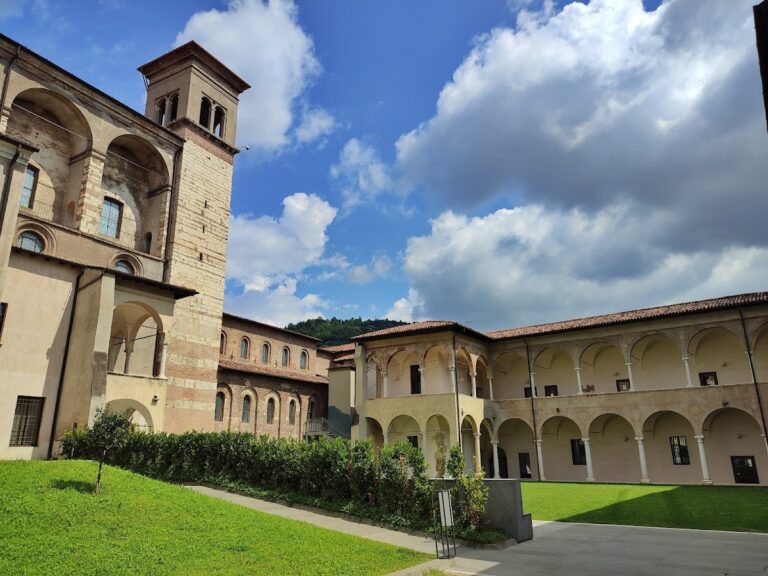
In June 2023, the UNESCO Corridor created an approximately one-kilometre monumental pedestrian connection between the Capitolium area and Santa Giulia. The route links Roman, early medieval, and Renaissance settings and includes two public squares formed within cloisters that had previously been accessible only to visitors of the Santa Giulia Museum.
Remains
The archaeological park covers approximately 4,000 square metres. Its principal remains occupy the Roman monumental centre and include the Republican sanctuary, the Capitolium, the Roman theatre, and the bronze deposit associated with the temple. Other excavated structures extend through the forum, bathing complex, and residential quarter on the lower slopes of the Cidneo hill.
Religious architecture
Republican sanctuary
The Republican sanctuary lies beneath Casa Pallaveri and the Capitolium. Its structures were identified in 1823, investigated between 1956 and 1961, and examined again from the 1990s. Four large rectangular rooms stand side by side on a common podium, with each room having its own entrance and pronaos, the columned porch before a classical temple or sanctuary. The complex occupied a terrace facing the decumanus, now Via dei Musei. The rooms measure approximately 8.30 metres in width and 10 metres in total length, and their podium rises about 2 metres.
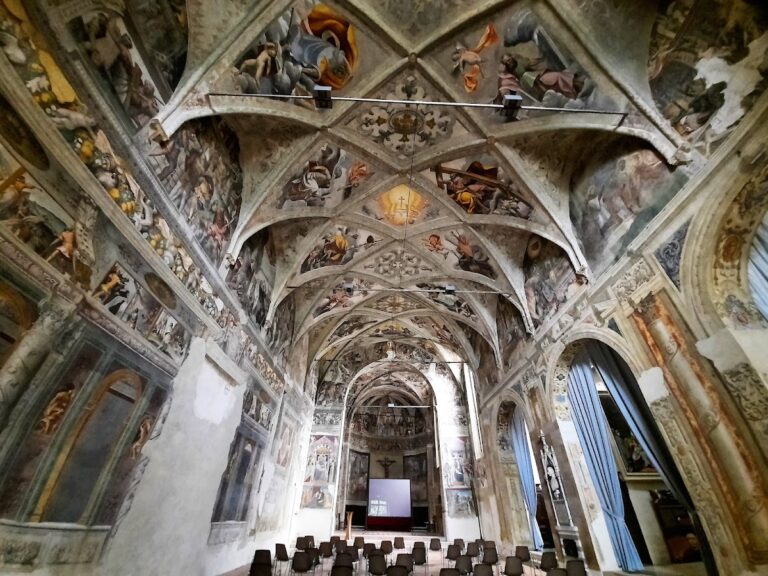
The interiors retain exceptionally well-preserved fresco decoration. Painted white fluted columns correspond to the physical columns and create the appearance of enlarged rooms. Painted panels imitate multicoloured marble slabs, while a painted cornice and hanging curtain conceal the masonry below. This decoration follows Hellenistic models mediated by Roman craftsmen and belongs to the second Pompeian style, which used painted architecture and imitation marble to create an illusion of expanded space. Recovered vault elements suggest that the rooms may have had vaulted coverings resting on entablatures or architraves supported by lateral rows of columns, although this remains an archaeological reconstruction.
Capitolium
The Capitolium stands on the northern side of the Roman forum beside the theatre. Its surviving and reconstructed fabric includes a pronaos with three large entrances leading to three internal cells, or temple chambers. The fronton carried an inscription naming Vespasian and listing his offices and titles, including emperor, chief pontiff, holder of tribunician power, imperator, father of the fatherland, consul, and censor.
Built above the earlier sanctuary, the temple used marble from the Botticino quarries near Brescia. Its reconstructed appearance combines original white stone with pinkish material added during the nineteenth-century restoration. The cells retain first-century AD floors made from coloured marble slabs fitted into geometric opus sectile patterns, a technique using cut stone or marble pieces to form decorative designs. Botticino stone altars, fragments of cult statues, and pieces of furnishings are displayed within the chambers, while the central cell contains the epigraphic collection assembled in 1830.
Winged Victory
The Winged Victory is a bronze statue approximately 194 centimetres high. It depicts a winged female figure, and although many fragments are missing, the surviving surface preserves detailed modelling and a strong three-dimensional effect. The statue is now interpreted as an ancient pastiche made under Vespasian. A third-century BC Hellenistic original, probably an Aphrodite reflected in the shield of Ares, was adapted with wings and a replacement right arm to represent Victory writing the victor’s name on a shield.
Dated to the first century AD, the statue is displayed in the eastern cell of the Capitolium. Its present installation was designed by the Spanish architect Juan Navarro Baldeweg, with the scale of the chamber and carefully planned lighting used to present the material and formal qualities of the bronze.
Theatre and forum
Roman theatre
The Roman theatre stands beside the Capitolium and was connected to it by a portico. Its cavea, the semicircular seating area for spectators, was partly laid against the slope of the Cidneo hill. The building could accommodate up to approximately 15,000 spectators.
The original layout belongs to the Augustan period, from the end of the first century BC to the first century AD. The theatre was enlarged and embellished over later centuries, including the rebuilding of its stage decoration during the second and third centuries AD. Its later collapse, quarrying, public use, and burial shaped the fragmentary remains visible today.
Forum structures
The forum area preserves the lowered remains of the forum portico, parts of a Roman road, and the remains of the basilica. Standing along the southern side of the forum, the basilica measured approximately 47 by 19 metres and served judicial and commercial functions. Its rebuilding during the Flavian period incorporated an earlier Augustan structure.
Baths and residential quarter
Flavian public baths
Flavian public baths were found beneath Palazzo Martinengo. Their surviving remains include part of a monumental bathing basin, or caldarium, a hot-water bathing room or basin. The structure has a cocciopesto floor, a waterproof Roman material made with crushed ceramic mixed into mortar, and walls once faced with multicoloured marble, fragments of which remain. The baths probably continued operating in Late Antiquity.
Domus dell’Ortaglia
The residential quarter known as the Domus dell’Ortaglia occupied terraced ground on the lower slopes of the Cidneo hill, between the monumental Roman area and the city walls. Its remains include second-century AD wall paintings, mosaic floors, the mosaic associated with the Domus of Dionysus, and the hypocaust of the Domus of the Fountains. A hypocaust was a Roman underfloor heating system, and its survival helps identify the arrangement of the residential complex.
Bronze deposit
The bronze deposit discovered near the Capitolium included the Winged Victory, six imperial heads, and hundreds of other bronze artefacts. Several portraits belong to the late third century or Late Antiquity and are identified or tentatively identified as Septimius Severus, Claudius Gothicus or Aurelian, and Probus. Another portrait represents Domitia Longina and dates to the Flavian period. Together, these bronzes form an important group of movable remains associated with the temple area.