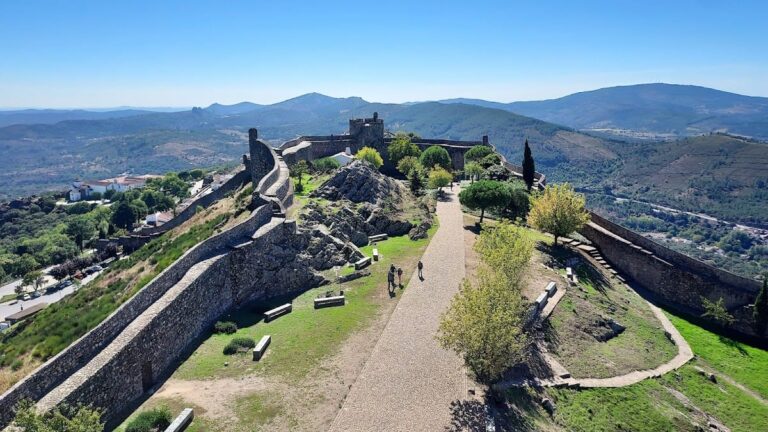
Castle of Alegrete: A Medieval Portuguese Fortress


Visitor Information
Google Rating: 4.6
Popularity: Low
Google Maps: View on Google Maps
Country: Portugal
Civilization: Medieval European
Remains: Military

History
The Castle of Alegrete stands in the municipality of Alegrete, Portugal, as a medieval fortress constructed by the Portuguese kingdom during the Middle Ages. Though traditional stories credit its initial reconquest from Muslim rule to King Afonso Henriques in 1160, historical documentation places the castle’s origins in the 13th century under King Afonso III, who oversaw the building or rebuilding of fortifications at the site.
Alegrete’s integration into the Portuguese realm was formalized by the Treaty of Badajoz in 1267, negotiated between Afonso III and Alfonso X of Castile. Shortly afterward, in 1319, King Dinis granted the settlement its foral, or charter, marking the start of significant reconstruction works. These efforts to strengthen the castle and town defenses continued throughout the 13th and 14th centuries, reflecting the fortress’s growing military role.
During the conflicts between Portugal and Castile, Alegrete was strategically important. In 1384, amidst the 1383-1385 crisis involving disputed succession, the renowned Portuguese general Nuno Álvares Pereira was based there. Despite later capture by Castilian forces in 1475 during King Afonso V’s reign, the castle returned to Portuguese control and received a renewed foral from King Manuel I in 1516, confirming its administrative and military significance.
The castle’s defenses remained relevant through the 16th to 18th centuries, particularly during the 1580 succession crisis and subsequent Portuguese Restoration War. Recognizing its importance, King John IV honored General Matias de Albuquerque with the title Count of Alegrete and maintained the castle as a frontline defense. A notable episode occurred in 1662, when a garrison led by the commander La Costé resisted a Spanish siege under John of Austria; local lore recalls that the defenders’ use of regional wine helped dissuade the attacker.
From 1664, the Marquess of Marialva undertook repairs and modernization works, including a now-lost bastioned outwork, enhancing the fortress’s defenses. The marquisate of Alegrete was created in 1687, first held by Manuel Teles da Silva, reflecting the castle’s continuing status in the nobility’s domain.
In 1704, the castle withstood a siege led by Philip V of Spain, and again faced bombardment during the War of the Oranges in 1801, despite its decline. Although the Liberal Wars of the early 19th century brought combat near the area, the castle itself played no prominent role. The municipality and its courts were abolished in 1855, leading to the castle’s gradual abandonment.
Recognizing its historical value, the Castle of Alegrete was classified as a National Monument in 1946. Restoration and consolidation efforts began in 1965 and have continued sporadically since then, aiming to preserve what remains of this fortress integral to Portugal’s border defense history.
Remains
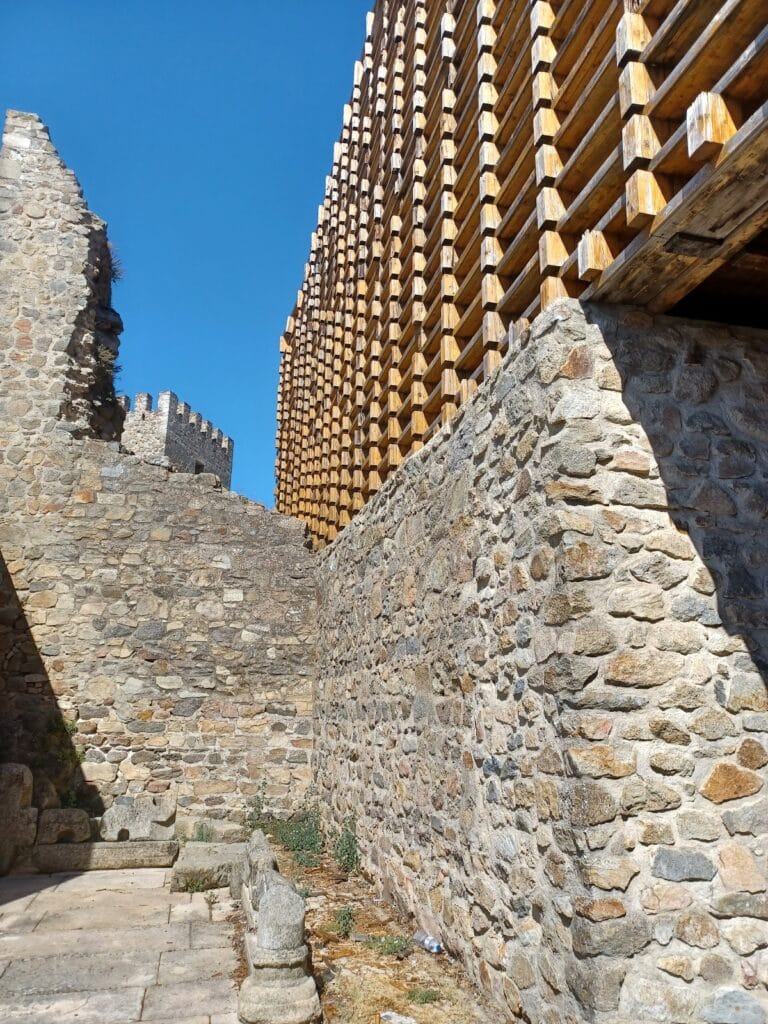
The Castle of Alegrete crowns a mountain rising approximately 503 meters above sea level, commanding views of its surroundings. Its overall plan is an irregular rectangle shaped according to Gothic military design principles. The fortress occupies the southern portion of a larger walled enclosure that once included the original settlement, itself protected by urban fortifications.
The main gate lies on the southern side, shielded by a small tower equipped with machicolations—openings through which defenders could drop projectiles on attackers below. This southern gate faces the town’s interior, emphasizing the castle’s role as the last stronghold. On the northern edge stands the “Vila” Gate, a well-preserved example of a Gothic urban entrance. It is flanked by two small defensive towers or corbels, designed to enhance protection and observation.
To the east, a rectangular keep tower rises with two floors and sits adjacent to a cistern integrated into the castle complex. The cistern, used for water storage, divides the tower internally: a lower floor includes a paved area and door facing south, while above the cistern, a second level can be reached by stairs from the courtyard. This arrangement highlights how the fortress combined military architecture with practical needs like water supply.
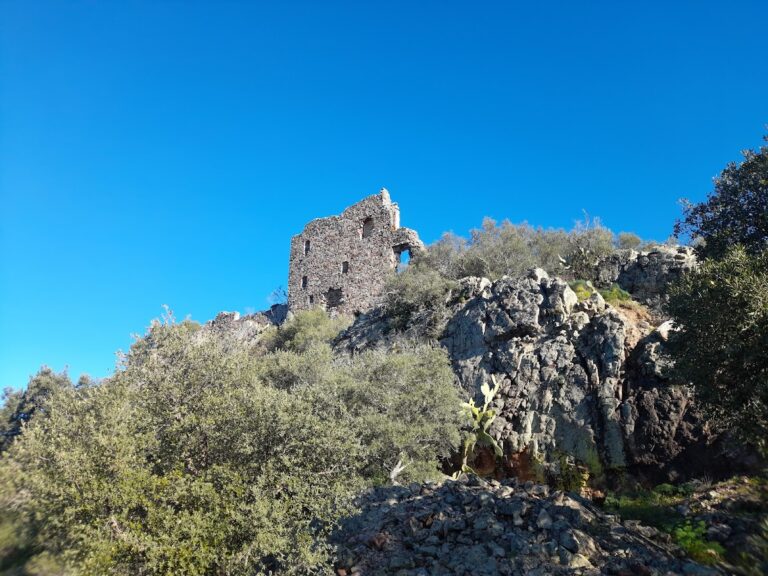
West of the keep lies a smaller tower and an open terrace, which connects to an inner patio space. In the south-southwest sector, ruins survive from a rectangular watchtower or cubel. This structure is accessible via a staircase affixed to the southern curtain wall, demonstrating the defensive layering of the castle.
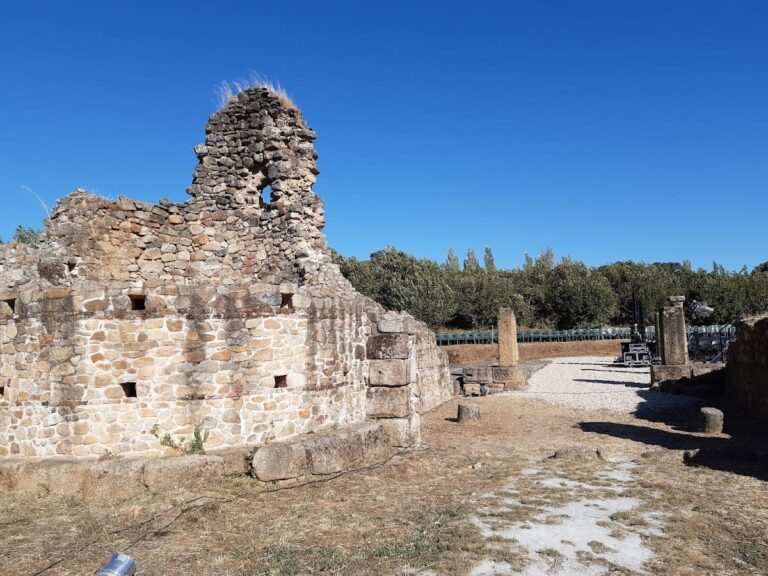
Within the castle grounds, the floor is uneven and rocky, reflecting the natural terrain incorporated into the fortress. Curtain walls surround the castle and connect to the town walls, which extend southwest from the “Santana” Gate, run west and then curve east-southeast at the Rua do Forno Gate to link back to the “Vila” Gate. These walls continue east to another small tower before turning south toward the castle. The walls are now largely in ruin but retain vestiges of trenches and defensive towers, attesting to their former strength.
A continuous wall walk, or adarve, runs transversely along the castle walls and is built into the terrain. Access to this walkway is provided by a stone staircase, allowing defenders to patrol the perimeter effectively.
In the 17th century, the castle’s defenses were augmented by a bastioned field fortification under the direction of the Marquess of Marialva. This additional fortification no longer survives and cannot be identified on the site today, but historical records confirm its past presence.
Together, the castle and its surrounding enceinte—an outer defensive wall—once formed a connected system safeguarding both the fortress and the town. Despite their current ruinous state, the remaining structures reveal a complex defensive arrangement developed over centuries to protect this crucial border settlement.
Nearby sites