Castello di Palizzi: A Historic Castle in Palizzi, Italy


Visitor Information
Google Rating: 4.3
Popularity: Low
Google Maps: View on Google Maps
Country: Italy
Civilization: Unclassified
Remains: Military

History
The Castello di Palizzi is located in the municipality of Palizzi in Italy. This castle dates most likely from the 14th century and is attributed to the Ruffo family, a noble lineage responsible for its initial construction. It was built primarily as a defensive stronghold designed to protect the region from frequent raids carried out by Turkish pirates who threatened the coastal areas.
By the late 16th century, the castle had already begun to show signs of deterioration caused by the passage of time. Above the entrance, a Latin inscription from 1580 records that the structure was “falling into decay due to age,” indicating that even within a few centuries of its foundation, upkeep challenges were evident. Throughout the centuries that followed, ownership and custodianship of the castle changed hands among several noble families. In the 16th century, the Romanos, the Colonnas, and the Erbos families undertook various modifications to the castle’s defensive structures, adapting them to the evolving military requirements of the time.
During the 18th century, the Arduinos di Alcontres family further altered the fortifications, continuing the trend of adapting the fortress to new needs. A significant transformation occurred in 1866 when the De Blasio baronial family converted the castle from a military fortress into a residential palace. This was marked by the construction of a masonry palace on the castle’s west side. The De Blasios maintained the site as a family residence until the 1960s and carried out some restorations. After this period, however, the building was abandoned, leading to its gradual ruin and the eventual loss of its roof.
Remains
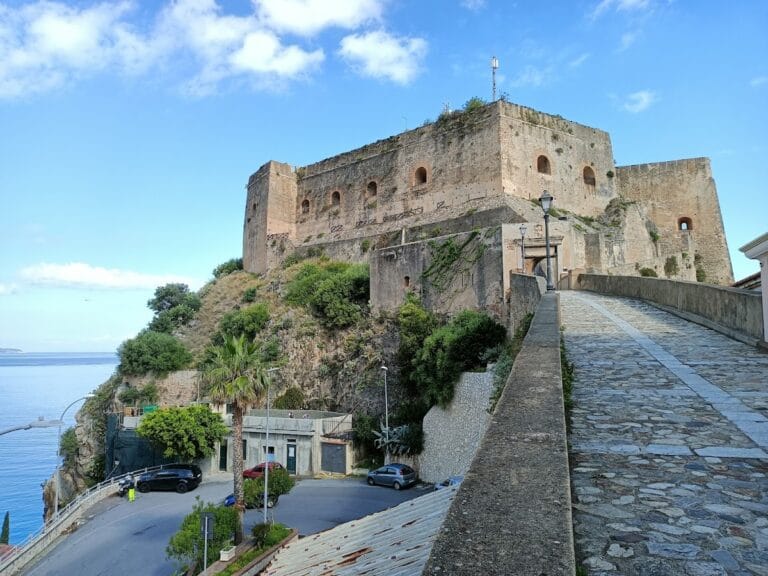
The remains of the Castello di Palizzi are perched on a rocky ridge approximately 300 meters above sea level, offering a commanding view over the village below. The castle’s position with only a single access road emphasizes its original defensive purpose. The surviving structure shows evidence of various phases of construction and alteration spanning several centuries.
Among the most prominent features still visible are two towers. On the east side stands a cylindrical tower topped with battlements, which are the parapets with gaps allowing defenders to observe and fire upon attackers. This tower dates back to the original period of construction or early modifications. On the west side, a rectangular tower can be seen, representing another key defensive element of the castle’s layout.
The perimeter walls of the castle remain largely intact, revealing a sophisticated defensive design. These walls include bastions with sloped bases, known as “scarpa,” which helped to deflect attacks from artillery or scaling attempts. Additionally, the walls feature separating bulls (“toro di separazione”), structural elements designed to strengthen the defensive barrier. Multiple tiers of gun openings are arranged along the walls, following the contours of the rocky ridge, allowing defenders to utilize various firing positions.
Traces of battlements and narrow vertical slits (arrow slits) can still be found on the ruins, testifying to the medieval military functions of the fortress. In the 19th century, the De Blasio family added a masonry palace on the west side built with brick, marking the transition from fortress to residence. Though this addition underwent some restoration efforts, the castle eventually fell into ruin after the 1960s, leaving the roof missing and the structure exposed to the elements.
Nearby sites