Castello Ruffo di Scilla: A Historic Fortress on the Strait of Messina


Site at a Glance
- Rating
- 4.5
- Popularity
- Medium
- Country
- Italy
- Primary era
- Medieval
- External website
- Open
- Eras represented
- Medieval, Early Modern, Modern
- Civilizations
- Byzantine, Crown of Aragon, French, Italian, Kingdom of Naples, Kingdom of Sicily
- Site type
- Military
- Remains
- Castle
On this page13 sections
History
Castello Ruffo di Scilla is a former fortress in Italy, located at Scilla on the promontory overlooking the Strait of Messina. Its first fortification was begun in 493 BC under Anaxilas, the tyrant of Rhegion, the ancient Greek city corresponding to modern Reggio Calabria. Built as a Greek defensive outpost during the classical period, it controlled maritime routes through the strait and became the defining historical landmark of Scilla.
Greek and Roman foundations
The fortification of the rock followed the defeat of Etruscan pirates who had used the area as a base. Later tyrants of Rhegion completed and strengthened the fortress, while a fortified harbor was established in the surrounding area toward Punta Pacì. Its position gave Rhegion control over an important maritime passage.
Dionysius I of Syracuse captured the fortress after a long siege in 390 BC. The Tyrrhenians reoccupied it during the roughly fifty years before Timoleon of Corinth, a Corinthian statesman and military leader, ended Syracuse’s tyrannical rule around 340 BC. Scilla then returned to the sphere of Rhegion.
In the third century BC, the fortress resisted Punic forces allied with the Bruttians while Rhegion supported Rome. Octavian, the Roman leader later known as Augustus, ordered further fortification after recognizing the strategic value of the promontory, which had provided him with refuge during his conflict with Pompey. Pliny the Elder later referred to Scilla as Oppidum Scyllaeum, using oppidum, a Latin term for a substantial fortified settlement.
Byzantine, Norman, and medieval rule
During the Byzantine period, the site was used by Basilian monks, who followed Eastern Christian monastic traditions associated with Saint Basil the Great. Their monastery of San Pancrazio was built around the middle of the ninth century, when the rock also served as protection against Saracen incursions. Excavations have revealed wall structures attributed to this monastic complex.
The fortress resisted the Norman siege of Reggio in 1060 for a long time and surrendered only because of famine. Robert Guiscard then established a military garrison there. In 1255, Manfred of Sicily ordered Pietro Ruffo of Calabria to strengthen the fortress and assign it a garrison. Charles I of Anjou carried out further fortification work during the thirteenth century.
Aragonese and Ruffo transformations
King Ferdinand I of Naples granted the castle to Gutierre De Nava in 1469. A Castilian knight associated with the Aragonese court, De Nava enlarged and restored the complex. During the fifteenth century, the medieval castle was adapted to the growing use of firearms and transformed into a Renaissance fortress, reflecting the European cultural period that began in Italy and influenced both the arts and military architecture.
Paolo Ruffo acquired the castle in 1543 and restored its baronial palace. The Ruffo family, a powerful noble house of the Kingdom of Naples, received the princely title of Ruffo di Calabria in 1578 and established its residence in the fortress in 1620. A prison was installed in the basement and became notorious for torture.
Decline, earthquakes, and military occupation
The fortress had lost its military importance completely by the beginning of the eighteenth century. Habsburg troops occupied it during the War of the Spanish Succession in 1713, a conflict over the succession to the Spanish monarchy. After the Treaty of Vienna in 1738, the castle passed to the Bourbon Kingdom of the Two Sicilies, the state that ruled much of southern Italy and Sicily from 1816 until Italian unification. Further fortress works took place between 1770 and 1772.
The Calabrian earthquakes of 1783 damaged the castle, after which the prison was closed. The fortress became state property in 1808 and was restored in 1810. Following the fall of the Parthenopaean Republic in 1799, the short-lived French-backed republic established in Naples, the site was occupied by Napoleonic troops. During the Coalition Wars, French and British forces changed control several times. French troops under General Louis de Partouneaux took possession in 1806 and regained the fortress in February 1808. Artillery damage from the preceding sieges led to alteration work between 1811 and 1813.
A lightning strike hit the powder magazine in 1812, severely damaging the fortress and killing two officers. The original structure was substantially altered, and little of the earlier fortress remained after the Napoleonic period. During Giuseppe Garibaldi’s Expedition of the Thousand in 1860, the campaign in which volunteer forces conquered Sicily and contributed to Italian unification, the fortress was surrendered without resistance to Garibaldi’s volunteers. Tradition holds that Garibaldi himself raised the Italian tricolor there.
Twentieth-century changes and present cultural use
The 1908 Messina earthquake destroyed most of the remaining older parts of the castle, including surviving portions of the former Ruffo residence. In 1913, the upper part of the fortress was closed to accommodate a lighthouse. During the Fascist period, some rooms were divided into apartments for employees and public officials, a use that contributed to further damage. Italian coastal artillery also used the fortress until the Second World War.
In the late twentieth century, the former fortress buildings housed a youth hostel. Extensive restoration later gave the complex a cultural function. It has hosted exhibitions and conferences and houses the Regional Centre for the Recovery of Calabrian Historic Centres.
Remains
Fortress layout and construction
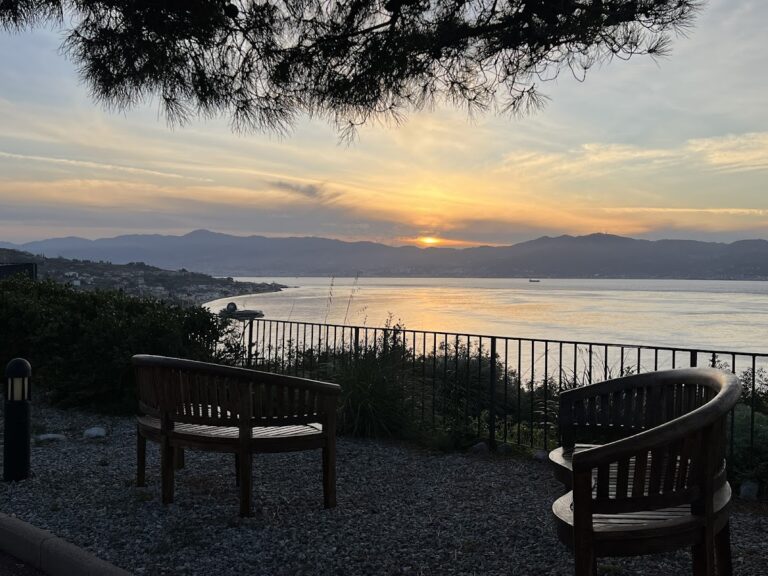
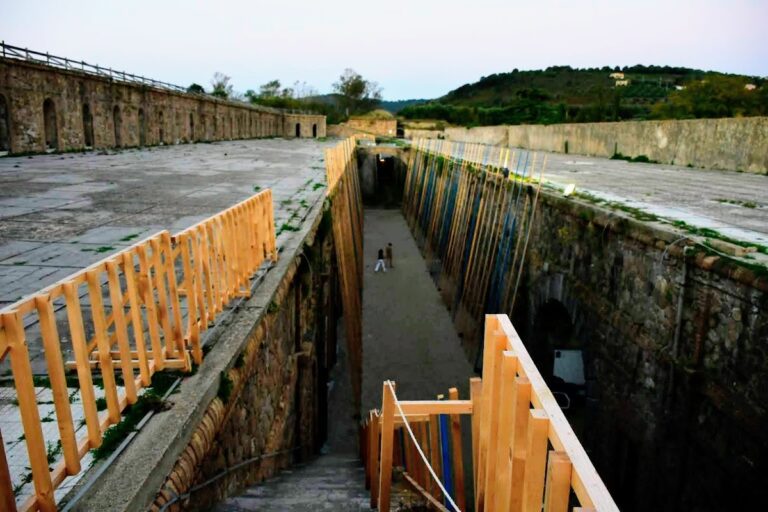
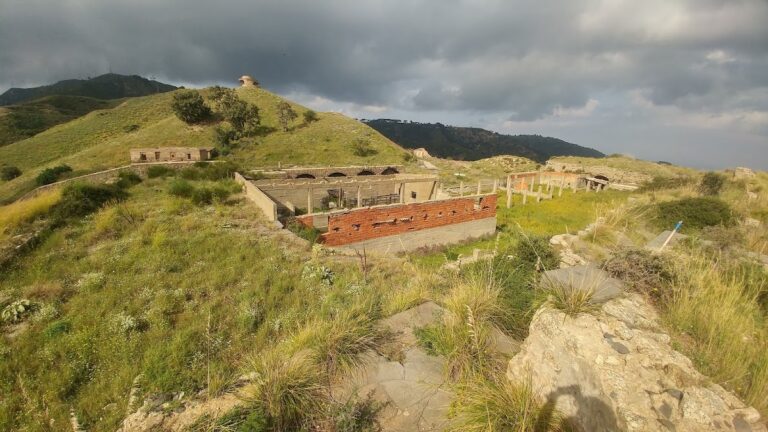
Castello Ruffo di Scilla occupies the rocky Scilla promontory at approximately 72 metres above sea level. The promontory projects into the Strait of Messina and separates the beaches of Marina Grande and Chianalea. The complex has an irregular plan because it incorporates fabric from several periods. Its surviving arrangement retains the character of a fortress, with curtain walls, towers or turrets, and loopholes, narrow openings through which defenders could observe or use weapons. Rubble stone and brick are among the recorded construction materials.
Entrance and courtyard
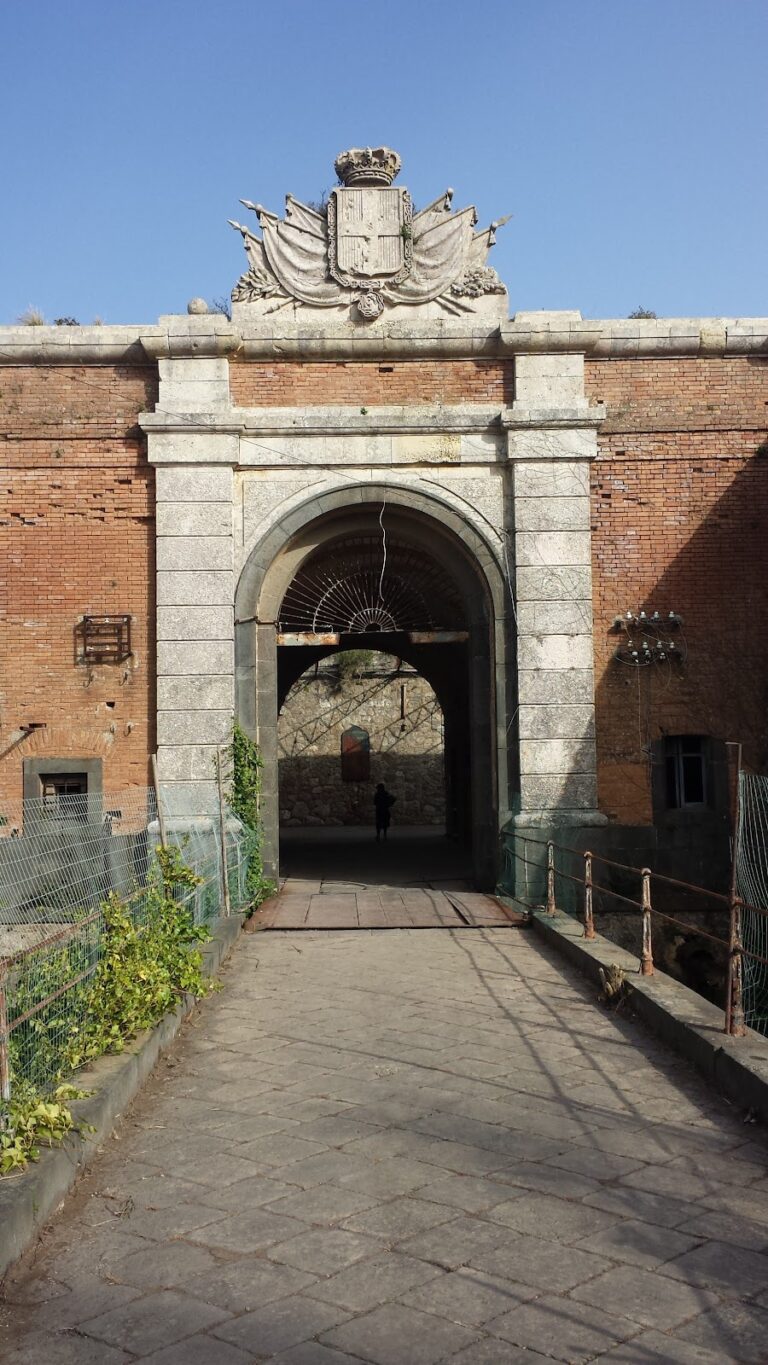
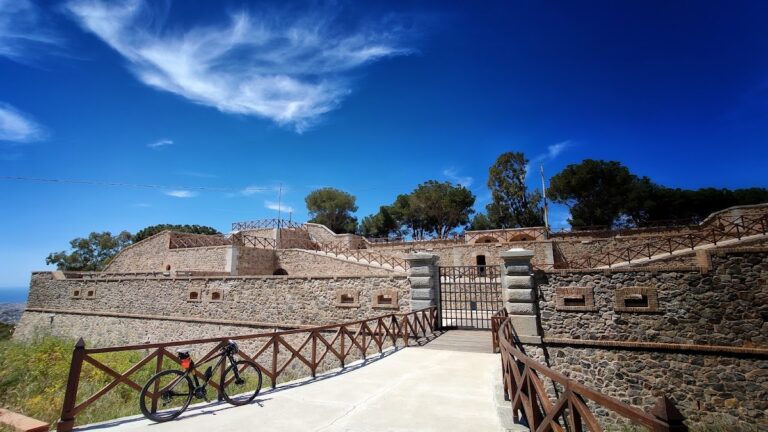
A bridge leads to the entrance. The principal doorway has a stone portal with a pointed arch, above which are the Ruffo family coat of arms and a plaque commemorating a sixteenth-century restoration. Beyond it, a low-vaulted passage or hall opens onto a courtyard. From the courtyard, a large staircase rises to the entrance of the residential section.
Residential section
The residential section was associated with large halls belonging to the Ruffo family, one of the wealthiest and most important noble families of the Kingdom of Naples. The older residential fabric was largely destroyed by the 1908 earthquake, leaving the surviving arrangement closely shaped by later alterations and restoration.
Lighthouse and exhibition areas
Scilla lighthouse
A small lighthouse occupies the northern edge and upper part of the rocky promontory. Built in 1913 as a navigational reference for ships crossing the Strait of Messina, it is a white tower with a black base. The lighthouse remains active under the management of the Italian Navy.
Restored cultural spaces
The restored complex includes exhibition spaces and viewpoints beside the lighthouse. A traditional swordfish-fishing boat, described as a luntre, has been displayed in the castle’s exhibition area, adding a material connection with the maritime environment historically controlled from the promontory.