Castle of Sant’Aniceto: A Byzantine Fortified Settlement in Calabria


Site at a Glance
- Rating
- 4.4
- Popularity
- Low
- Country
- Italy
- Primary era
- Medieval
- Eras represented
- Medieval
- Civilizations
- Byzantine, Norman
- Site type
- Military
- Remains
- Castle
On this page7 sections
History
Castle of Sant’Aniceto, also known as San Niceto or Motta Santo Niceto, is a Byzantine fortified settlement in Italy, near Motta San Giovanni and the hills overlooking Reggio Calabria. Built during the first half of the eleventh century under the Eastern Roman Empire, the kastron served as a stronghold where people could shelter and strategic goods could be protected. It was established to defend the population of Reggio from raids and to safeguard valuable silk produced in the area for the economy of Constantinople.
Byzantine and Norman periods
The castle belonged to the Eastern Roman Empire, the medieval continuation of the Roman Empire centered on Constantinople. Its dedication is traditionally connected with Sicilian refugees who reached Calabria with Byzantine government support and joined local inhabitants in building the stronghold. They are said to have named it for Saint Nicetas, a Byzantine admiral traditionally associated with the dedication whose cult was widespread in Sicily.
After the Norman capture of Reggio in or after 1060, the fortification continued to function as a lookout and refuge. This role became especially important as Saracen raids, a medieval term for Muslim raiders or forces, intensified along the coasts of Calabria and Sicily. During the Norman period, the castle was enlarged with rectangular towers.
Fief and barony
In the thirteenth century, Sant’Aniceto became the command center of a prosperous fief. Around 1200, the territory was drawn into wars between Angevin and Aragonese forces, rival dynastic powers whose struggle for southern Italy shaped political allegiances in Calabria. In 1321, the fief was handed over to the Angevins.
Sant’Aniceto became a barony in 1434. A barony was a feudal territorial lordship governed by a baronial authority, and this one ruled the territories of Motta San Giovanni, Montebello, and Paterriti. A document referring to Motta San Giovanni dates from 1412. Another document, from 1604, records Santo Niceto as belonging to the Barony of Motta San Giovanni.
Conflict and destruction
In the fifteenth century, Sant’Aniceto, like other Angevin-aligned fortified settlements in the area, came into conflict with Reggio, which was supported by the Aragonese. In 1459, with the approval of Duke Alfonso of Calabria, Reggio forces captured and burned the castle. The attackers deceived the defenders by placing lamps on goats’ horns. Mistaking the animals for an approaching army, the defenders left the fortification insufficiently guarded.
The castle was later abandoned by the authorities responsible for it. Restoration and recovery work subsequently aimed to preserve the site and promote its historical and cultural importance. Sant’Aniceto is regarded as one of the few examples of high medieval architecture in Calabria and one of the few Byzantine fortifications in the region to have undergone such work.
Remains
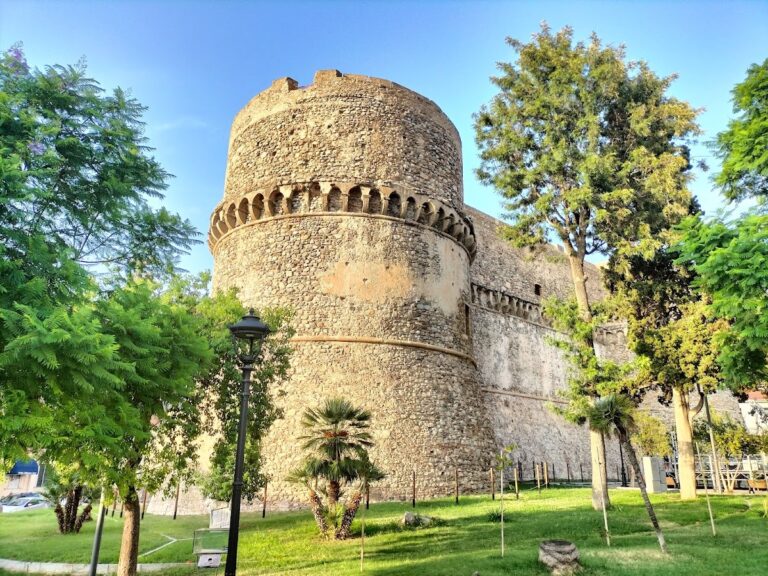
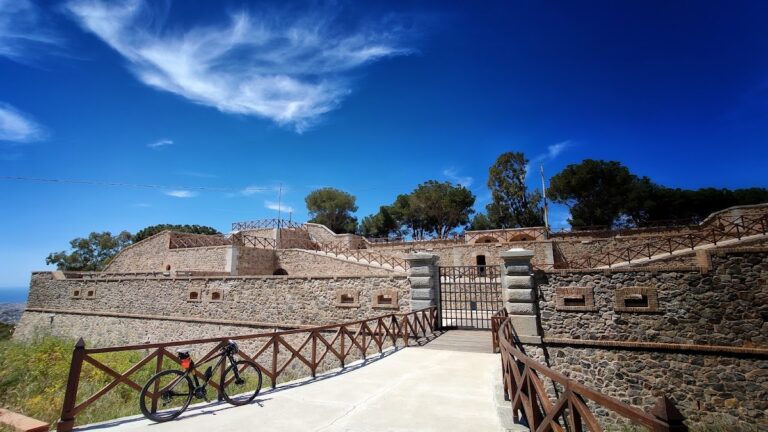
The castle occupies the summit of a rocky hill near Motta San Giovanni. Its irregular plan is described as resembling a ship, with the prow directed toward the mountains and the stern toward the sea. The surviving fortification is formed mainly from dressed stone, brick, and highly durable mortar, with stone and wood also listed among its construction materials. The walls stand approximately 3 to 3.5 metres high and are about 1 metre thick.
Fortification
Two square towers stand beside the entrance, while the rectangular towers belong to the Norman expansion of the stronghold. The walls are described as well preserved, allowing the defensive outline and the relationship between the entrance and its towers to remain legible. A short, steep path descends from the castle toward the plain.
Church at the foot of the hill
At the foot of the descending path stands a small church with a dome and frescoes. The domed vault includes a representation of Christ Pantocrator, the Byzantine image of Christ as the all-powerful ruler and judge. The church forms a separate surviving feature within the physical setting of the castle and preserves an architectural and artistic element associated with the site.