Castello Caldora: A Medieval Fortress in Pacentro, Abruzzo


Visitor Information
Google Rating: 4.5
Popularity: Medium
Google Maps: View on Google Maps
Country: Italy
Civilization: Medieval European
Remains: Military

History
Castello Caldora stands in the historic center of Pacentro, a town in the province of L’Aquila, within the Abruzzo region of Italy. Its origins trace back to the early medieval period, with construction phases beginning between the 11th and 13th centuries. Some evidence suggests that parts of the fortress, particularly the northeastern tower, may date as far back as the 10th century. This early phase established the castle as a strategic hilltop stronghold in the region.
Around the transition from the 14th to the 15th century, the castle underwent its first major renovation. This restructuring aimed to strengthen the fortress, adapting it to evolving defensive needs. Later in the 15th century, the Orsini family took control and significantly enhanced the castle’s defenses. They added large circular towers and built an outer trapezoidal wall, reflecting advances in military architecture designed to resist firearms.
Ownership of the castle shifted during the 15th century, passing to the Caldora family before returning to the Orsini in 1483. The Orsini continued to reinforce the fortress, preparing it for the challenges of gunpowder warfare. In the 20th century, the Gravina-Avolio family, the last private owners, donated the castle to the town of Pacentro due to the high costs of upkeep.
A notable legend surrounds the Torre Fantasma, or Ghost Tower. It is said that Baron Roberto de Luczinardo and his wife Margherita are commemorated there through a carved portrait. Another interpretation suggests the sculpture represents Rita Cantelmo, mother of the condottiero Jacopo Caldora, linking the castle to local noble families and their histories.
In the 1960s, the castle underwent restoration that initially used reinforced concrete, a method later criticized for its impact on the original structure. Subsequent restoration efforts focused on recovering the fortress’s authentic medieval appearance.
Remains
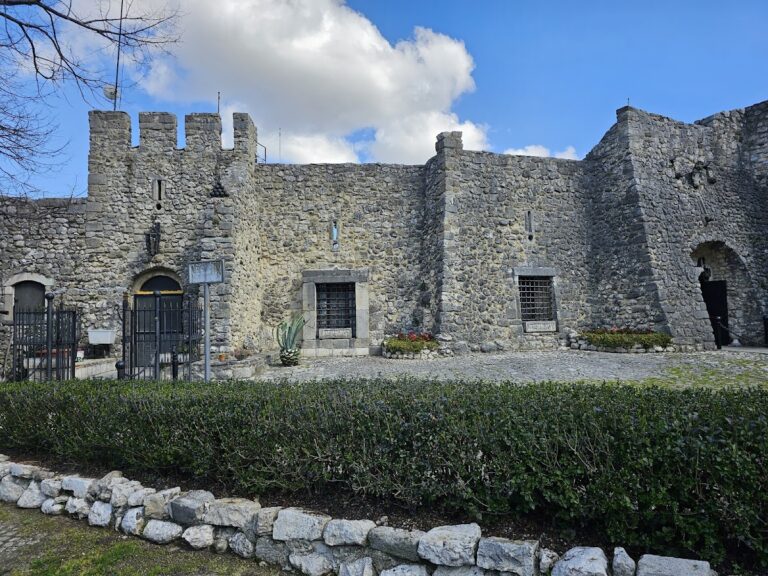
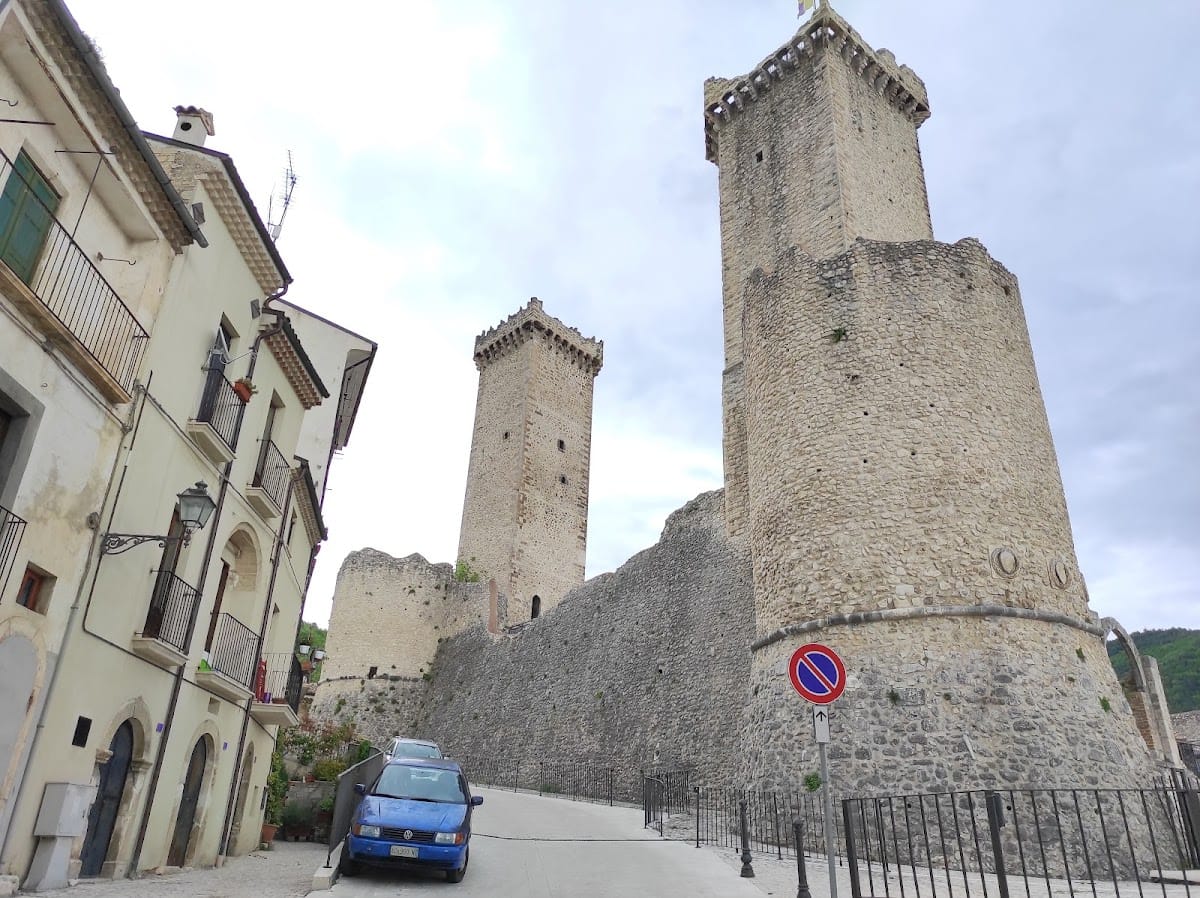
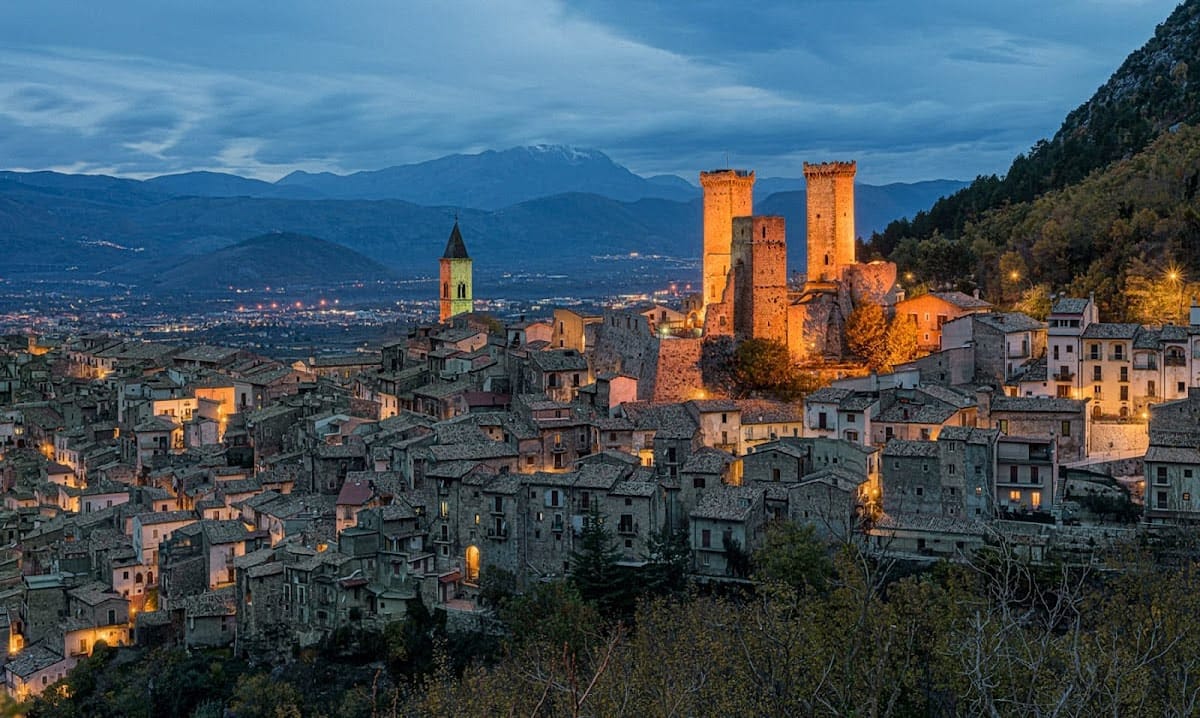
Castello Caldora is built on a hilltop and features a trapezoidal layout with two concentric rings of walls. The inner wall is older, while the outer wall dates from the Cantelmo period. Originally, four square towers stood at the corners, typical of the Valle Peligna area; today, three remain visible.
The castle’s defensive system was enhanced in the 15th century by the Orsini family, who added three large round bastions. These were designed to improve protection against firearms, reflecting changes in military technology.
Among the medieval towers, the Torre del Re (King’s Tower) stands out. Located in the northwest behind the drawbridge, this five-sided tower rises 25 meters. It earned its name from a feudal lord who ceremonially appeared there after taking possession of the castle.
The Torre Fantasma (Ghost Tower) in the northeast is 27 meters tall and dates from the 14th century. Its name comes from a local legend involving a carved portrait of Baron Roberto de Luczinardo’s wife, Margherita. Another theory identifies the figure as Rita Cantelmo, linking the tower to the Caldora family.
The oldest tower, Torre d’Assedio (Siege Tower), is in the southeast corner. It stands 12 meters tall but has a truncated upper section, damaged during an attack by Frederick II’s troops in 1230.
The castle’s façade, facing the square opposite the church of Santa Maria Maggiore, dates from the 17th century. It features decorative elements influenced by Renaissance style, similar to the church’s bell tower cornice, though the doorways retain pointed arches from earlier periods.
Near the entrance and on the towers, numerous coats of arms are visible. The most legible belong to the Orsini family, marking their historical presence and influence.
Castello Caldora is recognized for the skillful construction techniques used in its walls and towers. It ranks among the most masterfully built fortifications in Abruzzo, comparable to other regional castles such as Castello Piccolomini in Celano and Forte Spagnolo in L’Aquila.
Nearby sites