Castillo de Trujillo: Medieval Fortress in Spain


Site at a Glance
- Rating
- 4.5
- Popularity
- Medium
- Country
- Spain
- Primary era
- Medieval
- External website
- Open
- Eras represented
- Medieval, Early Modern
- Civilizations
- Crown of Castile, Spanish, Umayyad
- Site type
- Military
- Remains
- Castle
On this page9 sections
History
Islamic and Medieval Foundations
Castillo de Trujillo is a medieval fortress in Spain, at Trujillo in the province of Cáceres, whose complex includes an Islamic fortress dating from the ninth or tenth century and later medieval work. Its construction chronology remains uncertain. A later medieval castle was built over an earlier Moorish fortress, a term used for the Muslim peoples and culture associated with Muslim-ruled parts of the Iberian Peninsula.
Expansion of the Fortress
A second walled enclosure, known as an albacara, was added in the fifteenth century. An albacara was a secondary fortified enclosure used to shelter people, animals, or supplies outside a principal stronghold. The original enclosure had seven gates, and four of them, San Andrés, Santiago, Coria, and Triumph, survive after alterations made during the fifteenth and sixteenth centuries.
Protection and Heritage Status
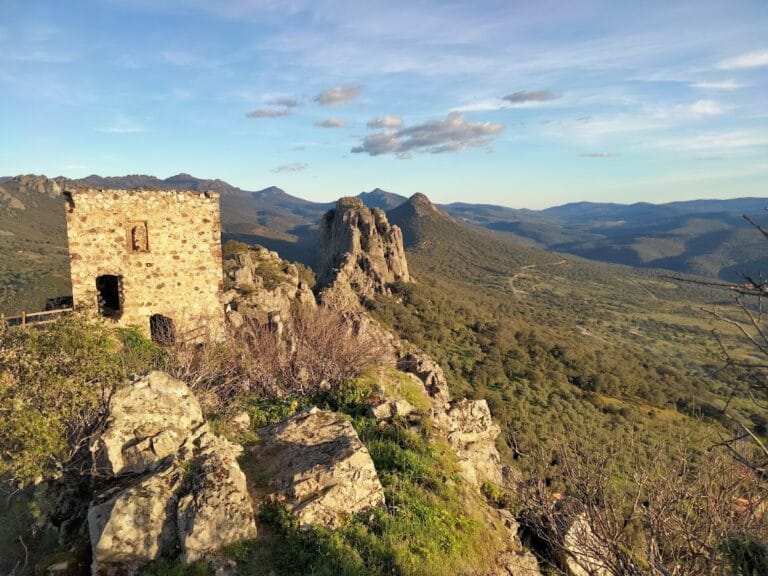
The fortress occupies the highest part of Trujillo on a hill above the town. Its defensive system includes walls, towers, and battlements, while a barracks courtyard formed part of the complex. Castillo de Trujillo has been protected as a historic monument since 7 April 1925, under registration code RI-51-0000308.
Remains
Fortress Enclosures and Defensive Works
Walls and Towers
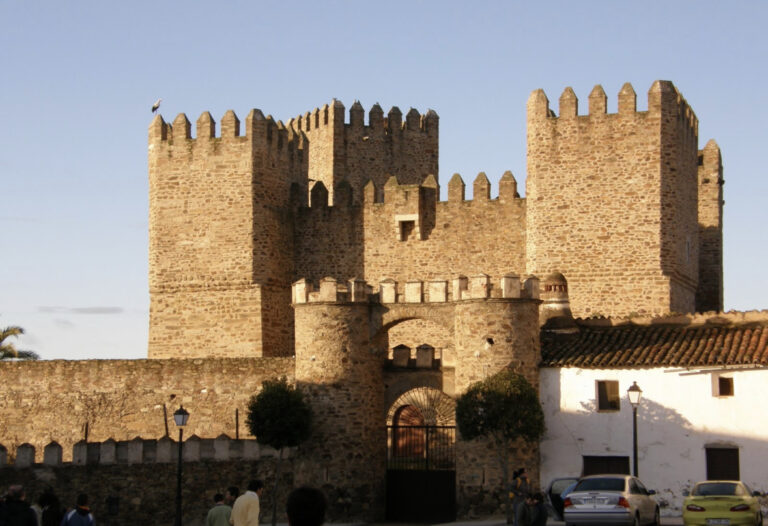
The castle is built mainly from dressed granite blocks. Its walled enclosure and barracks courtyard are accompanied by square defensive towers. The surrounding walls use ashlar, masonry made from regularly cut stone blocks, together with rubble masonry formed from less regularly shaped stones. Towers and battlements continue along the defenses, and seventeen rectangular towers survive. The area enclosed by these walls is known as the town’s old quarter.
Gates and Entrance
Four of the original seven gates remain: the Gates of San Andrés, Santiago, Coria, and Triumph. Each was remodeled during the fifteenth or sixteenth century. Two square towers protect the entrance gate, whose opening has a horseshoe arch, a form that curves inward beyond a semicircle and is characteristic of Islamic architecture in the Iberian Peninsula. The gate also bears an image of the Virgin of Victory, a devotional title for the Virgin Mary and the patron saint of Trujillo.
Early Water Infrastructure
The oldest surviving elements are two Islamic cisterns. They belong to the early fortress phase and preserve evidence of the water infrastructure associated with the Islamic stronghold.