Castello ducale di Palena: A Medieval Fortress and Museum in Italy


Site at a Glance
- Rating
- 4.3
- Popularity
- Very Low
- Country
- Italy
- Primary era
- Medieval
- External website
- Open
- Eras represented
- Medieval, Early Modern, Modern
- Civilizations
- Italian, Norman
- Site type
- Military
- Remains
- Castle
On this page8 sections
History
Castello ducale di Palena, also known as Castel Forte, is a medieval castle in Palena, Italy, whose origins are associated with the Normans and whose main construction belongs to the twelfth century. The Normans, a medieval people of Scandinavian origin, established political and military power in parts of southern Italy. Built on a rocky spur, the castle controlled the area as a fortified stronghold, a role it retained until the eighteenth century.
Norman Origins and Feudal Ownership
The site began as a Norman control tower during the eleventh century, when Norman settlement was established at Palena. It was subsequently enlarged into a defensive fortress. Matteo di Letto is among its earliest historically recorded owners. In 1269, Charles I of Anjou, the Angevin ruler who became king of Sicily and Naples, granted the castle to the feudal lord Sordello da Goito.
During the fourteenth century, ownership passed to the dukes of Manoppello and later to the Caldora and Di Sangro families, noble houses active in the political history of southern Italy. The fortress remained associated with grim legends about torture chambers in underground spaces within the rocky spur.
Prison, Destruction, and Abandonment
During the eighteenth and nineteenth centuries, the fortress was used as a prison for rebels, and the name Castel Forte became associated with it. Its last owners were the barons of Colledimacine. The castle was definitively abandoned during the twentieth century and then suffered severe neglect.
The 1933 earthquake and Nazi incursions during the Second World War in 1944 destroyed the turrets, main keep, and belvedere. The castle was restored in its original form during the following decade, although the destroyed turrets were not rebuilt. A belvedere, an elevated viewing structure, was reconstructed at one corner during the 1950s.
Municipal Restoration and Museum Use
After restoration, the castle became a museum and now houses the Alto Aventino Geopaleontological Museum, which concerns the geological and fossil history of the Alto Aventino area. The Municipality of Palena owns the complex, while work continues to restore or adapt its interiors for museum functions.
Remains
Castle Complex
The castle occupies a rocky spur and has a rectangular plan formed by the union of several buildings. Its surviving form combines medieval defensive origins with a sixteenth-century enlargement. The buildings are covered by double-pitched roofs of curved tiles, with eaves finished by cornices made from three overlapping tile courses. Rectangular windows are arranged on two levels. Along one of the longer sides, a loggia, or roofed gallery open along one or more sides, has four arches. The opposite side contains a series of four small arches.
Entrances and Reconstructed Features
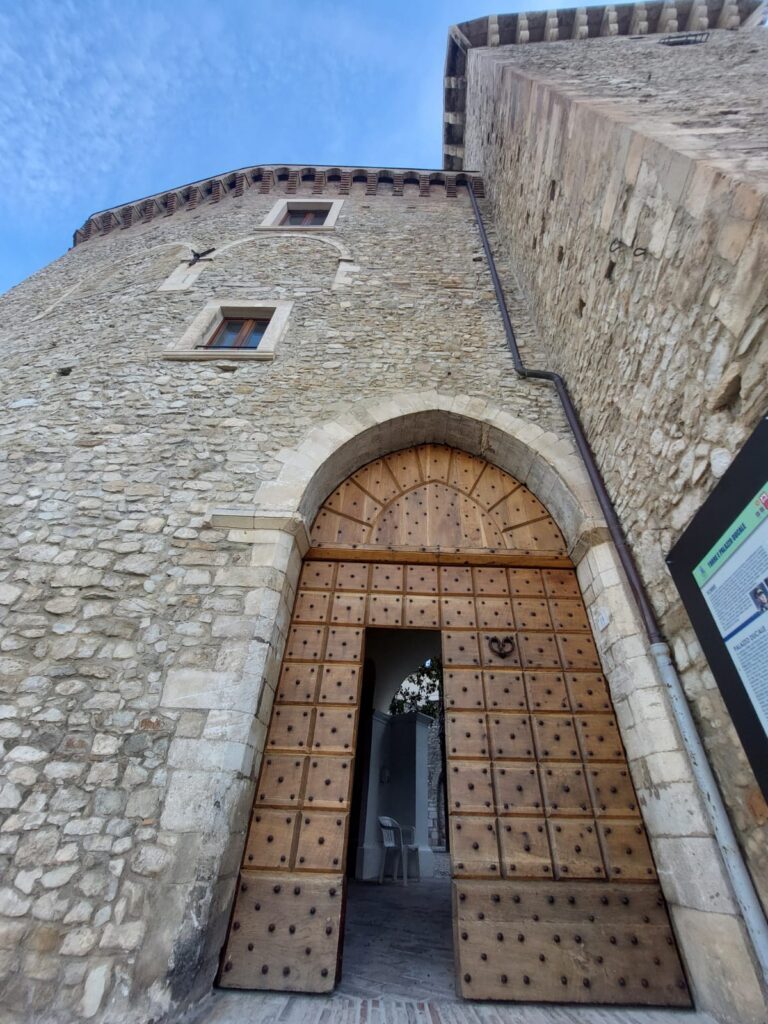
Access is provided by an urban gate with a single round-arched opening. On the opposite side, a lintelled portal has a horizontal beam above its opening, a moulded frame, and geometric designs. Much of the present appearance reflects postwar reconstruction after the destruction of 1944. The rebuilt corner belvedere forms part of this restored arrangement.
Courtyard Clock Tower
A new control tower was constructed in the courtyard around 1956. It replaced an earlier watchtower beside the Church of San Falco, which the municipal government demolished after the Nazi bombardments because it was considered unsafe. The demolition was contested by people who argued that the old tower remained in perfect condition, and only one arch survives from it. The replacement tower uses medieval architectural features, including battlements, four clocks on each facade, and a bell chamber at the top for striking the hours.