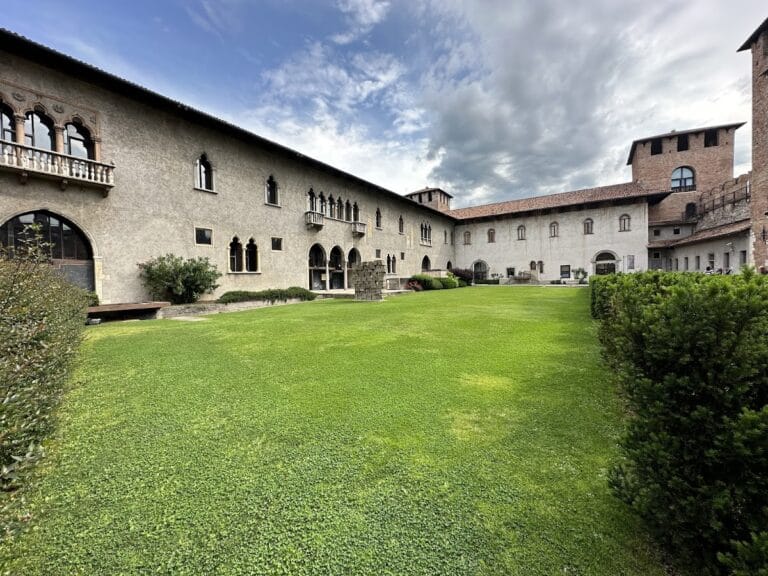
Castel San Pietro: A Historic Fortress Overlooking Verona
Visitor Information
Google Rating: 4.7
Popularity: Medium
Google Maps: View on Google Maps
Country: Italy
Civilization: Unclassified
Remains: Military

History
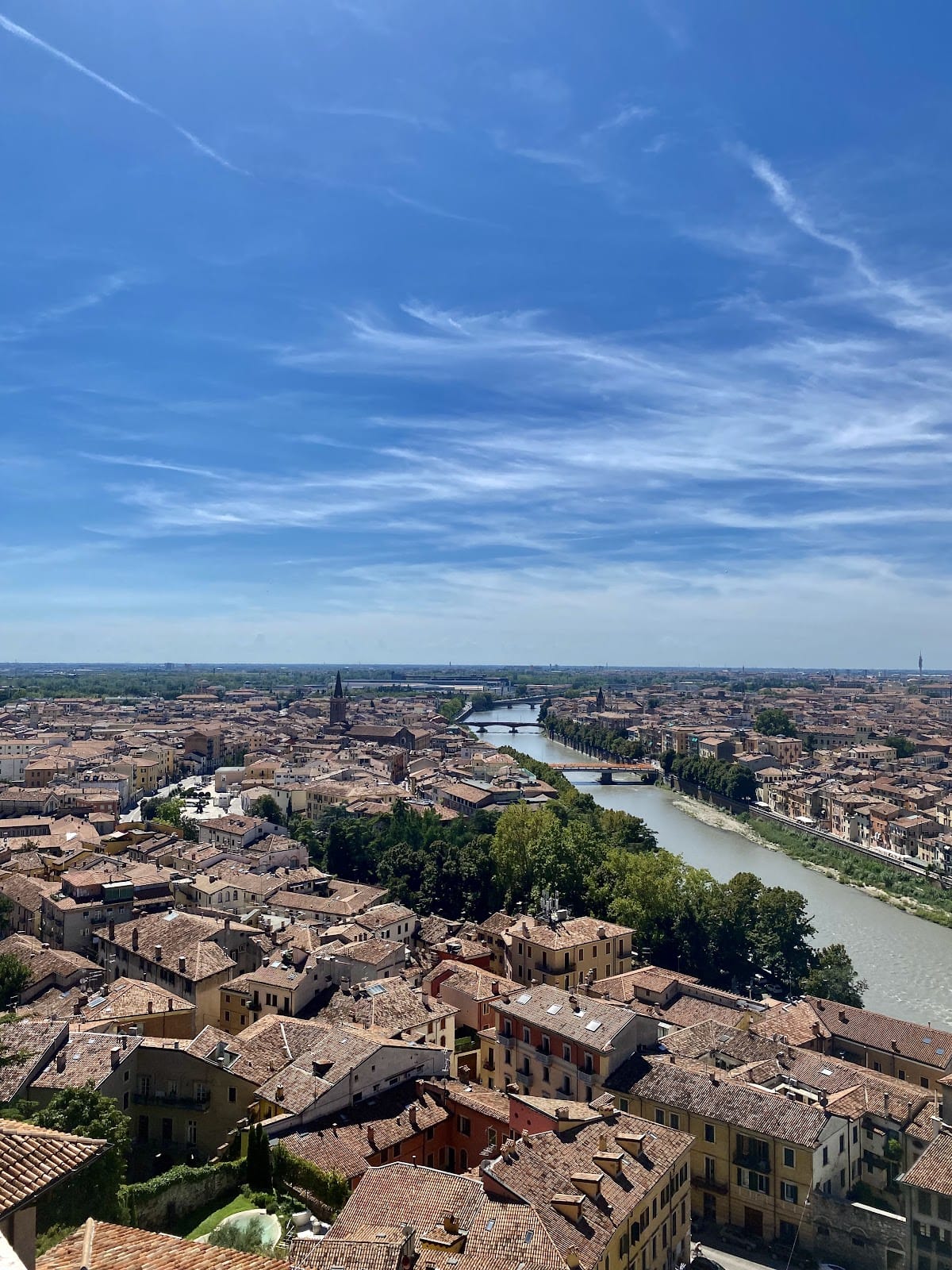
Castel San Pietro is located on a hill overlooking the city of Verona in northern Italy. The site has been valued for its strategic position since ancient times, with its origins tracing back to the Iron Age when early settlements established control over the territory.
In the early 1st century BCE, the area saw the development of a fortified sacred site known as the Arx by the Romans. This stronghold protected the crossing of the Adige River and the important Roman road named via Postumia. Archaeological and historical evidence indicates that a Roman temple once stood here, its ruins visible until the early 1800s. Over this pagan temple, a Christian church dedicated to Saint Peter was constructed and is recorded from the 8th century, highlighting the site’s continuous sacred and defensive use through the centuries.
During the early medieval period, the castle’s role as a fortification grew stronger. In 890 CE, under the reign of Emperor Berengario, the defenses of the site were reinforced to respond to military needs. Later, the castle underwent a significant rebuilding in 1393 by Gian Galeazzo Visconti, a powerful Milanese ruler. This reconstruction replaced many older structures and shaped the castle’s medieval form.
When Verona came under Venetian control, the castle functioned as a military headquarters, housing the commander’s residence. The Venetians expanded the fortress twice, in 1627 and again in 1703, to accommodate a larger garrison. These expansions doubled the infantry capacity from 150 to 300 soldiers, reflecting the ongoing military importance of the hilltop.
In the mid-19th century, the Austrian Empire constructed the current infantry barracks on the site between 1852 and 1858, following orders from Field Marshal Josef Radetzky. This new military building replaced earlier structures while retaining the site’s strategic function. Designed under the oversight of Conrad Petrasch by the Austrian k.k. Genie-Direktion Verona, the barracks served as a military installation until 1934.
Afterward, the building was repurposed for various civilian uses during the 20th century, including a fascist assistance center, an academy from 1939 to 1949, and later as an orphanage until 1978. More recently, beginning in 2002, efforts have been made to restore and transform the complex into a city museum, acknowledging its layered historical significance.
Remains
The historic complex of Castel San Pietro occupies an irregular, elongated area shaped by the contours of the hilltop on which it stands. The medieval castle’s curtain walls were distinctive for their alternating layers of pebbles and bricks, a technique that created striking, patterned surfaces. The original fortification featured twelve tall towers distributed along its perimeter, though most have been lost or reduced over time.
Notably, a high central keep known as the mastio was located near the northeastern end of the medieval fortress. Today, only ruins of this tower remain, marking where the strongest defensive point once stood. Access points included two main gates fitted with drawbridges on the eastern and southern walls, providing controlled entries, as well as a sally port—a small, concealed exit—connecting the northwest corner to a lower tower on the Scaliger walls encircling Verona.
Within the southern sector of the medieval castle were soldiers’ living quarters alongside the small church of San Pietro in Castello, which had been rebuilt in the early 19th century but was destroyed by Napoleonic troops in 1801. Despite this loss, a large underground cistern dating to the 16th century has been preserved, testifying to the castle’s logistical capacity to store water during sieges.
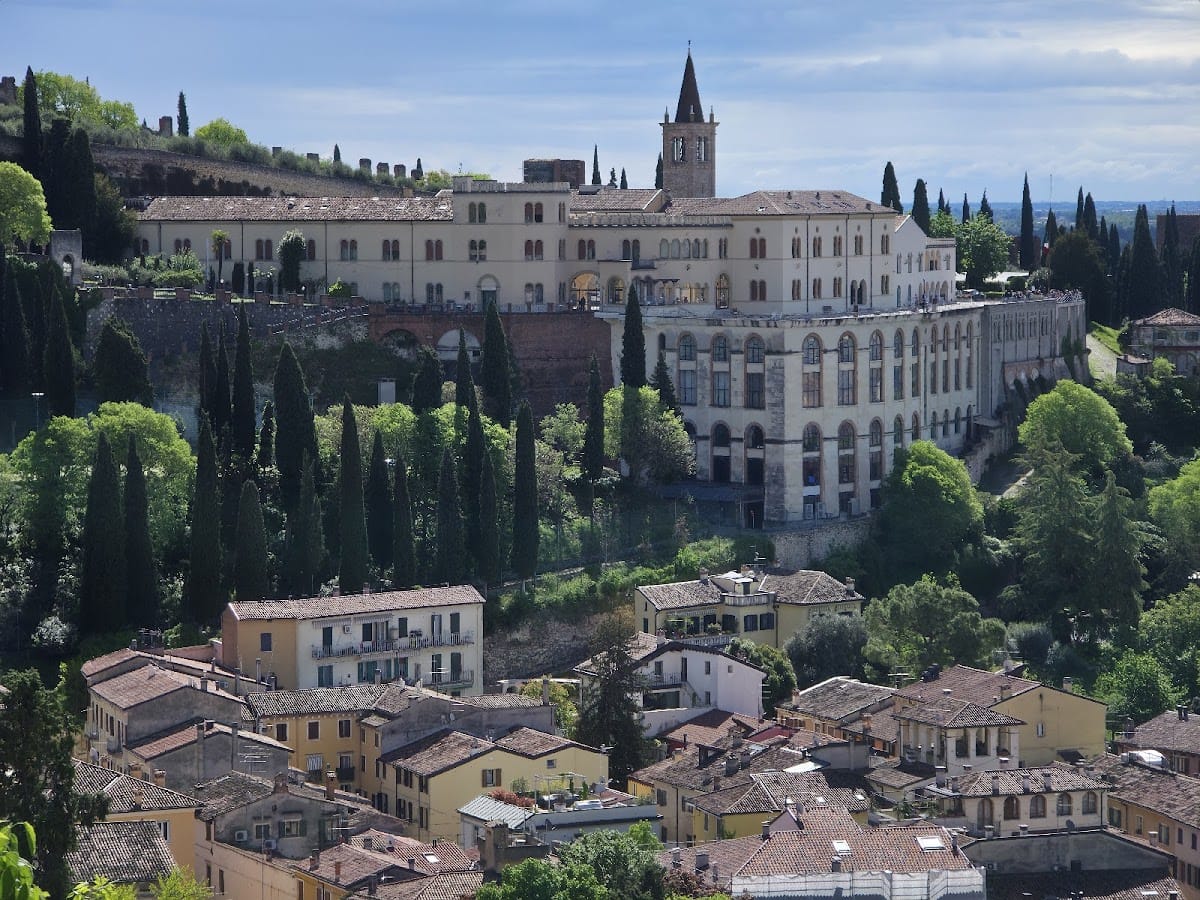
The Austrian infantry barracks built in the 19th century occupy the footprint of the original castle enclosure and partially cover the site where the church once stood. This structure takes the form of a tripartite linear block that adapts to the hill’s slope. Its central section rises four floors high, flanked on either end by taller, tower-like segments that exceed the main building’s height by one floor.
Internally, the barracks were organized with large, vaulted rooms created by lowered barrel vaults, which are curved ceilings that distribute weight efficiently. A main staircase is positioned centrally, and a long corridor runs along the rear side, vaulted through a full semicircular arch on the top level. This corridor connects multiple dormitory rooms on each floor that are also vaulted, reflecting careful design for accommodation and movement within the structure.
The two tower-like end modules feature vaulted rooms oriented perpendicular to those in the central block, linked by adjacent chambers. Sanitary facilities were housed separately in a small tower-like building located at the rear center of the barracks. The facility included spaces for sleeping quarters, command offices, officers’ accommodations, workshops for maintaining weapons and equipment, and storage areas. It housed two infantry companies along with artillerymen, accommodating a total of 452 soldiers and 9 officers.
The front courtyard of the barracks was intentionally designed to provide space for artillery deployment. This position allowed soldiers to oversee and control Verona from above if needed during military engagements.
Architecturally, the barracks exemplify the Rundbogenstil, or “round arch style,” a neo-medieval design first applied in Verona. This style features brick facades with decorative, polychrome arch rings, blending Central European medieval architectural elements with local Veronese artistic traditions. The building’s terrace roof is adorned with white battlements fashioned in a stylized manner. These battlements serve both military and aesthetic purposes, fulfilling directives from Radetzky to harmonize the new construction with the existing Scaliger fortifications on the hill.
Nearby sites