Capitolium of Brixia: A Roman Temple and Archaeological Site in Brescia, Italy

Visitor Information
Google Rating: 4.7
Popularity: Medium
Google Maps: View on Google Maps
Official Website: www.bresciamusei.com
Country: Italy
Civilization: Roman
Remains: Religious

History
The Capitolium of Brixia is located in what is now Via dei Musei, 55, in Brescia, Italy. It was built by the Romans during the first century AD, serving as a central religious and civic monument in the city known in antiquity as Brixia. The temple was constructed in 73 AD under Emperor Vespasian, commemorating his victory over General Vitellius during the Year of the Four Emperors. An original inscription on the temple’s pediment confirms this dedication. The site was chosen atop an earlier Republican-era temple, reflecting the city’s support for Vespasian by providing troops during the civil conflict.
The temple was dedicated to the Capitoline Triad of Roman gods: Jupiter, Juno, and Minerva. It functioned as the main religious center for the Roman inhabitants of Brixia, symbolizing the city’s integration into the Roman Empire and its religious traditions. The temple and the surrounding forum formed the heart of the city’s public and religious life during the Imperial period.
In the 4th century AD, the Capitolium was destroyed by fire amid barbarian invasions that affected the region. Following this destruction, the temple was buried by a landslide from the nearby Cidneo Hill during the Middle Ages. This natural event concealed the ruins for centuries, leaving the site hidden beneath layers of earth and debris.
Archaeological interest in the Capitolium began in 1823 when the Ateneo of Brescia, supported by municipal and private funds, initiated excavations. These efforts uncovered the temple and the adjacent forum area. In 1826, a significant discovery was made within the temple precinct: a hoard of Roman bronze artifacts, including the renowned Vittoria Alata, a winged victory statue. This find highlighted the cultural and artistic importance of the site.
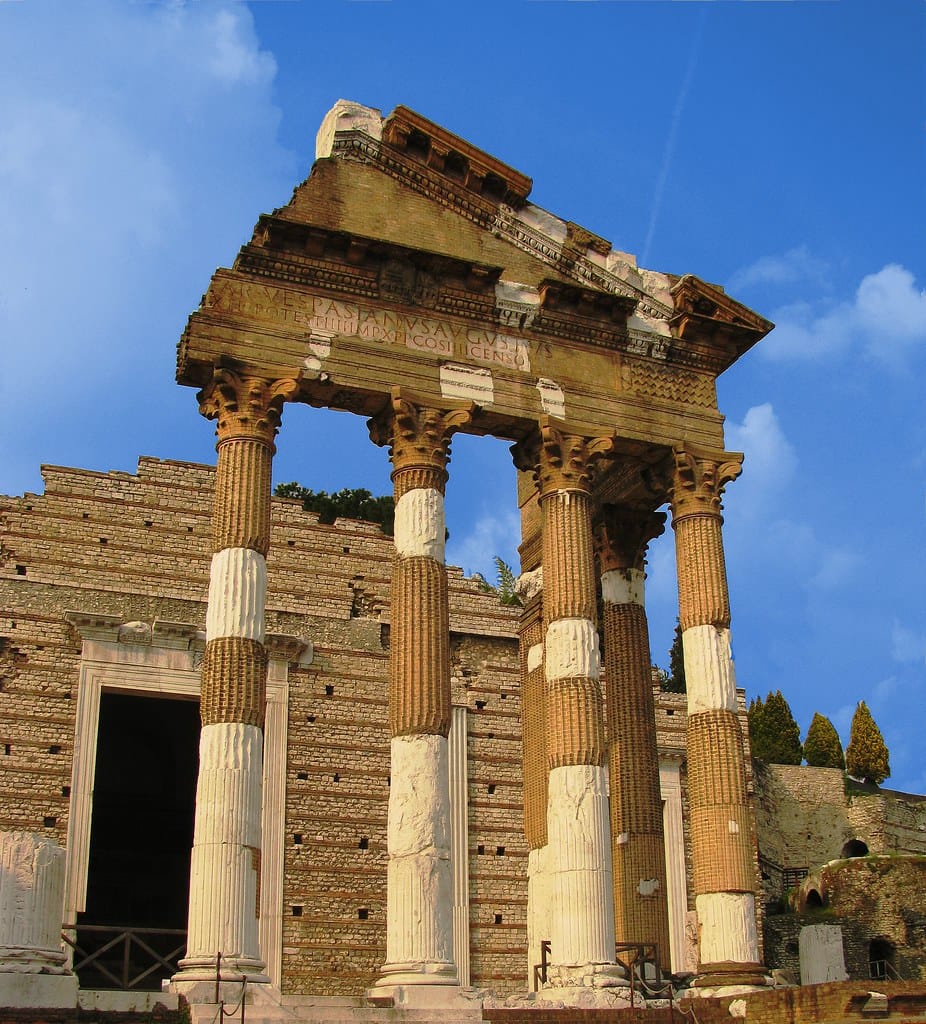
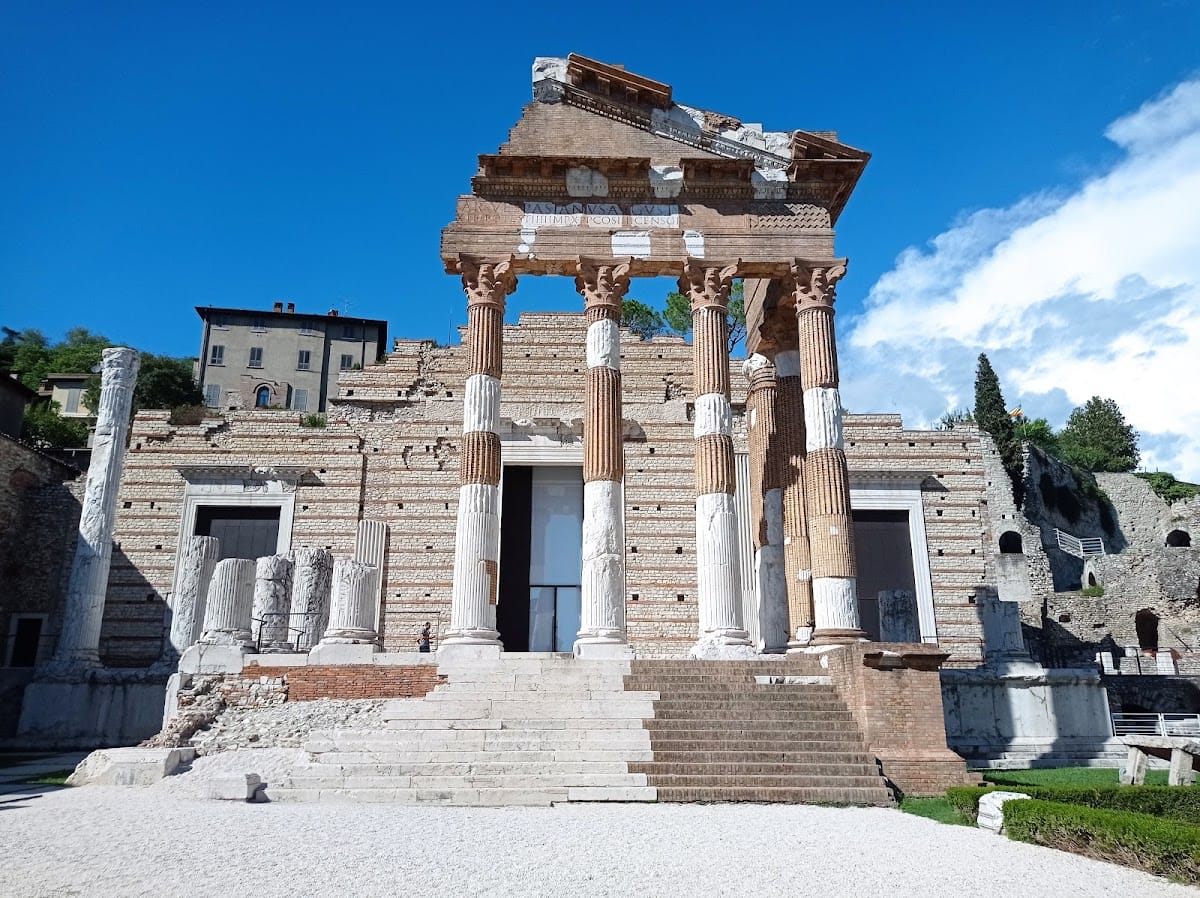
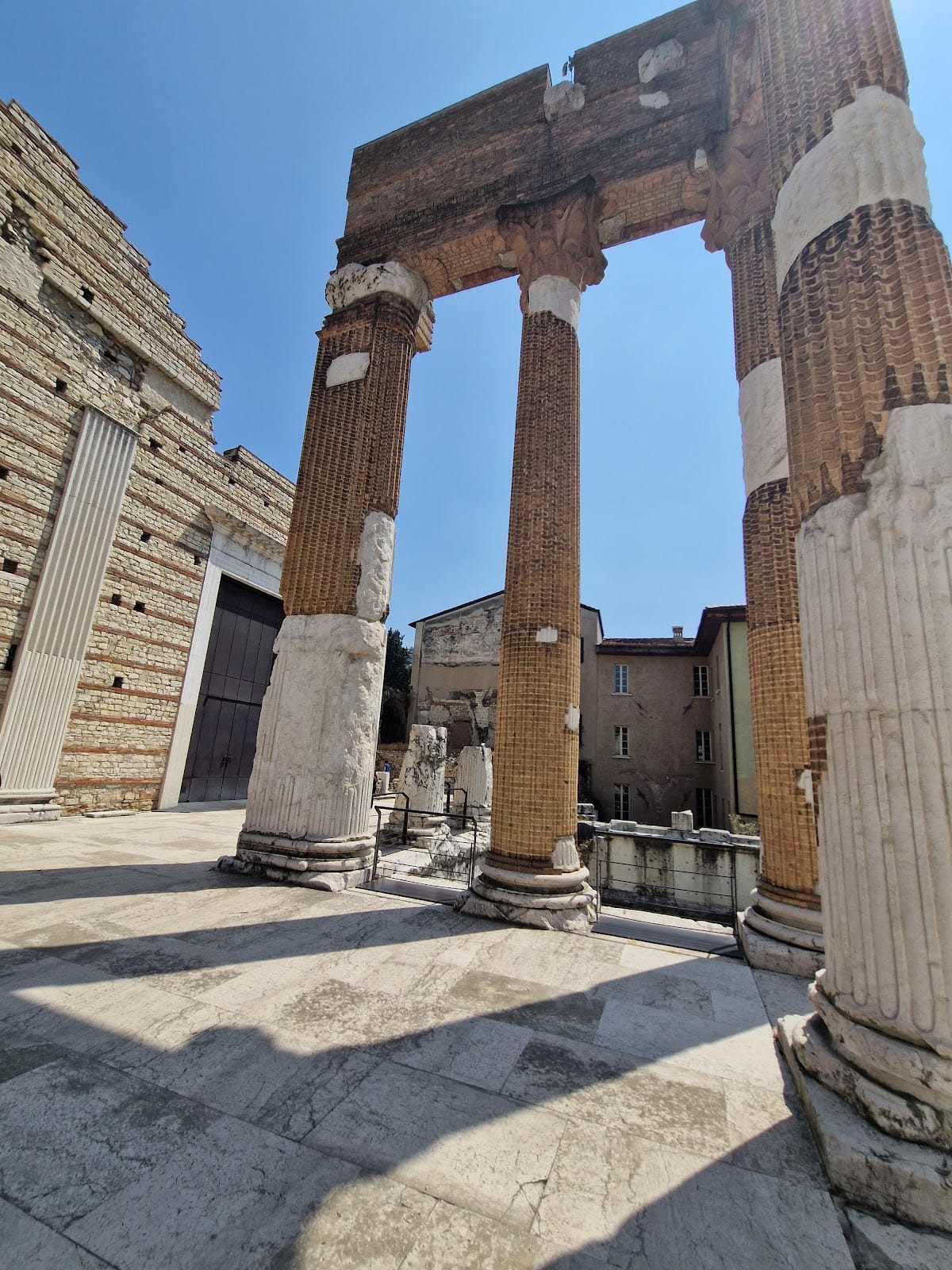
Between 1935 and 1938, partial restoration work was carried out. Using bricks, restorers rebuilt the Corinthian columns, the pronaos (the temple’s front porch), and the three cellae (inner chambers). Despite these efforts, a comprehensive restoration plan for the entire forum was never completed, leaving much of the area in a fragmentary state.
Since 2011, the Capitolium and its associated Roman archaeological complex have been recognized as part of a UNESCO World Heritage Site. It is included within the serial site titled “Longobards in Italy: Places of Power (568–774 AD),” acknowledging the broader historical significance of the region. In May 2023, the site was further marked with the Blue Shield emblem, signifying its international protection as cultural heritage during armed conflicts.
Remains
The Capitolium of Brixia is a Roman temple built in the classic Capitoline style, featuring three separate inner chambers called cellae. It has a prostylos layout, meaning the temple’s front projects forward with a row of six Corinthian columns forming the façade. Two porticoes of equal height flank the temple on either side, creating a balanced and monumental appearance.
Each of the three cellae housed an altar dedicated to one of the Capitoline Triad gods: Minerva, Jupiter, and Juno. The central cella is the largest and contains a well-preserved marble threshold made from Botticino marble, a local stone. The floors of the central and left cellae retain their original marble and African breccia with geometric opus sectile mosaics, a decorative technique using cut stone pieces. The right cella’s floor has been lost over time.
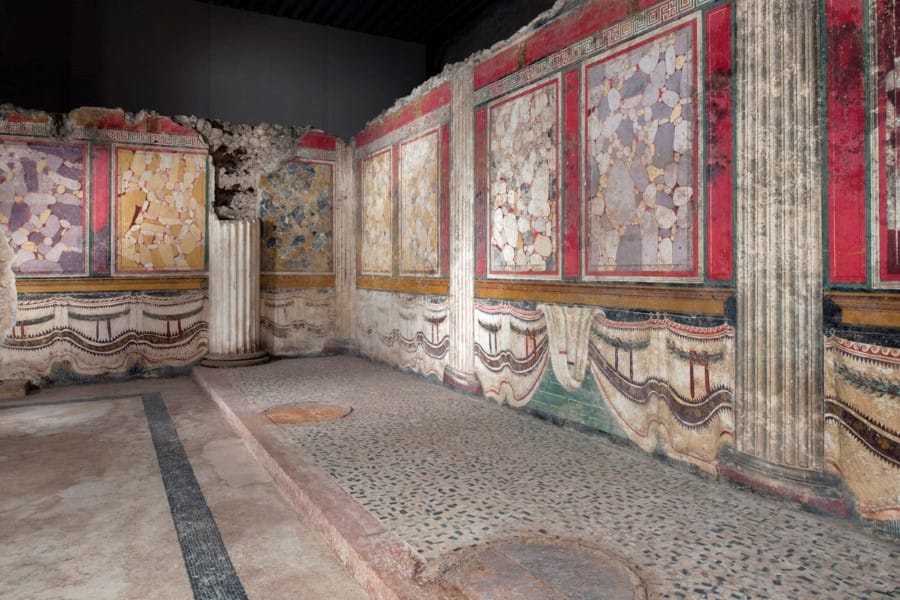
Inside the central cella, a two-stepped stone podium base remains, along with a lapidary collection established in 1830. This collection displays Roman stone artifacts such as altars, inscriptions, funerary steles, milestones, and monument bases. Evidence suggests there may have been a fourth cella to the east, and beneath the Imperial temple lies an older Republican-era cella. This earlier chamber was restored and opened to the public in 2015 after conservation of its frescoes.
The temple’s pediment, the triangular upper part of the façade, was largely reconstructed and likely featured statues, including a large acroterion group at its apex. Only one ancient column remains fully intact along its entire height: the first column on the left side of the façade. This column is distinguished by its complete white marble shaft without later brick additions and was the only visible remnant before 19th-century excavations.
The Capitolium stands about 4.5 meters below the modern Piazza del Foro, which overlays the ancient forum. Visitors can access the temple level via staircases descending to the ancient decumanus maximus, the main east-west street of Roman cities. The forum was originally surrounded by a portico, of which only one Corinthian column remains visible today. Beneath this column’s pavement, an incised rudimentary game board, or tabula lusoria, was found, possibly used by merchants.
Access to the temple was provided by a staircase ascending from the decumanus maximus, divided into two or three flights. This led to a terrace that may have featured two fountains. A corresponding descending staircase aligned with the ascending one connected the forum and porticoes, situating the decumanus midway between the forum and temple.
The temple complex is part of a larger monumental area that includes a Roman theater to the right. The theater dates from the 1st to 3rd centuries AD and retains surviving lower rows of seating resting on the ground. The upper tiers, once supported by arches, have collapsed partly due to medieval construction of the Palazzo Maggi Gambara on the seating area.
Building materials used in the temple include Botticino marble for thresholds and altars, marble and African breccia for flooring, and brickwork employed during 20th-century restorations. Some original decorative ceiling panels from the pronaos were repurposed in the façade of the nearby church of Santissimo Corpo di Cristo. The archaeological remains are integrated into the modern urban fabric along Via dei Musei and Piazza del Foro, forming part of the Brixia Archaeological Park.
Nearby sites