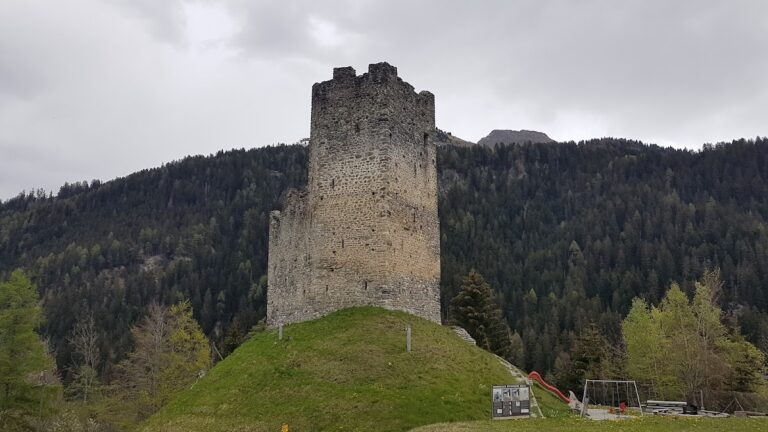
Cagliatscha Castle: A Medieval Fortress in Clugin, Switzerland


Visitor Information
Google Rating: 4.7
Popularity: Very Low
Official Website: www.pro-castellis.ch
Country: Switzerland
Civilization: Unclassified
Site type: Military
Remains: Castle

History
Cagliatscha Castle stands in the municipality of Clugin, Switzerland, and was constructed by local administrators known as ministeriales under the Freiherr von Vaz family during the mid-13th century. Dendrochronological studies have dated the wooden beams of the structure to approximately 1265–1266, pinpointing the period of its origin. The Panigad or Stainbrugg families, who were closely affiliated with the Vaz lineage and bore their coat of arms carved into the castle walls, likely oversaw its building and early administration.
The castle played a strategic role in safeguarding a trade route through the Hinterrhein valley. It was part of the network of smaller fortifications that the Vaz family controlled under a fief granted by the Bishop of Chur. After the extinction of the male Vaz heirs in 1338, ownership passed to the Counts of Werdenberg-Sargans, marking an important transfer of regional influence.
During the 15th century, the surrounding valley joined the Grey League in 1424, a confederation formed in opposition to the Counts’ attempts to regain power over this territory. This tension culminated in the sale of the land back to the ecclesiastical authority of the Bishop of Chur, and eventually, by 1458, the valley achieved a degree of self-governance independent from both secular and clerical lords.
The castle’s downfall likely occurred in the mid-15th century amid the Schamserfehde, a local conflict marked by violent clashes. It suffered extensive fire damage, which compromised the foundations and caused the collapse of most of its walls. Following this destruction, Cagliatscha Castle was never reconstructed. By around 1570, the historian Ulrich Campell referred to the site as “Castellatsch,” a Romansh term translating to “bad castle,” signifying its ruined state.
In the late 20th century, volunteers from the organization Burgenverein Graubünden undertook efforts to stabilize and preserve the remains of the castle during 1984 and 1985. These included the construction of a bridge over the castle’s defensive ditch. Later, in 2009, an informational plaque was placed near the ruins to provide context about the site’s history.
Remains
The surviving remains of Cagliatscha Castle are dominated by a tall, square tower known as a bergfried, located on a rocky outcrop roughly 1182 meters above sea level, positioned between Andeer and Clugin and about 200 meters above the floor of the Hinterrhein valley. This tower was the principal feature of the castle and stands as the most intact element of the fortification, accessible today via a twenty-minute hike from Clugin.
The tower rises across five stories and measures approximately 8.5 by 8.6 meters at its base. The thickness of the walls decreases from about 2.3 meters at ground level to approximately 1.8 meters near the top, built from large, irregular stones carefully fitted together. At the corners, finely carved squared stones, called long bossed ashlar blocks, provide structural strength and a distinctive appearance. Of the four sides, the southeastern wall remains largely intact, standing around 20 meters high.
Originally, the main entrance to the tower was set on the second story of the northeast or south face, but for defensive reasons, it was shifted to the third story on the west side in a later phase. The third-floor construction employed larger and more regularly shaped stone blocks, some weighing more than 700 kilograms, underscoring a phase of reinforced fortification.
Above, the final two stories were surrounded by wooden hoardings—defensive galleries known in German as wehrlaube—that projected from the tower walls to provide protection for defenders. The roof was pyramid-shaped and covered with slate. The wooden roof framework itself is of special significance, as it represents the oldest original roof construction discovered in Switzerland, dated precisely to 1266.
Inside the tower, traces of plaster still adhere to the walls, allowing for the division of floors to be clearly identified. The site has not revealed the remains of any outer bailey or curtain wall—a defensive enclosure around the tower—indicating the castle may have relied primarily on its tower and natural rock defenses.
Near the castle lies an area called Padnal, notable for evidence of a prehistoric settlement, suggesting the strategic importance of this location extends far back before the medieval era. In front of the ruins, indications of a well and a designated picnic area with a fire pit provide points of interest adjacent to the historic structure.
Nearby sites