Château de Murat (Allier): A Ducal Fortress in France


Site at a Glance
- Rating
- 3.7
- Popularity
- Very Low
- Country
- France
- Primary era
- Medieval
- Eras represented
- Medieval
- Civilizations
- French
- Site type
- Military
- Remains
- Castle
On this page7 sections
History
Medieval Fortress and Ducal Residence
Château de Murat (Allier) is a medieval fortress in Murat, France, documented from the eleventh century in an act of Archambaud III of Bourbon. It became one of the most powerful ducal fortresses of Bourbonnais, the historic territory and former duchy associated with the House of Bourbon in central France.
Its defenses were developed during the thirteenth century and strengthened again under Louis II, Duke of Bourbon. The castle also served as a residence for members of the ducal family. Beatrice of Burgundy, Lady of Bourbon through her marriage to Robert of Clermont, died there on 1 October 1310. Isabelle of Valois, the wife of Duke Peter I of Bourbon, also resided at Murat.
The fortress was never modernized or made comfortable as a ducal residence, and it consequently lost that role. Murat nonetheless remained the seat of a ducal, and later royal, châtellenie, a territorial and administrative district governed from a castle by an appointed official.
Dismantling and Administrative Change
After the Bourbon duchy was seized from the Constable of Bourbon, the fortress was dismantled and the lordship was granted to Chancellor Duprat. The castle then fell into ruin, a condition noted by Nicolas de Nicolay, a sixteenth-century French geographer and royal official whose writings described places in France.
Sébastien Zamet, an Italian financier, later became the lordship’s seigneur engagiste, a person granted the revenues and effective lordship of a domain in return for financial or administrative obligations. He was followed by his son, Jean Zamet, and then by his grandson, Jean II Zamet. During the eighteenth century, the administrative seat of the châtellenie was transferred to Montmarault.
The castle is privately owned and has been listed as a French historic monument since 1930.
Remains
Fortress Layout
Enclosure and Courts
The medieval fortress occupies a rocky promontory on the southwestern side of Murat, with a loop of the Murat stream, a left-bank tributary of the Aumance, bordering the promontory to the south. Its enclosure follows the natural outline of the height and forms a highly irregular trapezoid.
The eastern entrance was reached by a drawbridge. Inside the enclosure, the castle was divided into two courts, a lower bailey and a separate court associated with the donjon, the principal fortified tower of a medieval castle.
Towers and Donjon
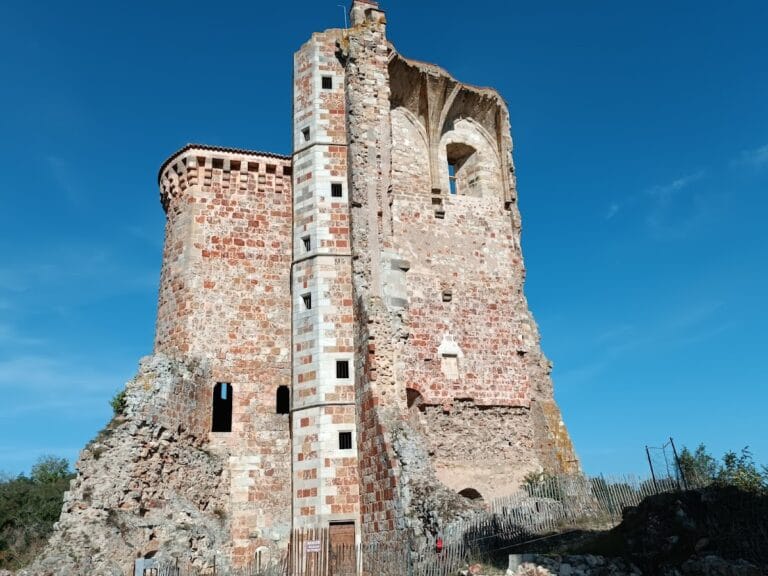
The defenses included seven towers, six of them round. A substantial donjon stood at the northeastern end of the enclosure, and a vaulted room survives at its base.
Remains of the enclosure and several towers remain visible among dense scrub. The castle as a whole survives in a ruinous condition.