Burgruine Stauf: A Medieval Castle Ruin in Haibach ob der Donau, Austria



Visitor Information
Google Rating: 4.5
Popularity: Low
Google Maps: View on Google Maps
Official Website: www.ausflugstipps.at
Country: Austria
Civilization: Unclassified
Remains: Military

History
Burgruine Stauf is situated in Haibach ob der Donau, Austria, and was constructed during the medieval period by the local nobility. It was established in the early 12th century, most likely by Wernhard de Stove, an ancestor of the Counts of Schaunberg. This castle originally served as the primary residence and power center for this noble family.
In the following centuries, the Schaunberg family maintained control of the castle, adapting it into an administrative seat governed by appointed stewards, known in German as Pfleger. Records confirm the presence of these stewards from at least 1337 until 1841. During the 14th century, the castle played a vital role amid local conflicts. Notably, during the Schaunberger Feud between 1380 and 1390, Burgruine Stauf withstood a siege laid by Duke Albrecht III of Austria in 1380-81. Although the castle initially resisted, Austrian forces eventually captured it in 1385 or 1386. The properties were subsequently placed under Habsburg administration but were restored to the Schaunberg family in 1383 as a hereditary lease.
Following the death of the last Schaunberg in 1559, Burgruine Stauf became the subject of inheritance disputes and passed in 1572 to the Liechtenstein family. By this time, the castle had sustained significant damage from a fire two years earlier, rendering it uninhabitable. The Liechtensteins did not restore the castle, instead building a new residence in the nearby town of Aschach an der Donau.
In subsequent decades, ownership changed hands several times. One of the notable holders was the Jörger family, known for their Protestant faith and participation in uprisings against Emperor Ferdinand II. Due to their opposition, their properties were confiscated in 1620. Two years later, in 1622, the castle was sold to Karl von Harrach; his family retained possession of the estate up to the 20th century.
Efforts to preserve the ruins began in the early 1900s under Count Alfred Harrach. Following World War II, local heritage organizations along with the Dreihann-Holenia family took responsibility for maintaining the site. Major conservation work took place between 1968 and 1977, including securing the ruins and adding a roof to the main tower. Starting in 1989, a dedicated association was formed to continue these preservation activities. The castle’s enduring presence has inspired poets such as Richard Billinger and Herbert Emmerstorfer, who found artistic inspiration in its ruins.
Remains
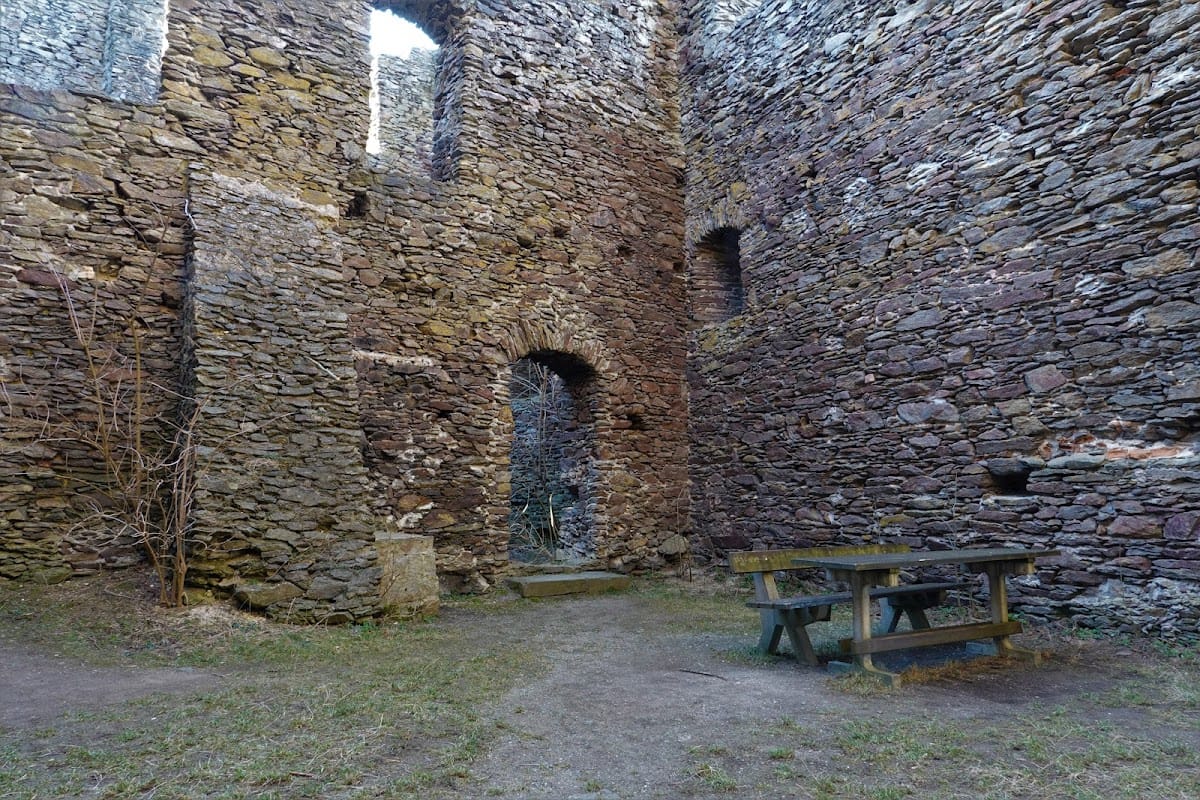
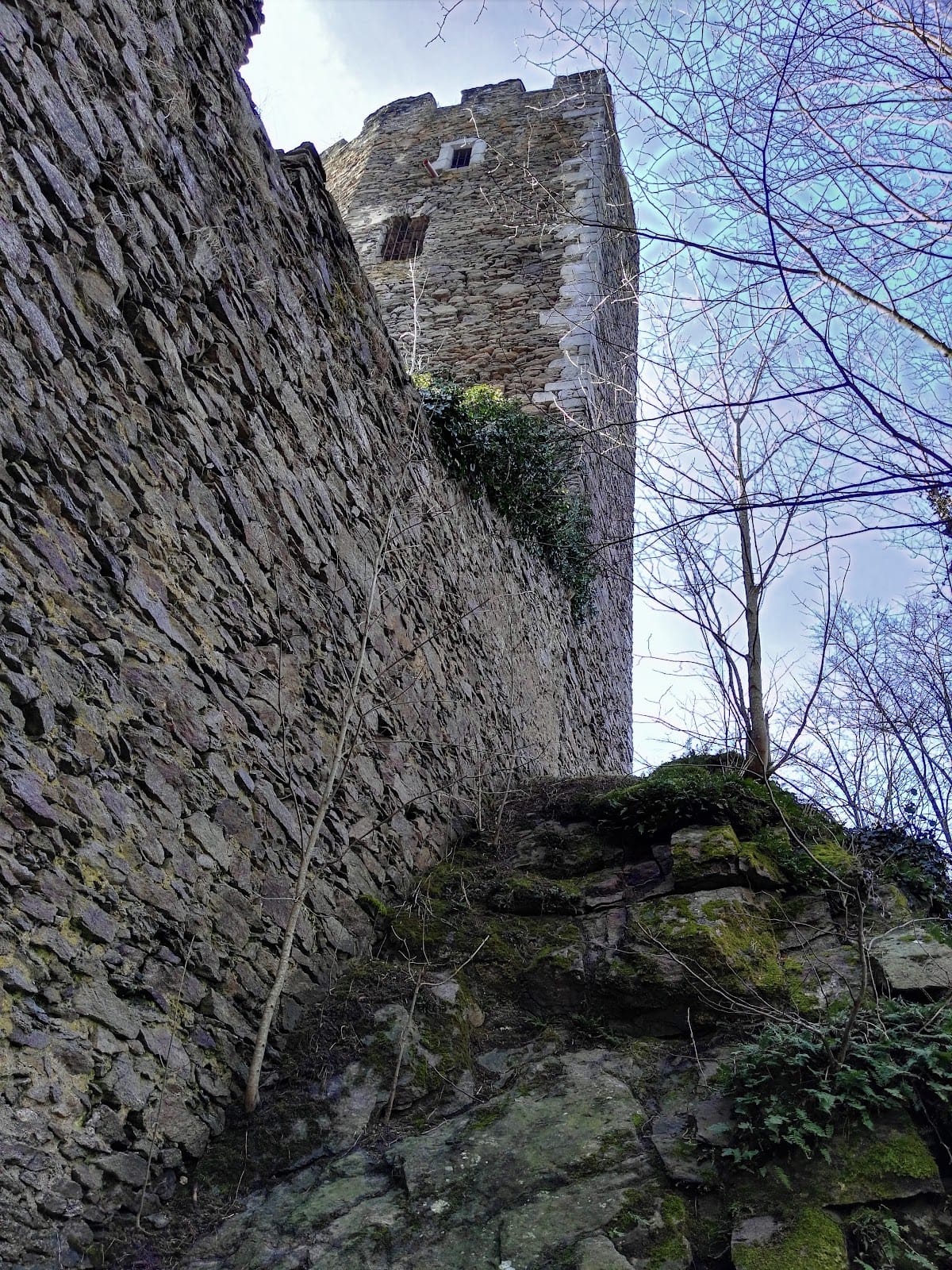
The ruins of Burgruine Stauf occupy a rocky hilltop plateau approximately 12.5 by 25 meters in size, situated at an elevation of 531 meters. This small medieval fortress, built primarily during the early 14th century on foundations dating back to the 12th or 13th century, follows the typical layout of a hill castle with a central fortified area known as the core castle and an adjacent outer bailey to the east. Constructed largely from local gneiss rubble and fieldstones, the masonry is plain and functional, with granite used sparingly for door and window frames.
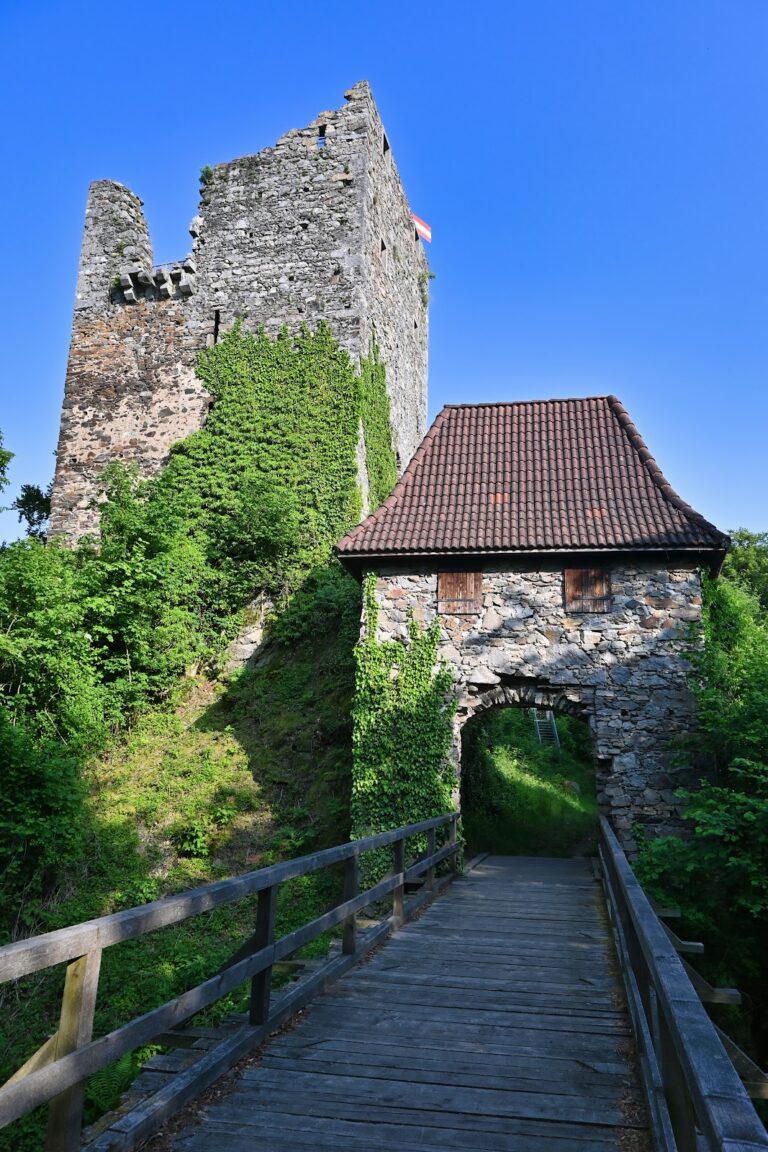
At the heart of the castle stands a distinctive six-sided tower called a bergfried, rising about 21.67 meters, though it no longer reaches its original height. Internally, the tower comprises four floors: the two lower levels are simple, windowless vaulted chambers with heavy northern walls up to five meters thick—likely built to withstand sieges. The upper floors feature large window niches with integrated benches, suggesting they served residential or lookout functions. The bergfried’s entrance was originally located high above ground level to enhance defense. Today, an observation platform near the top offers commanding views over the Danube valley and, on clear days, as far as the city of Linz.
Adjacent to the bergfried is the palas, the residential building measuring roughly 9 by 18 meters and standing three stories tall. Its design includes spacious windows on the upper floors to allow light and ventilation, along with battlements—defensive crenellations—on the southern and western exterior walls. A preserved garderobe, or medieval latrine, remains intact, illustrating aspects of daily castle life within the dwelling.
The outer bailey extends over 20 by 45 meters and was enclosed by a protective ring wall with surviving sections reaching up to nine meters in height. Access into this courtyard came through a northern gate featuring a striking Gothic portal approximately 3 meters wide and 6 meters tall, topped by a pointed gable arch reminiscent of gates found at Burg Hardegg. Flanking this entrance are two narrow windows with pointed arches, believed to be part of the gatekeeper’s chamber. Though much of the eastern ring wall has collapsed, the overall form of the bailey remains discernible.
Connecting the outer bailey to the inner core is a steep stairway comprising 49 steps. Entrance to the core castle was secured through a 15-meter-high eastern wall, which included a murder hole—a small opening above the doorway used to defend against attackers. The western wall of the core castle also preserves a similar murder hole. Remnants of an eastern gatehouse once controlled access to the bailey. Defensive works include a ditch approximately six meters deep on the southeastern side and a small sally port in the southern bailey wall, possibly leading to a wooden bridge crossing the ditch.
Strategically perched on a narrow ridge, Burgruine Stauf was positioned to oversee two natural routes running along the Danube’s right bank. Nearby, a small plateau to the northwest likely functioned as an outwork, providing an additional forward defense. Today, the ruins stand as a testimony to their medieval origins and evolution, with conservation efforts ensuring the survival of their key architectural elements.
Nearby sites