Burgruine Hörtenberg: A Medieval Hill Castle in Pfaffenhofen, Austria


Visitor Information
Google Rating: 4.2
Popularity: Very Low
Google Maps: View on Google Maps
Country: Austria
Civilization: Unclassified
Remains: Military

History
Burgruine Hörtenberg is a medieval hill castle located in Pfaffenhofen, Austria. It was constructed during the Middle Ages by the Counts of Eschenlohe and served as the administrative center for the County of Hörtenberg.
The castle’s earliest recorded mention dates back to 1239 when it belonged to the Eschenlohe family. In the late 13th century, ownership passed to Meinhard II of Tyrol, who acquired the castle in 1281 and secured full rights over the county by 1291 through a grant from Duke Otto of Bavaria. Around this period, the castle included a chapel dedicated to Saint Dionysius, the patron saint associated with the Carolingian dynasty. By the turn of the 14th century, Burgruine Hörtenberg functioned as the judicial seat of the county—housing judges and exercising both lower and higher courts, including a specialized court known as the Schlossberg court. Executions related to the court took place near the castle. However, court operations moved to the nearby town of Telfs in the 17th century, and later, in 1787, the Schlossberg court merged into the broader Hörtenberg jurisdiction.
Throughout the 14th and 15th centuries, the castle changed hands several times. The Lords of Matsch owned it from 1363 until 1405. Between 1413 and 1436, Ulrich von Windeck undertook significant renovations. In 1448, the castle became part of a dowry when Sigmund the Rich gave it to his wife, Eleonore of Scotland. Following the couple’s death in 1480, stewardship of the lordship passed to appointed administrators.
The castle also played a role in imperial affairs when Emperor Maximilian I used it as a base for hunting expeditions. In 1577, Archduke Ferdinand II redeemed a pledge on the property and granted it to Philippine Welser. Subsequent ownership passed through the Margraves of Burgau and then Archduke Maximilian III. Starting in 1619, the castle was pledged to different noble families over time, including the Wolkenstein family, the Counts Fieger von Hirschberg from 1633 to 1805, followed by the Counts Spaur and the Barons von Goldegg. The Goldegg family returned control of the court in 1824.
The early 18th century brought misfortune when the castle, used as a storage location for war materials, suffered a major fire caused by a lightning strike on August 5, 1706. The explosion ignited roughly 1500 Zentner (an old weight measure equivalent to approximately 50 kilograms per Zentner) of gunpowder, leading to substantial destruction.
State authorities assumed ownership in 1824 and soon transferred the site to the Lener family. Father Alexander Lener restored the castle’s keep in 1873, adding a protective pyramid-shaped roof. Later, the property was held by the Order of the Poor School Sisters and then by Eugen Matt beginning in 1973. In 2007, the municipality took charge of the site, clearing vegetation to reveal its historical remains.
Archaeological investigations in 2004 revealed artifacts spanning from the Bronze and Iron Ages through the medieval period, demonstrating the site’s long history of human activity. Items dating from the 13th to 16th centuries provide insight into the castle’s medieval occupation.
Remains
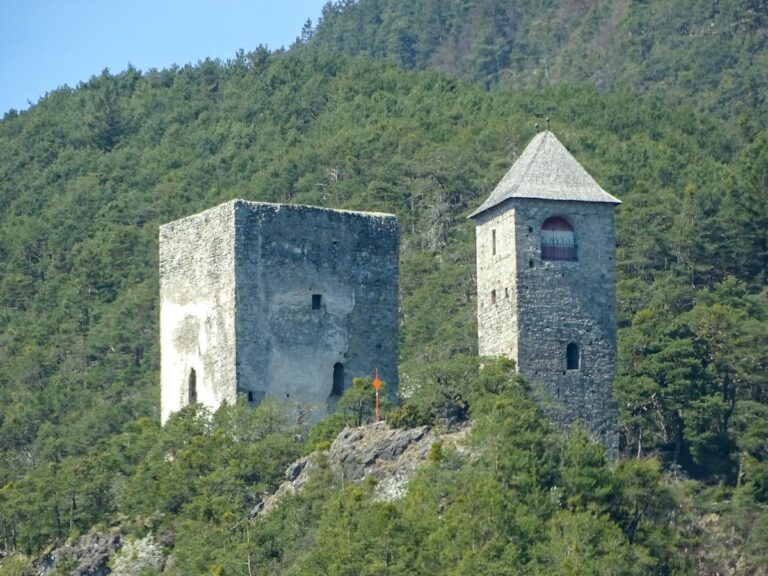
The surviving structures of Burgruine Hörtenberg reveal a castle complex built primarily during the 13th and 14th centuries. The site consists of a central stronghold, or core castle, and a lower-lying outer bailey that provided additional defense. The core structure is dominated by a five-story bergfried—a tall, fortified tower typical of medieval castles—measuring about nine meters square. Near its base, the tower’s walls are approximately 2.5 meters thick, constructed mainly from irregular schist stone blocks combined with rusticated ashlar masonry, which are roughly finished stone blocks giving the surfaces a textured appearance. Traces of painted stonework can still be seen on the tower’s corners, hinting at past decorative efforts.
Originally, access to the bergfried was through a high entrance measuring about 1.5 meters wide and 2.2 meters high, situated above ground level for defensive purposes. The tower contains no traditional windows, but the upper floors receive light through narrow vertical slits designed to allow illumination while maintaining protection. In 1873, a pyramid-shaped roof was added to the bergfried during a restoration aimed at preserving the structure.
Surrounding the core castle are remnants of a ring wall and extensive outer defensive enclosures known as zwingers. These zwingers, dating from around 1500, formed an additional enclosed courtyard designed to trap attackers between walls, enhancing defense. A well shaft on the site indicates a source of water within the castle—a crucial feature during sieges.
A small chapel built in 1866 stands near the ruins and is believed to occupy the original site of the medieval chapel dedicated to Saint Dionysius. This chapel’s location connects the present appearance of the site with its historical religious associations.
The emblem of the village of Pfaffenhofen, which features a trident and battlement motifs, originates from the heraldry of the Lords of Eben who were influential local nobles. This coat of arms reflects the castle’s historical importance and its lasting influence on regional identity.
Nearby sites