Burgruine Groppenstein: A Medieval Castle in Austria



Visitor Information
Google Rating: 4.8
Popularity: Medium
Google Maps: View on Google Maps
Official Website: www.groppensteinschlucht.at
Country: Austria
Civilization: Unclassified
Remains: Military

History
Burgruine Groppenstein is a medieval stone castle situated in the municipality of Raufen, in present-day Austria. It was constructed by the Germanic peoples during the medieval period, with origins traceable to the early days of the High Middle Ages.
The first known written reference to the site appears in 1254, when the fortress is recorded as “turris Cropensteine.” At that time, Archbishop Philip of Salzburg granted land near the castle to his archer, Heinrich Swärhaupt. This document was witnessed by Pabo de Cropensteine, a ministerial officer serving the Counts of Ortenburg, indicating that the castle was already an established landmark. Linguistic evidence suggests the name derives from the Old High German personal name Groppo, hinting that the stone tower may have been built before this first written mention.
During the late 13th or early 14th century, control of Groppenstein shifted to the Counts of Gorizia, a noble family prominent in the region. In 1324, a figure named Friedrich von Groppenstein appears in records as an official at the joint Gorizia-Tyrol court. By the mid-14th century, Groppenstein transformed from a simple tower castle into a fortified stronghold encircled by protective walls. In 1342, the castle was leased as a feudal fief to Jörg von Groppenstein, son of its castellan Konrad der Gröppler.
The Groppenstein family maintained possession for several generations until the last heiress, Veronika von Groppenstein, brought the castle into the Schernperg family through her marriage to Count Wilhelm von Schernperg. Between 1470 and 1480, under a Gorizian ministerial, Groppenstein underwent extensive enlargement that fortified its defenses and added a residential palace, commissioned by Jakob Gröppel von Groppenstein. This period marked the castle’s evolution into a more complex and imposing residence.
After Veronika’s death in 1486, ownership passed jointly to her three sons. Later in 1506, Emperor Maximilian I officially granted the castle to Count Christoph von Groppenstein from the Schernberg family. Christoph also gained administrative authority over Goldegg im Pongau from Archbishop Matthäus Lang von Wellenburg, indicating the castle’s continued regional importance.
By the late 16th century, ownership changed hands to Bartholomäus von Khevenhüller and Friedrich von Hollenegg, related by marriage to the current lords. In 1612, they sold Groppenstein to Adam Jakob von Lind. The castle remained under noble stewardship in subsequent centuries, most notably belonging to the Sternbach barons from 1693 until 1870.
In 1872, Viennese architect Adolf Stipperger acquired the fortress and undertook extensive restoration, reshaping Groppenstein’s appearance with modern additions while preserving its historic character. Since its initial construction, the castle has been continually inhabited, which allowed for ongoing maintenance and conservation through the centuries. Restoration efforts resumed in 1968 and have continued intermittently. Today, Burgruine Groppenstein remains in private ownership and is accessible under special arrangements only.
Remains
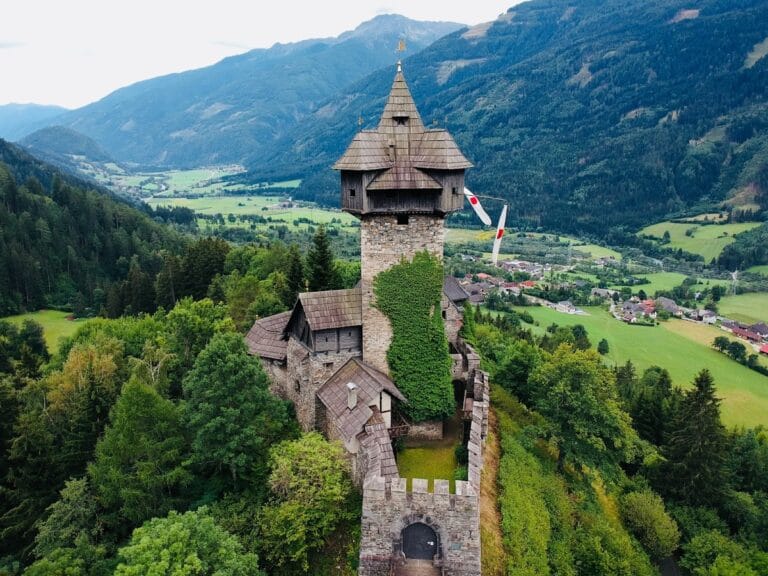
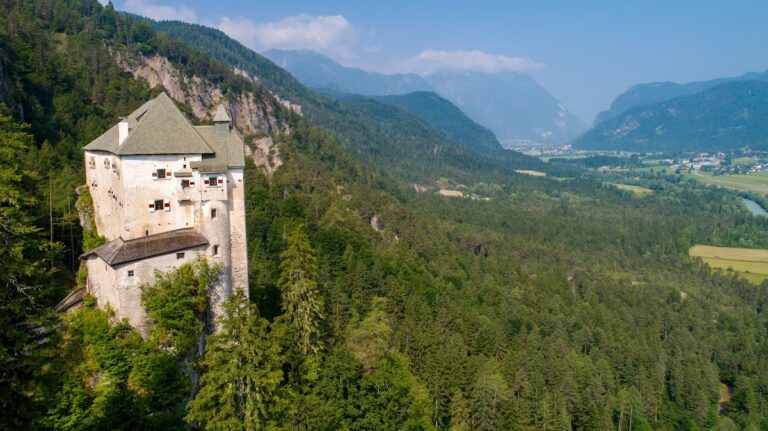
Burgruine Groppenstein occupies a commanding rock promontory that overlooks the village of Raufen and the nearby confluence of the Mallnitzbach and Möll rivers. The fortress layout centers on a courtyard encircled by its principal structures: the bergfried, the palace, and a surrounding ring wall topped with battlements.
The massive bergfried, or main defensive tower, dates back to the Romanesque period and rises approximately 23 meters tall across five stories. Constructed in a robust rectangular form, this tower retains much of its original medieval character. It stands connected to the Gothic-style residential palace by a wooden bridge positioned at the second floor level, facilitating access between living quarters and defense installations.
The three-story palace building mainly stems from the 15th century, although it underwent significant renovation in the 19th century. During this restoration, the structure acquired modern chimneys, a crenellated (or battlemented) gable, and large windows, blending medieval and more contemporary styles. The palace facade bears the mid-16th-century coat of arms of the Schernperg counts, reflecting the noble lineage that once resided there. Inside, many late Gothic architectural details have been preserved, offering insight into the castle’s historic interior design.
Surrounding these core buildings is a crenellated defensive wall accompanied by a three-story gate tower known as the Torturm. This gate and the curtain walls underwent repairs in the 19th century aimed at stabilizing and restoring their medieval appearance. Originally, access to the castle was secured only on the western side via a deep moat crossed by a drawbridge, forming a formidable barrier. Today, the drawbridge has been replaced by a permanent concrete bridge, altering the nature of the entry while maintaining connection to the fortress.
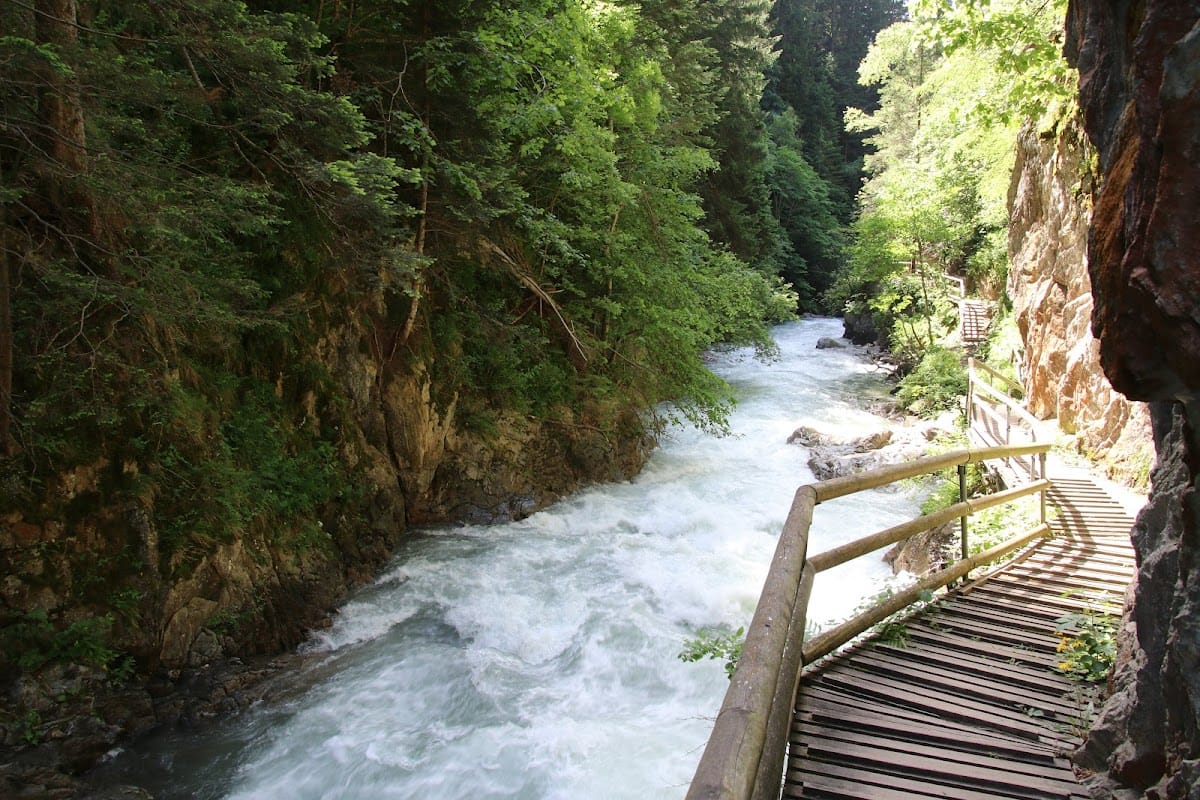
The castle’s strategic position on a steep rock formation with steep drops on three sides further enhanced its defendability and allowed it to command views over the surrounding landscape. Moreover, Groppenstein lends its name to the nearby gorge, marking the site’s prominence in the local geography.
Thanks to ongoing habitation through the centuries, Burgruine Groppenstein remains remarkably well preserved. Archaeological and historical investigations confirm the survival of primary structural elements including the tower, palace, walls, and gatehouse, coupled with restorations that have maintained its integrity and visible medieval character.
Nearby sites