Niederfalkenstein Castle: A Medieval Lower Fortress in Austria


Site at a Glance
- Rating
- 4.3
- Popularity
- Low
- Country
- Austria
- Primary era
- Medieval
- Eras represented
- Medieval
- Civilizations
- Holy Roman Empire
- Site type
- Military
- Remains
- Castle
On this page13 sections
History
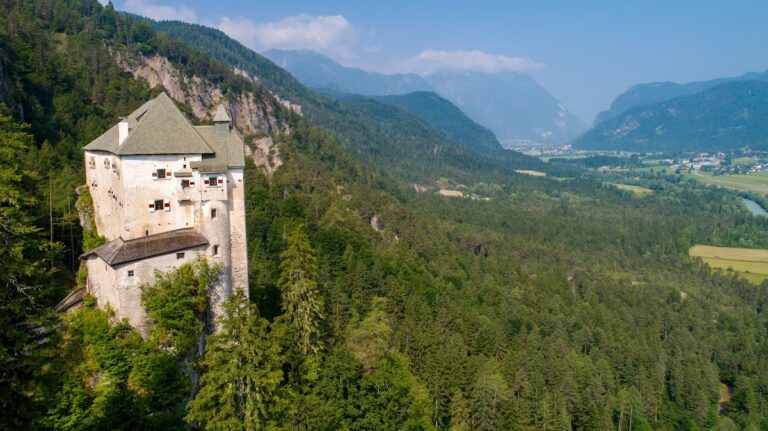
Niederfalkenstein Castle is a medieval fortress in Austria near Obervellach, first associated with the Falkenstein complex in written records from 1164 and Romanesque in character. It formed the lower part of a two-building defensive system on the steep northern side of the Möll Valley, while Oberfalkenstein stood higher on the ridge. Niederfalkenstein retains substantial built fabric and has undergone extensive restoration after periods of decay and a devastating fire in 1969.
Origins and the lords of Falkenstein
The foundation date of Falkenstein is uncertain. The complex was recorded in 1164 as Valchenstain and was later also known as Walchenstein. The name may preserve a reference to an earlier Walchen settlement. The Walchen may have been descendants of the Roman population of Teurnia, an important Roman city and later ecclesiastical centre in the region of present-day Carinthia, who withdrew into the surrounding mountains before about 600 during the advance of Slavic populations.
The early lords of Falkenstein were ministeriales, members of the lower medieval nobility who served more powerful rulers in administrative, military, and courtly roles. They served the Meinhardiner counts of Gorizia. Gumpoldus de Valchenstein, named in 1164 as a ministerial of Count Engelbert I, belonged to the third recorded generation of the family. In 1271, Otto von Falkenstein acted as a judge in a dispute between the counts of Gorizia and Admont Abbey concerning newly cleared land near Stall in the upper Möll Valley.
The family also maintained friendly relations with Millstatt Benedictine monastery. In 1272, Chotos von Falkenstein gave the monastery a farmholding at Litzelsdorf as the dowry of his daughter, who entered its nunnery. The Falkenstein family died out around 1300. The counts of Gorizia thereafter treated Upper and Lower Falkenstein as separate holdings and granted them to different lesser nobles.
Transfer to Habsburg control
On 24 June 1394, Count Henry IV of Gorizia pledged Oberfalkenstein to Duke Albert III of Austria. The pledge was not redeemed, and the castle passed permanently into Habsburg possession, a transfer formalized by the Peace of Pusarnitz. The Habsburgs were a major European ruling dynasty whose Austrian line later controlled extensive territories in central Europe and held the imperial title.
Emperor Frederick III later assigned the two castles to different custodians. Their tenures changed frequently because the pledges required high sums. Andreas von Graben zu Sommeregg was recorded as lord of Unterfalkenstein in 1462. In 1504, Emperor Maximilian I pledged Falkenstein, its district court, and the offices of Obervellach and Großkirchheim to Count Julian von Lodron in return for a loan of 7,500 gulden.
After Julian’s death in 1510, his widow Apollonia married the Croatian nobleman Christoph Graf von Frangipani. Apollonia was the sister of Salzburg Archbishop and Cardinal Matthäus Lang von Wellenburg, and Frangipani subsequently acquired the castle. He later came into conflict with the Habsburgs and was killed in battle. After his childless marriage, the estate changed hands several times, including through ownership or tenure by Christoph Weitmoser, Count Ferdinand von Salamanca-Ortenburg, and Bartholomäus Khevenhüller.
Deterioration and restoration
Falkenstein was already in poor condition at the beginning of the sixteenth century. In 1507, 500 gulden were authorized for repairs, and around 1510 Apollonia received permission to spend a further 200 gulden restoring the deteriorated buildings. The barons of Sternbach owned Falkenstein from 1693 to 1883, but they lived at Groppenstein Castle west of Obervellach and allowed the complex to decay.
In August 1825, the Viennese alpinist and court-chamber official Josef Kyselak visited the ruins. He described a large tower containing a beehouse and a small church with a wooden tower. In 1905, Hofrat Ferdinand Kaltenegger von Riedhorst purchased the ruins and undertook major restoration work, giving Niederfalkenstein much of its present appearance. A Hofrat was a senior court or government councillor. After Kaltenegger von Riedhorst died in 1912, ownership changed several times. Georg Friedrich Scheier, who had been adopted by Baron Trütschler von Falkenstein, owned the property from 1939 to 1947.
In 1959, Scheier’s son sold the two castles to Anni Helene Johanna Oehmichen, a German import-export businesswoman from Dithmarschen who had previously lived in China, Japan, and the United States. Niederfalkenstein had again severely deteriorated, so Oehmichen financed extensive restoration and furnished it with paintings and antiquities.
In 1969, an intruder set fire to the principal building, reportedly to conceal a burglary. The palas, the main residential and representative building of a castle, and much of its inventory burned down to the foundation walls. The perpetrator was soon arrested in the Tauern Tunnel with a backpack containing silver objects. Oehmichen then financed the reconstruction and refurnishing of the palas. She died at Niederfalkenstein in 1987 after a long illness.
After her death, the two castles passed by inheritance to her nephews Rolf-Peter Oehmichen and Erhard Christian Mahnke. Rolf-Peter Oehmichen carried out further restoration at Niederfalkenstein, including replacing ceilings, installing tiled roofs, and reconstructing battlements. Some of the roof coverings used hand-hewn larch shingles up to one metre long. Oberfalkenstein was sold to the businessman Weißmann in 1989, while Niederfalkenstein was sold in 1998 to the Fersterer family, a hotel-owning family from Saalbach. The complex has remained privately owned in the modern period.
Remains
Fortified ridge and two-part layout
Falkenstein occupies a high rocky ridge on the steep northern flank of the Möll Valley near Pfaffenberg, above the valley road. Oberfalkenstein and Niederfalkenstein are approximately 25 minutes’ walk apart, with Niederfalkenstein at an elevation of about 843 metres. Niederfalkenstein was originally a lower outwork, a subordinate fortified installation, of the much higher Oberfalkenstein rather than an independent castle. The two buildings are now commonly distinguished as Oberfalkenstein, or Upper Falkenstein, and Niederfalkenstein, also called Unterfalkenstein or Lower Falkenstein.
The earlier complex had a Romanesque character, with massive masonry, relatively small openings, and rounded arches. A surrounding stone defensive wall protected the site. Parts of the wall later collapsed, but it was repaired and strengthened during construction of the Tauern Railway so that it could withstand vibration and blasting associated with the railway tunnel. Arch supports and buttresses also helped secure the site against collapse.
Niederfalkenstein structures
Bridge and main gate
The approach to Niederfalkenstein crosses a wooden bridge that replaced an earlier drawbridge. A commemorative plaque dedicated by the municipality of Obervellach to Oehmichen’s reconstruction work is mounted to the right of the main gate.
Palas and later restoration
The Niederfalkenstein palas was destroyed by the 1969 fire down to its foundation walls. It was subsequently rebuilt and refurnished. Later work included new roofs and reconstructed battlements, with some roof coverings made from hand-hewn larch shingles up to one metre long. These interventions account for much of the castle’s present physical form.
Oberfalkenstein and the chapel
Upper castle remains
Oberfalkenstein retains the remains of a square bergfried, the principal fortified tower of a medieval German-speaking castle, used mainly for defence and refuge. The site also preserves the foundations and ground plan of a strongly walled palas, together with a neck ditch at the entrance on the mountain side. The former four-storey residential building is otherwise largely ruined.
Saint John the Baptist Church
A small Romanesque chapel at Oberfalkenstein was dedicated to Saint John the Baptist. A chapel was recorded by 1246, and chaplains serving Upper Falkenstein were documented in 1295 and 1346. In 1772, farmers from Pfaffenberg substantially enlarged it in the Baroque style into a church that remains in use. The building retains a Romanesque masonry core and has a hall without an apse, together with a two-storey wooden gallery.
The church’s high altar and ceiling painting depict the Baptism of Christ, while the pulpit carries full-length Gospel scenes. The side Marian altar and other sacred artworks date from the eighteenth century. A sixteenth-century panel painting depicts Saint Barbara, the patron saint of miners.
Railway works and the intervening bridge
The Tauern Railway originally passed through a 67-metre tunnel beneath the rock carrying the Oberfalkenstein ruins. During the double-track expansion from 1971 to 1973, the tunnel was replaced by a broad railway bridge. The present Falkenstein Bridge passes between Oberfalkenstein and Niederfalkenstein and is 396 metres long.