Burg Hauneck: A Medieval Castle Ruin in Haunetal, Germany


Visitor Information
Google Rating: 4.7
Popularity: Low
Country: Germany
Civilization: Unclassified
Site type: Military
Remains: Castle

History
Burg Hauneck is a medieval castle ruin located in the municipality of Haunetal in modern-day Germany. It was built by the knights of Haune, a noble family whose original seat was the nearby Burghaun castle in the Haune valley. The castle on the Stoppelsberg mountain likely dates back to the 14th century, as suggested by the mountain’s name and regional tradition.
The castle’s initial purpose was to protect the valley castle and monitor an important old trade route, known as the Antsanvia, which passed through the surrounding upland terrains called the Hessian Kegelspiel and the Kuppenrhön. The first written record mentioning Burg Hauneck appears around 1397, or possibly a few years later in 1402 or 1403, in the context of conflict when Landgrave Hermann II of Hesse defeated the local knights. During this confrontation, the castle was partially destroyed and brought under Hessian control.
After being captured, Burg Hauneck was repaired and sold to Landgrave Hermann II in 1409. From that point, the castle served as an administrative and judicial center for the landgrave’s territory. The villages of Oberstoppel and Unterstoppel were also incorporated into the Hessian lands. The castle remained an important regional seat for several decades.
In 1469, during the Hessian brother war—a civil conflict within the ruling family—the castle suffered destruction once again. Simon von Buchenau attacked the fortress amid hostilities involving various noble families and military moves by Landgrave Heinrich III of Hessen-Marburg. Between 1482 and 1490, however, the castle was rebuilt under the direction of Wilhelm III. The reconstruction was overseen by the fortress master builder Hans Jakob von Ettlingen, who became Burg Hauneck’s first official bailiff, or Amtmann.
Following its restoration, the castle continued to function as an administrative seat until 1560, when the administrative office moved to Holzheim. After 1572, Burg Hauneck no longer appears in official documents, indicating that it was abandoned or fell into disuse. The structure likely sustained additional damage during the Thirty Years’ War in the early 17th century, contributing to its eventual ruin. The site remained in a state of decay until modern preservation efforts in the 20th century.
Remains
Burg Hauneck’s ruins rest atop the 524-meter-high Stoppelsberg, a volcanic formation dating to the Miocene epoch. The castle features a roughly square plan, predominantly constructed from dark basalt stone quarried locally from the mountain itself. Notably, some architectural elements such as door and window lintels, cornerstones, and decorative bossed stones were carved from white sandstone taken from the nearby natural monument called Lange Steine.
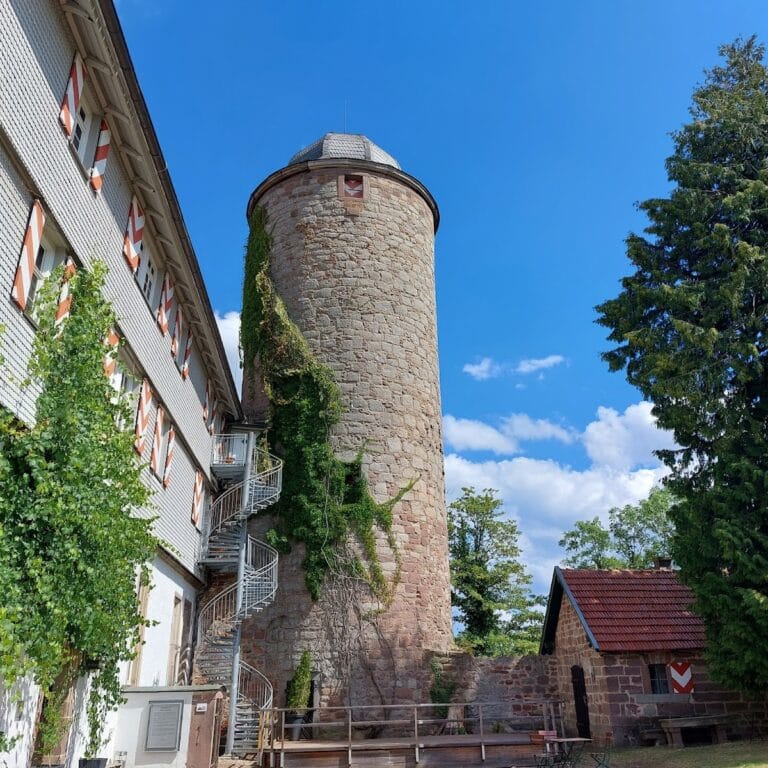
Most of the visible ruins date from the late 15th-century rebuilding phase, with the exception of the bergfried—a tall central tower—whose base rests on striking hexagonal basalt columns. This tower is the oldest surviving part and originates from the castle’s original 14th-century construction. The bergfried stands centrally within the courtyard and provides extensive views of the surrounding regions, including the Kuppenrhön, Seulingswald, and Knüll forests. A modern survey marker is also installed at its summit.
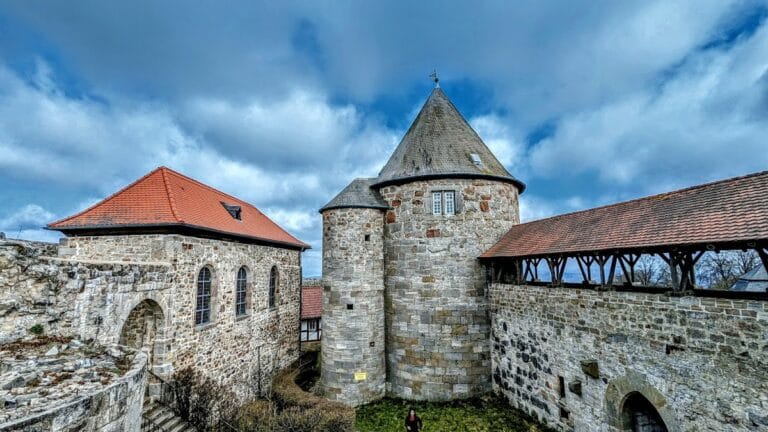
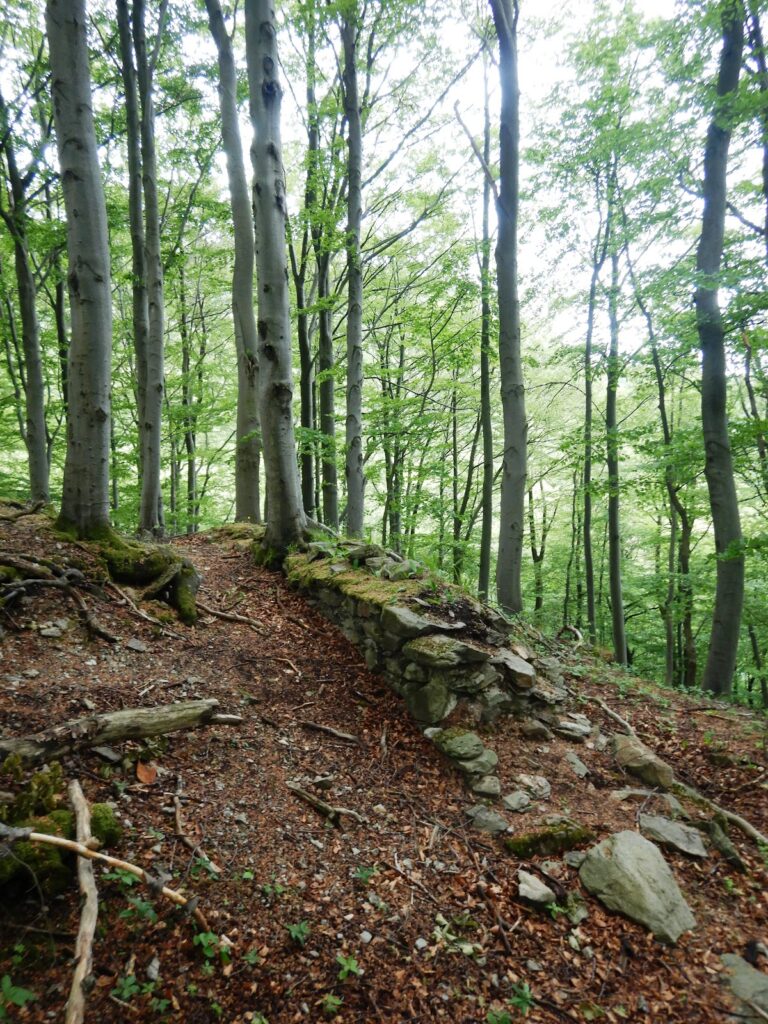
Surrounding the summit is a ring wall approximately 1.5 meters thick, enclosing the entire mountaintop. Some sections of the wall survive up to 15 meters in height, offering a dramatic sense of the castle’s former scale. The gatehouse is positioned on the southeast side, featuring a double gate. While only the outer walls of the building above these gates remain, they rise noticeably higher than the arches themselves. Remarkably, original stone hinges that once supported internal gate doors are still present.
Next to the southern corner lies the palas, a principal residential building characterized by a pointed Gothic gate. This structure measures roughly 17.5 meters long and 3.5 meters wide and likely contained at least two floors, as indicated by the partial remains of outer walls. Inside the ground floor of the palas are several narrow arrow slits and stones that once supported the ceiling. Beneath it, a vaulted cellar provides access to a cistern located in the courtyard near the kitchen stairs.
A notable feature of the palas is a central hearth situated between the cellar entrance and the kitchen staircase, which connected to a tiled stove on the upper story. This upper room, known as the Dürnitz, was a heated hall accessible by an external staircase adjacent to the gatehouse.
Extending northwest from the palas, the kitchen wing contains a Gothic gate opening into the courtyard. Archaeological remains here include the base of an original hearth, a stone for drainage, paved flooring, the foundation for a cooking fireplace with stone columns, chimney remains, and the base of a narrow spiral staircase leading upward to the heated hall.
The ring wall continues from the kitchen wing back toward the gatehouse and retains vestiges of a lower battlement walkway where defenders would have patrolled. While no further stone building structures remain along this section, it is believed that wooden outbuildings such as stables once stood within the enclosed area.
Together, these elements offer a vivid picture of the castle’s military and residential functions during its occupation. The ruins’ dramatic basalt construction and late medieval Gothic features reveal the careful reconstruction efforts undertaken in the late 15th century, preserving the castle’s role until its decline in the 16th century.
Nearby sites