Bonkyll Castle: A Medieval Scottish Fortress and Barony Seat
Visitor Information
Google Rating: 5
Popularity: Very Low
Country: United Kingdom
Civilization: Unclassified
Site type: Military
Remains: Castle

History
Bonkyll Castle stands near the town of Duns in what is now Scotland, originally constructed by the de Bonkyll family during the medieval period. This fortress was a significant seat within the barony and honour of Bonkyll, shaping local governance and defense from the 11th century onward.
The castle’s early custodianship remained with the de Bonkyll lineage until around 1300, when the last male heir, Sir Alexander de Bonkyll, died. Through his daughter Margaret’s marriage to Sir John Stewart, who died in 1298, control of the castle passed into the Stewart family. This union established the junior branch known as the Stewart of Bonkyl, who continued to hold the estate into the 14th century. During the turbulent years of the First War of Scottish Independence, the castle suffered damage inflicted during military campaigns. However, in 1304, after Margaret reconciled with King Edward I of England, the castle was returned to her under the English crown.
The Stewarts of Bonkyl played a notable role in Scottish nobility. Sir Alexander Stewart, who died in 1319, and his son John Stewart, 1st Earl of Angus, who passed in 1331, expanded their influence through marriage and royal favor. John Stewart’s marriage to Margaret de Abernethy and his elevation to Earl of Angus by King Robert I in 1329 substantially increased the family’s holdings across Berwickshire, Angus, and Kinross-shire.
In the early 15th century, the castle and associated titles shifted through Margaret Stewart, the sole heiress who died in 1417. Her clandestine relationship with William Douglas, 1st Earl of Douglas, resulted in their son George Douglas becoming the 1st Earl of Angus. From this point until the late 1700s, Bonkyll Castle remained in the possession of the Douglas family lineage.
By the 1500s, the castle had fallen into disrepair, signaling a decline in its strategic importance. During the late 18th century, ownership transferred to the Earls of Home. The castle also played an administrative role in the late 16th century when poet Patrick Hume of Polwarth served as its bailie in 1593. Under the reign of James VI, Hume managed the collection of rents to fund royal officials, highlighting the estate’s ongoing bureaucratic significance. Local tradition remembers Bonkyll alongside neighboring fortifications Billie and Blanerne, reputedly built during the reign of King David I, and all ultimately fell into ruin following the union of Scotland and England in 1707, as commemorated in a regional rhyme.
Remains
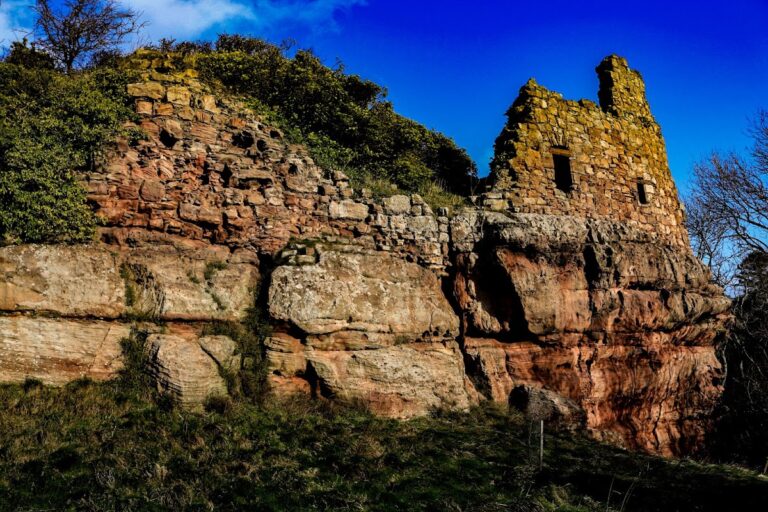
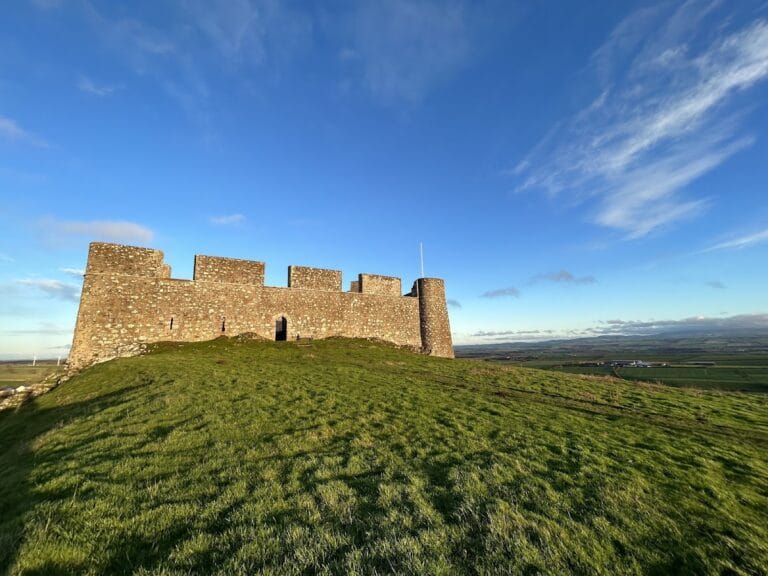
Bonkyll Castle was once enclosed within a strong defensive wall, known in medieval terms as an enceinte—a type of continuous protective barrier surrounding a fortress. Today, the site is identified chiefly by its motte, an earthen mound upon which the castle would have been constructed. This raised platform formed the foundation for the castle’s main structures and afforded a vantage point over the surrounding landscape.
Alongside the motte, a small fragment of the castle’s curtain wall—the stone wall that enclosed the fortress—remains visible. These remnants indicate the existence of substantial fortifications that once surrounded the site, although no significant above-ground stone buildings survive. The limited surviving masonry preserves a glimpse of the castle’s former defensive character.
The site is officially recognized as a scheduled monument, underscoring its importance for archaeological research and cultural heritage. This protective status ensures the preservation of Bonkyll’s earthworks and surviving stonework, allowing study of the medieval fortress’s layout and its role within the wider network of Scottish border defenses. Local historical commentary and oral tradition link the castle’s remains to a broader narrative shared with nearby castles, reinforcing its role within the landscape and its declining condition after the 18th century.
Nearby sites